

Why the Australia-India relationship has nowhere to go but up, despite differences on Russia and trade
- Written by: Ian Hall, Deputy Director (Research), Griffith Asia Institute, Griffith University
Few of Australia’s relationships with countries in Asia have progressed so far and so fast as its ties with India. Over a decade, Canberra and New Delhi have constructed a broad strategic partnership, catalysed by shared concerns about China.
The recent virtual summit between Australian Prime Minister Scott Morrison and his Indian counterpart, Narendra Modi, illustrated this new closeness well.
The two made a point of emphasising their personal bonhomie. Morrison greeted Modi in Gujarati, the language of his home state, while the Indian leader dropped his usual formality, addressing the Australian prime minister as “Scott”.
There was also substance in this discussion. Morrison and Modi unveiled no fewer than 11 agreements on things like exchanging military officers, harmonising tax on pension funds and facilitating greater mobility for skilled workers, among others.
Working through points of disagreement
However, one much-anticipated pact was not announced. Australia and India have been negotiating a free-trade deal – the so-called Comprehensive Economic Cooperation Agreement or CECA – for more than a decade.
Free-trading Australia and protectionist India have struggled to agree on the deal, not least because Canberra wants market access for agricultural produce and New Delhi wants to protect farmers who might not be able to compete with Australian imports. This is a hard issue to fix, because all Indian governments depend on the votes of farmers and their families, who comprise more than half the population.
Differences over Russia’s invasion of Ukraine also overshadowed the Modi-Morrison meeting. India is Russia’s biggest arms importer and has not publicly rebuked Moscow or voted against it in the UN Security Council over its invasion.
On this issue, India is in a bind – it needs Russian arms to defend itself from China. Extricating New Delhi from this predicament will take time, investment and a reorientation of Indian strategy, but also careful diplomacy by its partners, including Australia.
For that reason, Morrison, like his American and Japanese counterparts, refrained from publicly hectoring Modi about India’s lack of direct criticism of the war.
A shared wariness over China
Indeed, Australia and India have had much success in defence and security cooperation and diplomatic coordination in recent years. They have obvious overlapping interests here, principally the management of China’s assertiveness across the Indo-Pacific region.
New Delhi’s concerns about China long predate Australia’s. The scale of the threat Beijing could pose to India is much greater, too.
In 1947, the British bequeathed independent India an unsettled northern border – a situation exacerbated by Chinese leader Mao Zedong’s invasion of the erstwhile buffer state of Tibet a couple of years later.
Since then, China and India have watched each other warily and periodically come to blows. They had a border war in 1962, a large-scale confrontation in 1986-87 and a brief but nasty engagement in 2020.
Since the 1962 border war, New Delhi has handled the potential threat with a mix of strategic partnerships with other countries and military power.
In 1971, India signed a treaty with the Soviet Union that gave it access to advanced defence technology and Moscow’s diplomatic backing.
Then, in 1998, as India watched Chinese leader Deng Xiaoping’s reforms work their magic on China’s economy, New Delhi acquired a nuclear deterrent as an added safeguard.
And since the mid-2000s, India’s leaders have looked to new potential partners to invest in its economy, boost its military capabilities even further and bolster its regional influence. These include its partners in the Quad security grouping – the US, Japan, and Australia.
Read more: Explainer: what exactly is the Quad and what's on the agenda for their Washington summit?
Australia pivots toward India
Australia’s recent history with China obviously looks quite different. For most of the 1990s and 2000s, Canberra simply saw opportunity. China’s economy was booming and its hunger for resources saw it become Australia’s biggest trading partner.
But then came the global financial crisis and China’s shift towards a more assertive geopolitical strategy and nationalistic tone, not least during the 2008 Beijing Olympics.
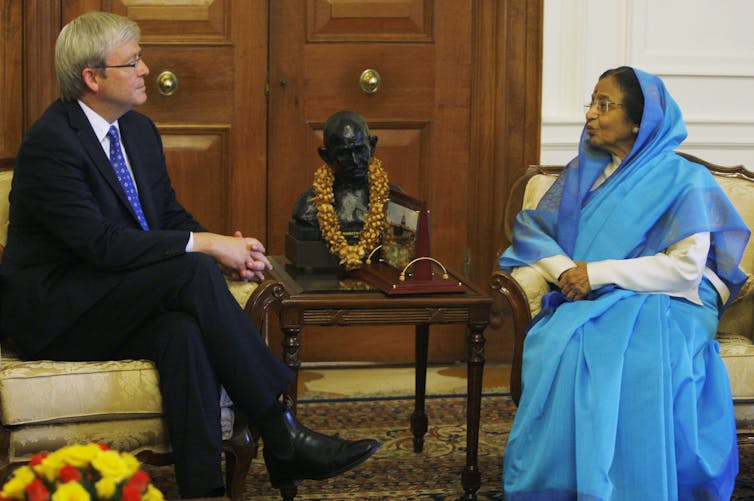
In response, Australia began to show a new interest in India. In 2009, then-Prime Minister Kevin Rudd went to New Delhi and signed a new security agreement. Talks about a trade deal followed and Australia’s longstanding ban on uranium sales to India were dropped.
Canberra adopted a new India-inclusive term to describe the region – the Indo-Pacific – and began in earnest to construct new defence and security ties with New Delhi.
A decade on, with no sign of the pressure from Beijing abating for either Australia or India, these ties are blossoming.
Read more: ScoMosas over Zoom: what to expect from Scott Morrison's virtual summit with India's Narendra Modi
Thanks not just to bilateral efforts, but also partnerships like the Quad, Australia and India now cooperate on a wide range of areas, including counter-terrorism, the mining and refining of critical minerals, cyber-security, infrastructure financing, maritime security, space exploration and security, strategic research, supply chain resilience, sustainable energy projects, and vaccine manufacturing.
Both countries are also committed to expanding the economic side of their relationship. India is Australia’s seventh-largest trading partner, but there is potential to boost bilateral flows of goods, services and investment.
Some questions remain
Lots of work, of course, remains to be done. It is unclear whether the free-trade deal will be concluded, as promised, by the end of 2022.
The full scope of bilateral defence cooperation in the Indian Ocean, which could involve Australian access to bases on the Andaman and Nicobar Islands, has yet to be determined.
And both countries also need to invest in improving public knowledge of the other. Too few Australian leaders have been to India, and too few Indian leaders have travelled in the opposite direction. There are also not enough scholars and analysts focusing on each other in Australian and Indian think tanks and universities.
Both countries understand each other far better now than they did just a decade ago, allowing them to better manage differences over issues like Ukraine. But more could and should be done to keep the relationship on the upward trajectory.
Authors: Ian Hall, Deputy Director (Research), Griffith Asia Institute, Griffith University


















