

how Russia and Ukraine are using social media as the war drags on
- Written by: Collette Snowden, Senior Lecturer, School of Communication, International Studies and Languages, University of South Australia
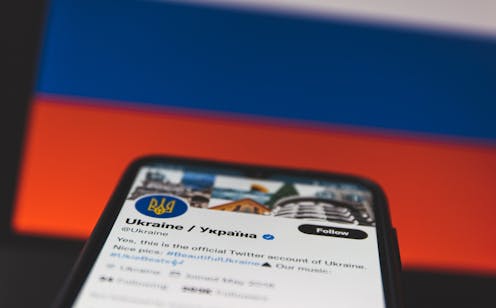
Social media has become a primary source of information for news-hungry audiences around the world trying to make sense of the Russian invasion of Ukraine.
At the same time, it’s being used by the governments of Russia and Ukraine to set the agenda for wider media reporting.
Official Russian government accounts have been found to be amplifying pro-Russia disinformation on Twitter. Meanwhile, the Ukrainian government has taken to the platform to appeal to its two million followers for support.
Information warfare is no longer an additional arm of strategy, but a parallel component of military campaigns. The rise of social media has made it easier than ever before to see how states use mass communication as a weapon.
Read more: Fake viral footage is spreading alongside the real horror in Ukraine. Here are 5 ways to spot it
Putting social media in the mix
Mass communication began as political communication intended to establish and control empires.
Whether it was Darius the Great imposing his image on buildings and coins to help control the Persian Empire; Henry VIII’s inspired use of portraiture, or the well-documented use of radio and film in World War II – media technologies have long been used to spread political ideas.
Social media has added another element to the mix, and brought immediacy to strategic political communication.
In asymmetric conflicts (such as the one we’re seeing now in Ukraine), a successful social media account can be a useful weapon against an adversary with many guns and tanks.
The local uprisings in the 2010 Arab Spring, especially in Egypt and Tunisia, were among the first campaigns where social media played a pivotal role.
Advocates of democracy used Twitter, Facebook and YouTube to maintain networks of communication and openly criticised their governments for the world to see.
It didn’t take long for governments to realise the power of social media. And they responded both by restricting access to social media as well as using it themselves.
Social media alone may not be capable of instigating widespread change, but it can undoubtedly play a role.
Information warfare
Tension between Russia and Ukraine has a long history, and was highly charged on social media well before the latest invasion.
Pro-Russian accounts have circulated disinformation about Russia’s role in the Donetsk region since before 2014, fuelling confusion and destabilisation, and assisting Russia’s takeover. This was in fact a critical element of Russia’s “hybrid warfare” approach.
Russia’s strategic actions, and counter actions by Ukraine, have been studied widely by researchers. Unsurprisingly, the research has overwhelmingly found each side to be framing the conflict in very different, and divergent ways.
Research has also found social media can sustain, and even aggravate, the hostility between Ukrainians and Russians online.
For example, after Malaysian Airline flight MH17 was shot down by Russia over Ukraine, an analysis of 950,000 Twitter posts found a plethora of competing claims online, creating a struggle for truth which continues today.
As early as 2014, NATO’s Supreme Allied Commander Europe, General Philip Breedlove, described the Russian communication strategy in Ukraine as “the most amazing information warfare blitzkrieg we have ever seen in the history of information warfare”.
These efforts have escalated since Russia’s recent expansion of its invasion into Ukrainian territory. And with so much noise, it’s becoming increasingly difficult for users to make sense of the deluge of contradictory, emotive and (often) difficult-to-verify information.
It’s even more difficult when the tone of posts changes quickly.
The Ukraine government’s Twitter account is a study in contrasts of both content and tone. Set up in more peaceful times, the profile cheerily states: “Yes, this is the official Twitter account of Ukraine. Nice pics: #BeautifulUkraine Our music: #UkieBeats”.
But the account now posts a range of content, images and video related to the war as part of its strategic communication campaign.
This has included serious news updates, patriotic allusions to historic events and people, anti-Russian material and – prior to the recent reports of mass deaths – quite a lot of humour.
Read more: Ukraine’s Twitter account is a national version of real-time trauma processing
Why use humour?
Humour has a long history of being used as an element of communication and public diplomacy – even during wars.
For instance, humour was used effectively by the Serbian Otpor resistance movement in its campaign to overthrow dictator Slobodan Milošević at the turn of this century.
Humour is particularly effective on social platforms because it produces virality.
And in the case of Ukraine’s defence, it displays defiance. After all, Ukraine’s President Volodymyr Zelenskyy (a former comedian) was famously thrust into the political spotlight thanks to a satirical television production. In it he played the role of a teacher whose secretly-filmed rant about corruption goes viral, leading the character to become President.
Zelenskyy’s Twitter account is now the most immediate and reliable way for many Ukrainians to get crucial information on the invasion and negotiations between Zelenskyy and other leaders.
The thousands of “shares” the posts receive are helping Ukraine’s communication campaign.
Zelenskyy’s recent address to the Grammy Awards reinforces that he understands the necessity of remaining visible to the world at this critical point. His speech has produced much support on social media (as well as cries of “propaganda” from Russia’s supporters).
Meanwhile, Russian President Vladimir Putin’s Twitter account has been dormant since March 16.
Authors: Collette Snowden, Senior Lecturer, School of Communication, International Studies and Languages, University of South Australia


















