

Women have been at the centre of political debate in the past two years. Will they decide the 2022 election?
- Written by: Michelle Arrow, Professor of History, Macquarie University
After months of speculation, Australians will go to the polls on May 21.
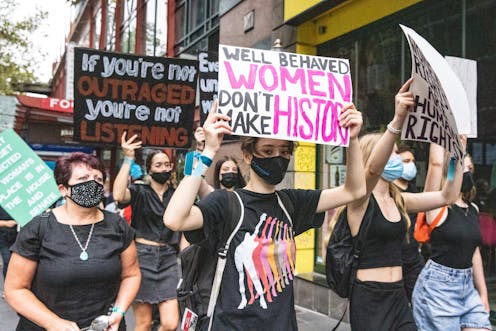
Given the events of the past two years, so-called “women’s issues” look set to play an important role in the campaign. Apart from the government’s headline gender problems, most notably their handling of the Brittany Higgins case, the COVID pandemic exposed the ways our culture still relies on women to perform most of the care work that keeps society functioning. Women workers in retail, health and aged care were at the pandemic frontlines; at home, many juggled paid work with care for children and ageing relatives.
How will the major parties speak to these women?
This government is nine years old, and it has had what former Prime Minister Malcolm Turnbull described as a “women problem” in its parliamentary ranks for all of that time. The LNP still has far fewer women in parliament than the Labor party, and since the departure of Julie Bishop, they have few popular female campaigners to draw on.
In contrast, more than 40% of Labor’s MPs are women. According to recent research, Penny Wong is Australia’s most trusted politician, with Tanya Plibersek not far behind.
Yet despite these high-profile women, for most voters, the election is a contest between two white men, close in age and appearance. After the ALP’s demoralising defeat in 2019 on a progressive platform of redistributive tax reform (changes to franking credits and negative gearing) and health (free cancer treatment and abortions in public hospitals), this time they have chosen a small target strategy. The differences between the two parties are far less obvious than they were in 2019.
Yet much has changed since then. The country has experienced a disruptive three years. While Australians rose to the occasion during the pandemic, enduring lockdowns and quickly getting vaccinated, they were let down by the government’s failures in planning and procurement.
The politics of climate change have also changed since 2019, when Labor was caught between “coal seats” and progressive voters. Three years of unprecedented natural disasters and the government’s failure to take meaningful action mean the LNP is now wedged on climate by the “teal” independents in blue-ribbon seats.
And since the last election, the Coalition’s treatment of women has become a defining issue. In 2018, the party’s humiliation of Julie Bishop as a leadership contender raised the hackles of many in the LNP, including Julia Banks, who resigned from parliament, alleging bullying.
But it was the emergence of 2021 Australian of the Year Grace Tame as an eloquent critic of the government on gender issues and Brittany Higgins’ allegation of sexual assault that galvanised Australian women.
Add to that Morrison’s response to the allegations made against Christian Porter, his treatment of former Australia Post CEO Christine Holgate, the expensive stage three tax cuts that will overwhelmingly favour men, failure to enforce a “positive duty” on employers to ensure workplaces free of sexual harassment, and more allegations of bullying against the prime minister from women in his party, and it’s pretty clear the government still has a “women problem”.
The unseemly eagerness with which the government seized on unproven allegations that the late Senator Kimberly Kitching had been bullied showed how desperate they are to level the playing field on “women’s issues”.
But how will all this play out in the election campaign?
How women reshaped the major parties
The last few decades have seen a realignment of support for the major parties along gender lines, and the gender differences in voter bases have been especially stark in the Morrison era.
Historically, Australian women tended to vote conservative. While there were very few women in Australia’s parliaments until the late 1970s, those elected tended to represent the Liberal and National parties. The ALP was regarded as a party with a male-dominated union culture, hostile to women.
The emergence of what historian Judith Brett called a “moral middle class” in the 1960s began a larger political realignment in Australia. The Labor party broadened its appeal to the emerging progressive middle class, and women became a crucial part of this constituency as they moved into the workforce and education, expanding their horizons and changing their priorities.
Since the 1980s, the gender gap between women and men’s support for the major parties has waxed and waned. But at the last election, the Liberal Party attracted the lowest number of votes from women since 1987. More women than men voted for Labor) in 2019.
Anthony Albanese’s focus on aged care in his budget reply signalled that care, in the broadest sense, would be a central plank of Labor’s campaign. This should matter to everyone – both men and women have ageing parents or grandparents. But because women largely perform society’s paid and unpaid care work, it is an issue that will resonate more with female voters.
To win government, Labor needs to retain women’s votes while renewing their appeal to blue collar men, many of whom shifted to the LNP in 2019. Polling suggests they have succeeded, though how it will play out in individual seats remains to be seen.
Morrison constantly courting the male (tradie) vote
So what might Morrison do to retain the “men’s vote”? Katharine Murphy has astutely observed that his political attention is always focused on men who “might vote Labor”. This explains why so many women are turned off by his repeated tradie cosplay: he’s not addressing them.
In 2019, Morrison’s “daggy dad” persona served him well: he was happy on the campaign trail, serving up stunts for the 6pm news. However, since then this strategy has faltered. He doesn’t hold a hose when it counts, and his willingness to take credit but never responsibility might represent a kind of masculinity that few Australian men will want to embrace.
In focusing so tightly on the male vote, Morrison has neglected women. It may yet cost him government. The wild card in this election is the number of largely female independents running in safe Liberal seats.
In an alternate universe, most of these women would be Liberal Party moderates, had the party not worked so hard to alienate them. In the early 2000s, John Howard dismissed Liberal-leaning women who disliked the party’s policies on refugees and social issues as “doctors’ wives”: Anne Henderson noted critics regarded them as women with “enough money to afford a conscience”.
Yet in 2022, the Liberal party would do well to remember that many “wives” are also doctors – professional, socially progressive and economically centrist, looking for candidates who represent their values. This is why the “teal” independents have made urgent action on climate, an integrity commission, and better action on gender equity central to their platforms. Their views on aged care reform – which will require increased government spending – are less clear.
The next few weeks will reveal whether they emerge as a new force in Australian politics. Whatever happens, many women voters are clearly signalling they will no longer be taken for granted, and this renewed engagement is a promising sign for a more responsive, representative politics.
Authors: Michelle Arrow, Professor of History, Macquarie University


















