

Modern Australian
The Times

The top 3 skills needed to do a PhD are skills employers want too

  • Written by Lilia Mantai, Senior Lecturer and Academic Lead, University of Sydney
The top 3 skills needed to do a PhD are skills employers want too

More and more people are applying to do a PhD. What many don’t know is it takes serious skills to do one – and, more importantly, complete it.

We analysed the selection criteria for PhD candidates on a platform that advertises PhD programs. Our analysis of thousands of these ads revealed exactly what types of skills different countries and disciplines require.

Why do a PhD in the first place?

People pursue a PhD for many reasons. They might want to stand out from the crowd in the job market, learn how to do research, gain a deeper expertise in an area of interest, or pursue an academic career.

Sadly, too many PhD students never finish. The PhD turns out to be too hard, not well supported, mentally taxing, financially draining, etc. Dropping the PhD often means significant financial loss for institutions and individuals, not to mention the psychological costs of other consequences such as low self-esteem, anxiety and loneliness.

Read more: 1 in 5 PhD students could drop out. Here are some tips for how to keep going

Our society and economy can only benefit from a better-educated workforce, so it is in the national interest to manage PhD intakes and be clear about expectations. The expansion of doctoral education led to a more competitive selection process, but the criteria are opaque.

To clarify PhD expectations, we turned to a European research job platform supported by EURAXESS (a pan-European initiative by the European Commission) where PhD programs are advertised as jobs. Required skills are listed in the selection criteria. We analysed 13,562 PhD ads for the types of skills different countries and disciplines require.

We made three specific findings.

1. Top 3 skills needed for a PhD

It turns out that it takes many so-called transferable skills to do a PhD. These are skills that can be translated and applied to any professional context. The top three required skills are:

  • communication – academic writing, presentation skills, speaking to policy and non-expert audiences

  • research – disciplinary expertise, data analysis, project management

  • interpersonal – leadership, networking, teamwork, conflict resolution.

Trending skill categories are digital (information processing and visualisation) and cognitive (abstract, critical and creative thinking and problem-solving).
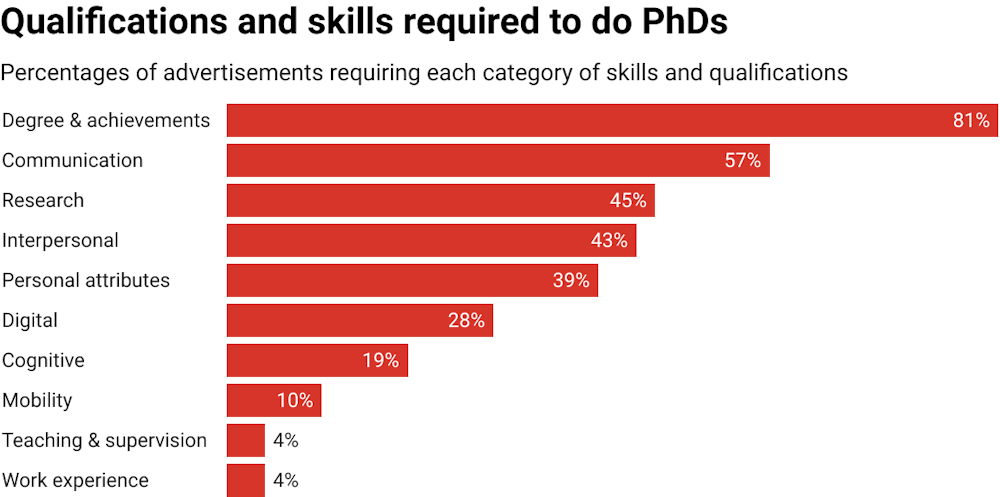
Bar chart showing percentages of each category of skills/qualifications required by PhD ads
Chart: The Conversation. Data: Mantai & Marrone, 2022, Author provided Previous research shows transferable skills are requested for post-PhD careers, including both academic and non-academic jobs. Our research shows such skills are already required to do a PhD. Those keen to do a PhD are well advised to provide strong evidence of such skills when applying. 2. Skill demands vary by country and discipline Skill demands significantly differ by country and discipline. For example, 62% of medical science ads mention interpersonal skills. This is twice as often as in biological science ads. Digital and cognitive skills score much higher in the Netherlands than in other countries. Our research article reports on 2016-2019 data and the top five represented countries (Netherlands, Germany, France, Spain and the UK) and the top five represented disciplines (biological sciences, physics, chemistry, engineering and medical sciences). However, you can use this tool for granular detail on 52 countries – including non-European countries like Australia, New Zealand, the US, etc. – and 37 disciplines included in the data sample. For continuously updated data, please visit https://www.resgap.com/. 3. PhD expectations are rising We see a rise in PhD expectations over time (2016-2019) as more skills are listed year on year. The publish or perish culture prevails and rising demands on academics have led to calls for more engaged research, collaborations with industry, and research commercialisation. PhD students get accustomed early to competitiveness and high expectations. Read more: Is it a good time to be getting a PhD? We asked those who've done it Research-based learning needs to start early These insights have implications for pre-PhD education and pathways. Undergraduate and postgraduate degrees can further promote PhD readiness by embedding authentic hands-on research with academic or corporate partners, either as part of the curriculum or as extracurricular activities. Many postgraduate degrees offer authentic research project work opportunities but are shorter. Those entering the PhD without a postgraduate degree miss out on developing essential research skills. Authentic research experiences need to happen early on in higher education. Organisations like the Council on Undergraduate Research (CUR), the Australasian Council for Undergraduate Research (ACUR) and the British Conference of Undergraduate Research (BCUR) are designed to support institutions and individuals to do this effectively. They showcase great models of undergraduate research. To get a good idea of what undergraduate research looks like, start with this comprehensive paper and catch up on undergraduate research news from Australasia. We know research-based learning develops employability skills such as critical thinking, resilience and independence. Embed career development in PhD programs Doctoral training needs to take note, too, if it is to further build on the skill set that PhD applicants bring with them. The good news is doctoral education has transformed in recent decades. It’s catching up to the call for better-skilled graduates for a range of careers. The training focus has shifted towards generating practice-based and problem-solving knowledge, and engaged research with other sectors. Read more: It's time to reduce the number of PhD students, or rethink how doctoral programs work Some institutions now offer skill and career training. Generally, though, this sort of training is left to the graduates themselves. Many current PhD candidates will attest that the highly regulated and tight PhD schedule leaves little room for voluntary activities to make them more employable. Most PhD candidates also know more than half of them will not score a long-term academic job. Institutions would serve them better by formally embedding tailored career development opportunities in PhD programs that prepare for academic and non-academic jobs. It’s not only PhD graduates’ professional and personal well-being that will benefit but also the national economy. Authors: Lilia Mantai, Senior Lecturer and Academic Lead, University of Sydney

Read more https://theconversation.com/the-top-3-skills-needed-to-do-a-phd-are-skills-employers-want-too-175923


Chatswood Tutoring And Its Role In Academic Achievement

Academic success often requires more than classroom attendance alone. Students face increasing expectations as they progress through school, particu...

Why Laser Hair Removal Treatments Continue Growing In Popularity

Managing unwanted hair can become time-consuming and frustrating for many people, especially when shaving, waxing, and other temporary methods requi...

Choosing the Right Devices for a Flexible Workplace

For IT leaders managing large fleets, the device layer is where workforce productivity and security policy meet. The shift towards flexible and hybrid...

How Business Advisory Services Help Companies Achieve Sustainable Growth

Every business owner aims to build a profitable and sustainable organisation. While dedication, innovation, and hard work are important, achieving l...

Why Body Contouring Has Become A Popular Cosmetic Treatment

Many people maintain healthy lifestyles through regular exercise and balanced eating habits but still struggle with stubborn areas of fat that are d...

How to Choose the Right POS Hardware for Your Business in Australia

A lot of Australian business owners spend weeks researching POS software but buy hardware almost as an afterthought. That's a mistake. The wrong har...

Why Material Handling Hose Is Critical for Industrial Efficiency

A high-performance material handling hose is an essential component in industries that transport abrasive, dry, or bulk materials on a daily basis...

How to Choose the Right Lawyer in Melbourne for Your Situation

Choosing legal support can feel difficult, especially when the stakes are personal or business-related. The right lawyer in Melbourne should underst...

Hoteliers Look to Clever Value Adds to Increase Revenue

The Australian hospitality industry is still in recovery mode after a notoriously rough patch in recent years. While there has been a post-COVID tra...

Moving to Queensland? Here’s How to Prep Your Car for the Big Move North

There’s no sign of the northern migration slowing down, with thousands of southerners fleeing from chaotic lifestyles and cooler climates for a brig...

Diesel Shortage to Impact Trades and Contractors

Strait of Hormuz blockage affecting all major parts of trades and construction Trades and construction across residential, commercial and industria...

Why Holiday Home Owners Turn to Rental Management Agents

The Allure — and the Reality — of Renting Out Your Property Owning a holiday home is a dream for many Australians. Whether it's a beachside sha...

Why Finding Reliable Doctors In Bundoora Is Important For Long-Term Health

Access to quality healthcare plays an important role in maintaining overall wellbeing and managing health concerns early. Trusted Doctors in Bundoor...

Understanding the Different Types of Car Services: Minor vs Major

When it comes to car maintenance, one of the most important things every vehicle owner should understand is the difference between a minor and a maj...

How Superannuation and TPD Insurance Work Together

Superannuation is an essential part of financial planning in Australia. It is designed to provide individuals with income during retirement, helping...

Tiny Towns funding granted for Mt Hotham and Mt Buller upgrades

Alpine Resorts Victoria (ARV) has welcomed funding support from the Victorian Government’s  Tiny Towns Fund, with both Mt Hotham and Mt Buller se...

Locksmith Services: Why Professional Security Solutions Matter More Than Ever

Security is a critical concern for homeowners, businesses, and vehicle owners alike. Whether it involves protecting a property, replacing damaged lo...

Why Tooth Fillings Are Important For Protecting Damaged Teeth

Cavities and minor tooth damage are common dental problems that can worsen if left untreated. Professional tooth fillings help restore damaged teeth, ...















