

A new method of extracting ancient DNA from tiny bones reveals the hidden evolutionary history of New Zealand geckos
- Written by: Nic Rawlence, Lecturer in Ancient DNA, University of Otago
Aoteaora New Zealand has experienced a dynamic geological and climatic history. There was the separation from the southern super-continent Gondwana, the near drowning during the Oligocene some 27-22 million years ago, and the dramatic changes wrought by ice ages during the Pleistocene which started 2.6 million years ago.
In concert with these landscape-scale changes, the biodiversity of Aotearoa has undergone an equally dramatic journey, evolving into something uniquely New Zealand. Jared Diamond famously described our wildlife as “the nearest thing to studying life on another planet”.
The arrival of humans from the late 13th century seriously hampered our ability to study this evolutionary history. It resulted in the extinction of around 70 birds, one mammal, a fish, up to three frogs and potentially a skink. Those that survived suffered severe range contractions and significant loss of genetic diversity.
Ancient DNA preserved in bones for tens of thousands of years has allowed scientists to unlock the genetic secrets of some of our taonga species and show how they responded to environmental change.
But most palaeogenetic research has focused on big flashy animals, like moa and sea lions, whose bones can sustain having small chunks chopped out without erasing the landmarks we use to distinguish species, such as a heavy-footed moa from a giant moa. Smaller animals were often ignored because sampling would have destroyed the whole bone, leaving only an angry museum curator to deal with.
Read more: Ancient DNA suggests woolly mammoths roamed the Earth more recently than previously thought
What if there was a way to extract ancient DNA from these small bones, or taonga tūturu (cultural artefacts), without destroying the very specimen you are interested in? We have developed a technique that does just that – an enzymatic bone bath that soaks out ancient DNA, allowing us to sequence ancient genomes without any observable bone damage.
The upshot of our work is we can now reconstruct the previously hidden evolutionary histories of these small and neglected animals.
Take New Zealand’s geckos for example. There are at least 48 species, all of which have been severely impacted by human arrival, masking their true evolutionary history.
It was previously thought you could only distinguish gecko species based on their size, not shape, to the point that pre-human gecko bones were separated into coarse quasi-taxonomic size bins. Considering most living New Zealand geckos show considerable overlap in size, this doesn’t help in discriminating between species.
Using 3D scanning and our new non-destructive extraction method, we focused on the largest size class of gecko bones. It turns out you can distinguish gecko bones by shape but not size (with the exception of the largest extant species), which means our knowledge of Aotearoa’s geckos is now a palaeontological “blank slate”, a rare thing indeed.
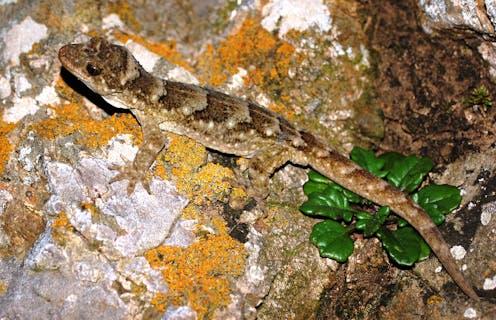
3D scanning showed the bones from the largest size class either represented a previously unknown extinct gecko or Duvaucel’s gecko (Hoplodactylus duvauceli) had undergone a large decline in morphological diversity as it was exiled from mainland New Zealand after human arrival.
Our genetic analysis of ancient mitochondrial genomes showed that Duvaucel’s gecko had undergone a major morphological and genetic bottleneck associated with mainland extinction. Not only that – it had a dynamic evolutionary history stretching back through time in response to some of the biggest changes in New Zealand’s geological and climatic past.
North and South Island populations diverged about five million years ago, as Duvaucel’s gecko dispersed across Pliocene straits and ephemeral islands that separated the two main islands of New Zealand long before Cook Strait formed some 500,000 years ago. These populations have now diverged so much that we think they could be different species, though more work remains to support our hunch.
On the South Island, the ice ages forced Duvaucel’s gecko (and its forest home) to retreat into separate northern and southern refugia during cold glacial periods, highlighting that glaciation can be a creative force for biodiversity. As sea levels rose, several populations were isolated on craggy islands in Cook Strait. While these island populations survived the arrival of humans, those on the mainland weren’t so lucky.
In the North Island it was a tale of two different worlds. Ancient lineages lived in remote and rugged areas like Waitomo, Northland and on geologically old islands like the Poor Knights and Great Barrier. In contrast, younger lineages became restricted to offshore islands as sea levels rose at the end of the last ice age some 11,000 years ago. Like their South Island cousins, isolated island lineages are today’s sole survivors.
Read more: The frog and the gecko: why tropical species are at greater climate risk
Far from being neglected, our small vertebrate fauna is finally coming of age as new scientific techniques are developed to reconstruct their biological heritage, and in turn, help evidence-based conservation management.
Further exciting discoveries are no doubt around the corner with new projects our lab group is conducting on geckos, skinks (they are plagued by sized-based identifications, too), frogs and tuatara. Sometimes the smallest things can unlock the biggest secrets.
Authors: Nic Rawlence, Lecturer in Ancient DNA, University of Otago


















