

The poem as pantechnicon, the poet as polymath: John Kinsella's boundless creativity
- Written by: David Brooks, Honorary Associate Professor of Literature, University of Sydney
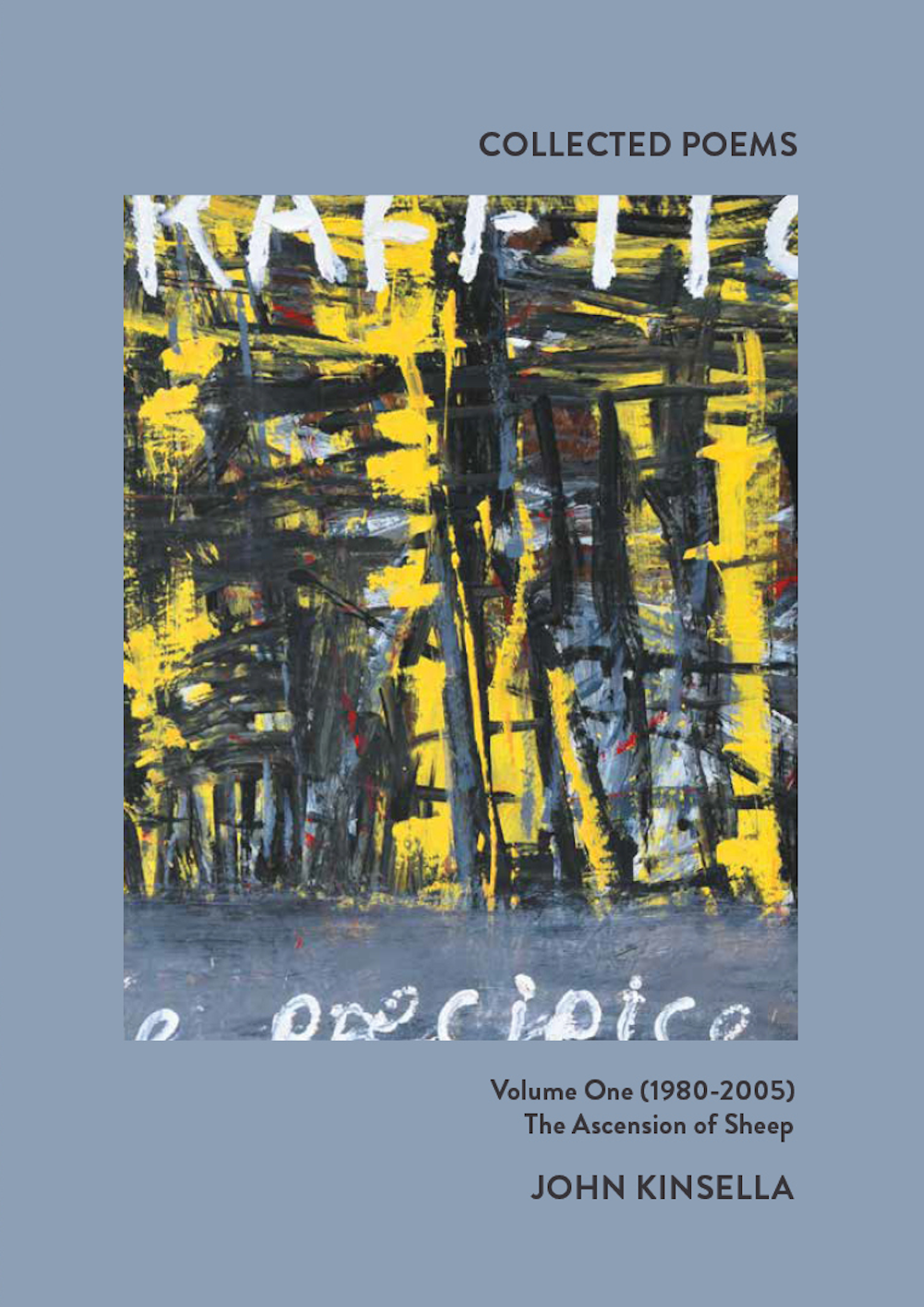
University of Western Australia Publishing has just released the first of three volumes of John Kinsella’s Collected Poems.
Subtitled The Ascension of Sheep, this monumental text (848 pages) covers the first 25 years of Kinsella’s writing, from The Frozen Sea (1983), which he published – as John Heywood – at the age of 20, to his remarkable New Arcadia (2005) which relocates (re-places) Sir Philip Sidney’s 1598 classic pastoral romance in the salt-blighted landscape of Kinsella’s native Western Australia.
Review: The Ascension of Sheep: Collected Poems Volume One (1980-2005) - John Kinsella (UWAP)
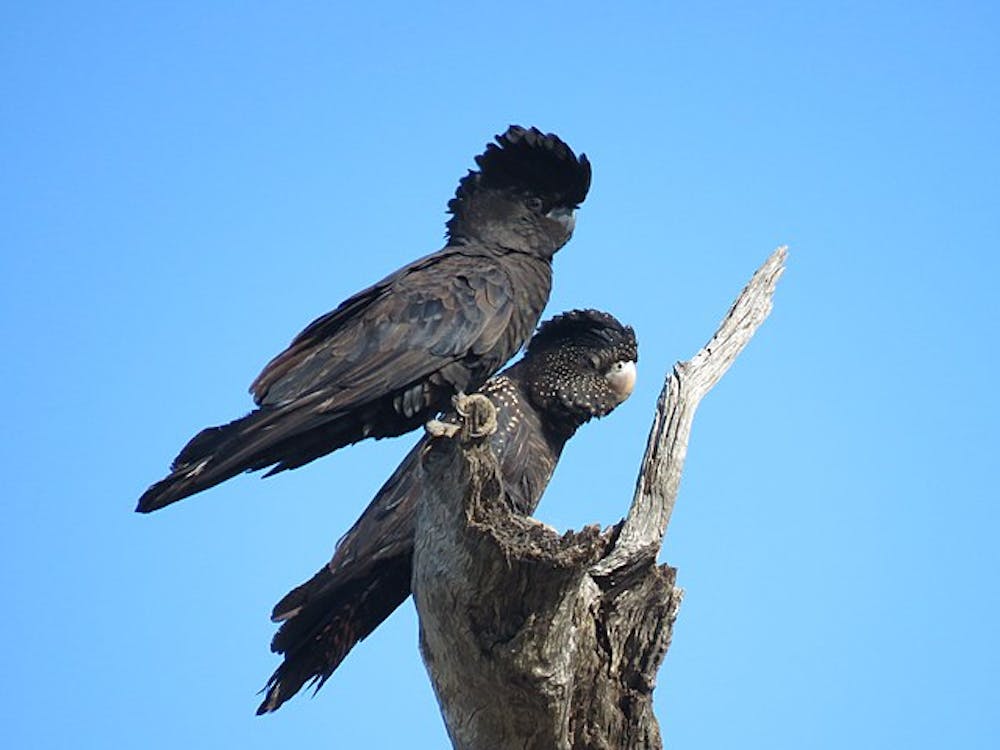 Red tailed black cockatoos, Coalseam Conservation Park.
Calistemon/Wikimedia commons
Language, attitudes and practices
Much of the language we have been bringing to poetry, and the forms and genres into which we have been shaping it, Kinsella would argue, have become imbued with the attitudes and practices that have led us to this crisis in the first place. To free ourselves from these attitudes and practices – to enable ourselves to see more clearly the extent and nature of the damage, let alone begin to do something about it – our language and our ways of using it have to change.
Philosophy has for some time been telling us our world is shaped by – is – language. Feminism, postcolonialism and other movements have long been aware that ghosts in the language (gender, racism, speciesism, and something else, a brutality and arrogance toward the environment) are a key part of their problem.
Australian poets have been aware of the various ghosts and carceral qualities embedded within language for decades now. But it is hard to think of any who have tried as hard as Kinsella to free our landscape, our views of landscape, and our thinking about landscape from them.
Look, for example, at a few short passages from “York-Spencer’s Brook Road”, one of Kinsella’s many “roadside” poems – poems for the most part drawn from a “natural” space between two points of human habitation, such as a car driver might encounter, pulling onto the side of a country road and stepping out, looking around. See how these passages track, within the space they view, the intersection of human and non-human networks:
I have a pavilion of land-folds in my vision, noinland sea, just roadside drainage, scorched river, cored-mountain rangeevoking leeward hills…
the valley, river running irregularly parallel to the road,a fraction of its deep-hold self, running level and dry,a treeline of flooded gums, York gums, jam tree,roadside foliage as well. There are points where a polygraphwould detect a change, or take it as standardto tell truth and lies of quartz against: flood points,crests, the road so narrow cars almost touchin passing…
The gravel has the taint of salt, white crystalsundoing laterite and clay, easing out of the run-off cut marks.So, memory is sectioned out of the aerial photo,and heavy haulage fragments the road edges. In this,a theory of disaster, in the farmhouse centred in wastedfields, the panopticon. Closely, a black-shouldered kitehooks a mouse, and an unrecorded species of possumfeeds nightly on crown land, thin about the railway line.
This kind of tracking – of roads, fences, survey lines, water and electricity supply-lines, telecommunication waves, language, say, with vegetation, bird and insect life, weed cover, water level, salinity – and the way it is interwoven with local histories, memories, personal experiences, has become a feature of Kinsella’s poetic: an ecopoetic that entails a mode of seeing, a plurality of knowledges.
At its best, it can enable a poem, through its capacities for image, elision and juxtaposition, to condense networks and situations that might take an essay many pages to set out. It can also, intriguingly (the erosion, the wounds in the soil, detritus), bring to the textual space, as I think it does here, something of the quality of a crime scene.
The poem, then, as pantechnicon. The poet as polymath. To help rescue, to help halt the damage – to help undo the crime – one must know, one must inform oneself to inform others.
This knowledge, this steeping-in-place, the insistence upon it, not to mention Kinsella’s re-placing and interrogation of earlier ways of poetic seeing (“York-Spencer’s Brook Road” could be seen as an arid eclogue, an elegy or bitter satire in the ruins of an ode), is, I think, one of Kinsella’s gifts. .
Consider another piece, or set of pieces (“Sad Cow Poems” from The New Arcadia), for a glimpse of some of his others. “Affect flat as dung,” it begins,
… or sludgethat slicks the gradient, the youngthat drive an udder, as if a wordfor ‘cow’ might make cattlemight make beef and mightmake muscleson seasons of less light—late sunrise suppressing melatonin
Our senses are immediately drawn in here (dung, sludge, slicks), but also strangely restrained. “[T]he young / that drive an udder” is clever, a nice conceit, but lines three and four are not so clear. In turning their attention to language itself, they make us suddenly suspicious of the very word (“cow”) upon which the poem seems to depend, as if a cow wasn’t itself somehow.
Lines five to eight introduce some animal husbandry (who knew suppressing melatonin can lead to greater body mass?), before the next lines –
and that bell, sounding out,as silver as a twisting acacia leafdriven by a wild front coming in
– sound a note as clear and clean as the one they refer to, pulling together and at the same time opening the poem, which (however) gives us then, as if to betray what we’ve just glimpsed:
to discharge the drought, the wanking machines,gleam of the tankerthat’ll feed the cream separator,centrifuge making heavywater
This is only the first poem in a sequence of 17. Different as it is from “York-Spencer’s Brook Road”, we find in it that network again, the interaction of parts, knowledges and voices: anger (restrained), lyricism, understanding of processes (technology, milking), understanding of processes within those processes.
I’d like to visit more –
Molly B12 poked her headthrough the door of the shackmost mornings. Her calf daysshortening. Some say pitycomes because of the sizeof their eyes. Her eyeswere small, and their vocabularytoo immense for translation
– but I will jump to the last:
The stomach plug, flagrant to openand check-up, ant colony of the chamber,the enzymal action, belly business,fragrant, busy, the reaching inand pulling out the mush, like the bin-composterthat turns around on its metal frame,the sort that local industry can build and market,you just throw in your grass clippings and the like,make of it that extra stomach.
A cow, with a port-hole in her stomach: a shocking emblem and indictment of industrial farming, another part of the damage.
Read more:
Friday essay: species sightings
Expanding environmental knowledge
A few months ago, the editors of a forthcoming history of Australian poetry circulated a draft table of contents, indicating the volume would conclude with an essay on Kinsella, the only contemporary poet to be thus singled out. There were some complaints behind the scenes. People questioned why Kinsella should get this attention and not A or B or C.
I don’t know how the matter panned out, but I imagine similar questions might be asked of this volume. Why such attention to Kinsella, when so many other very worthy poets have no such accolade? Do we need so much Kinsella? And isn’t there a touch of self-contradiction in so dedicated an environmentalist sanctioning such an investment of trees? (Judith Wright declared, late in her life, she would rather save trees than publish more books of poetry.)
Fair questions, and I don’t discount these concerns. I must admit that when I first received the book, having agreed to review it, I was rather dismayed at its size. I wondered – still do – whether we need quite so much of Kinsella’s early work, and why he didn’t edit himself more aggressively. And, yes, I reflected too that there were others who could and probably should receive the same kind of serious and generous treatment.
But having lived with the volume for a while, and thought about its processes, I have come to see another side to the matter.
I wonder if UWAP, like the editors of the aforementioned history, might be trying to change or challenge the story and direction of our poetry a little, trying to make a statement that in this time of environmental crisis we, and our poets especially, as self-appointed legislators of our language, do need to think differently, do need to know more, do need to question our inherited assumptions and expand our environmental knowledges, and whether the apparent anointment of an experienced and dedicated exponent of “ecopoetics” might be, not an affront, but possibly, just possibly, the right thing to do.
Authors: David Brooks, Honorary Associate Professor of Literature, University of Sydney
Red tailed black cockatoos, Coalseam Conservation Park.
Calistemon/Wikimedia commons
Language, attitudes and practices
Much of the language we have been bringing to poetry, and the forms and genres into which we have been shaping it, Kinsella would argue, have become imbued with the attitudes and practices that have led us to this crisis in the first place. To free ourselves from these attitudes and practices – to enable ourselves to see more clearly the extent and nature of the damage, let alone begin to do something about it – our language and our ways of using it have to change.
Philosophy has for some time been telling us our world is shaped by – is – language. Feminism, postcolonialism and other movements have long been aware that ghosts in the language (gender, racism, speciesism, and something else, a brutality and arrogance toward the environment) are a key part of their problem.
Australian poets have been aware of the various ghosts and carceral qualities embedded within language for decades now. But it is hard to think of any who have tried as hard as Kinsella to free our landscape, our views of landscape, and our thinking about landscape from them.
Look, for example, at a few short passages from “York-Spencer’s Brook Road”, one of Kinsella’s many “roadside” poems – poems for the most part drawn from a “natural” space between two points of human habitation, such as a car driver might encounter, pulling onto the side of a country road and stepping out, looking around. See how these passages track, within the space they view, the intersection of human and non-human networks:
I have a pavilion of land-folds in my vision, noinland sea, just roadside drainage, scorched river, cored-mountain rangeevoking leeward hills…
the valley, river running irregularly parallel to the road,a fraction of its deep-hold self, running level and dry,a treeline of flooded gums, York gums, jam tree,roadside foliage as well. There are points where a polygraphwould detect a change, or take it as standardto tell truth and lies of quartz against: flood points,crests, the road so narrow cars almost touchin passing…
The gravel has the taint of salt, white crystalsundoing laterite and clay, easing out of the run-off cut marks.So, memory is sectioned out of the aerial photo,and heavy haulage fragments the road edges. In this,a theory of disaster, in the farmhouse centred in wastedfields, the panopticon. Closely, a black-shouldered kitehooks a mouse, and an unrecorded species of possumfeeds nightly on crown land, thin about the railway line.
This kind of tracking – of roads, fences, survey lines, water and electricity supply-lines, telecommunication waves, language, say, with vegetation, bird and insect life, weed cover, water level, salinity – and the way it is interwoven with local histories, memories, personal experiences, has become a feature of Kinsella’s poetic: an ecopoetic that entails a mode of seeing, a plurality of knowledges.
At its best, it can enable a poem, through its capacities for image, elision and juxtaposition, to condense networks and situations that might take an essay many pages to set out. It can also, intriguingly (the erosion, the wounds in the soil, detritus), bring to the textual space, as I think it does here, something of the quality of a crime scene.
The poem, then, as pantechnicon. The poet as polymath. To help rescue, to help halt the damage – to help undo the crime – one must know, one must inform oneself to inform others.
This knowledge, this steeping-in-place, the insistence upon it, not to mention Kinsella’s re-placing and interrogation of earlier ways of poetic seeing (“York-Spencer’s Brook Road” could be seen as an arid eclogue, an elegy or bitter satire in the ruins of an ode), is, I think, one of Kinsella’s gifts. .
Consider another piece, or set of pieces (“Sad Cow Poems” from The New Arcadia), for a glimpse of some of his others. “Affect flat as dung,” it begins,
… or sludgethat slicks the gradient, the youngthat drive an udder, as if a wordfor ‘cow’ might make cattlemight make beef and mightmake muscleson seasons of less light—late sunrise suppressing melatonin
Our senses are immediately drawn in here (dung, sludge, slicks), but also strangely restrained. “[T]he young / that drive an udder” is clever, a nice conceit, but lines three and four are not so clear. In turning their attention to language itself, they make us suddenly suspicious of the very word (“cow”) upon which the poem seems to depend, as if a cow wasn’t itself somehow.
Lines five to eight introduce some animal husbandry (who knew suppressing melatonin can lead to greater body mass?), before the next lines –
and that bell, sounding out,as silver as a twisting acacia leafdriven by a wild front coming in
– sound a note as clear and clean as the one they refer to, pulling together and at the same time opening the poem, which (however) gives us then, as if to betray what we’ve just glimpsed:
to discharge the drought, the wanking machines,gleam of the tankerthat’ll feed the cream separator,centrifuge making heavywater
This is only the first poem in a sequence of 17. Different as it is from “York-Spencer’s Brook Road”, we find in it that network again, the interaction of parts, knowledges and voices: anger (restrained), lyricism, understanding of processes (technology, milking), understanding of processes within those processes.
I’d like to visit more –
Molly B12 poked her headthrough the door of the shackmost mornings. Her calf daysshortening. Some say pitycomes because of the sizeof their eyes. Her eyeswere small, and their vocabularytoo immense for translation
– but I will jump to the last:
The stomach plug, flagrant to openand check-up, ant colony of the chamber,the enzymal action, belly business,fragrant, busy, the reaching inand pulling out the mush, like the bin-composterthat turns around on its metal frame,the sort that local industry can build and market,you just throw in your grass clippings and the like,make of it that extra stomach.
A cow, with a port-hole in her stomach: a shocking emblem and indictment of industrial farming, another part of the damage.
Read more:
Friday essay: species sightings
Expanding environmental knowledge
A few months ago, the editors of a forthcoming history of Australian poetry circulated a draft table of contents, indicating the volume would conclude with an essay on Kinsella, the only contemporary poet to be thus singled out. There were some complaints behind the scenes. People questioned why Kinsella should get this attention and not A or B or C.
I don’t know how the matter panned out, but I imagine similar questions might be asked of this volume. Why such attention to Kinsella, when so many other very worthy poets have no such accolade? Do we need so much Kinsella? And isn’t there a touch of self-contradiction in so dedicated an environmentalist sanctioning such an investment of trees? (Judith Wright declared, late in her life, she would rather save trees than publish more books of poetry.)
Fair questions, and I don’t discount these concerns. I must admit that when I first received the book, having agreed to review it, I was rather dismayed at its size. I wondered – still do – whether we need quite so much of Kinsella’s early work, and why he didn’t edit himself more aggressively. And, yes, I reflected too that there were others who could and probably should receive the same kind of serious and generous treatment.
But having lived with the volume for a while, and thought about its processes, I have come to see another side to the matter.
I wonder if UWAP, like the editors of the aforementioned history, might be trying to change or challenge the story and direction of our poetry a little, trying to make a statement that in this time of environmental crisis we, and our poets especially, as self-appointed legislators of our language, do need to think differently, do need to know more, do need to question our inherited assumptions and expand our environmental knowledges, and whether the apparent anointment of an experienced and dedicated exponent of “ecopoetics” might be, not an affront, but possibly, just possibly, the right thing to do.
Authors: David Brooks, Honorary Associate Professor of Literature, University of Sydney 

















