

Modern Australian
Times Advertising

Australia's unemployment rate of 4% is good news – and set to get even better by polling day

  • Written by Peter Martin, Visiting Fellow, Crawford School of Public Policy, Australian National University
Australia's unemployment rate of 4% is good news – and set to get even better by polling day

When Labor leader Anthony Albanese couldn’t say whether the unemployment rate was 5% or 4% on Monday, he might have had a point.

It’s 4%. But for a decade – the entire decade leading up to COVID – it never strayed too far from five-point-something per cent.

Melbourne University labour market specialist Jeff Borland points out that in March 2010, Australia’s unemployment rate was 5.4%. Ten years later, before COVID changed things in March 2020, it was 5.3%.

In the years between, it briefly dipped to 4.9% (three times), climbed slowly as the mining boom wound down, edged above 6% in 2014 as the newly-elected Coalition government cut spending, and then fell back slowly towards what the Treasury then regarded as the long-term sustainable rate of 5%.

For much of Albanese’s time in parliament, from 1996 to now, it has been 5-6%.

And a case can be made that it is 5% right now.

Independent economist Saul Eslake says what he calls the “effective” rate of unemployment is indeed 5%. To the 607,900 officially unemployed Australians in February 2022 (the lowest slice of the population in decades), Eslake adds the historically high:

  • 72,000 people who were counted as employed despite working zero hours, for what the Bureau of Statistics called “economic reasons” including being stood down or because there was insufficient work

  • 59,000 people who were counted as employed despite working zero hours for reasons “other than economic”, including being on leave

The result is an unemployment rate of 5%, which doesn’t count as unemployed the 221,000 employed Australians who worked zero hours due to illness or injury – twice as many as before COVID.

The figures point to something real

But even Eslake’s effective rate of 5% is lower than before COVID.

The massive 26,000-household survey of employment conducted each month by the Bureau of Statistics is pointing to something real.

To get an idea of the scale of the bureau’s survey, compare it to the Essential and Newspoll surveys used to indicate how people are going to vote in the election. Essential surveys 1,000 people each time, Newspoll about 1,500.

The bureau surveys 26,000 households every month to obtain information on the employment status of about 50,000 people aged 15 and over. The scale of the operation is exceeded only by national elections every three years and the census every five years.

Australia’s biggest survey

The survey asks first whether those surveyed worked in the previous week, then whether they were employed but away from work because of holidays, sickness or another reason. Then it asks about hours. Less than one hour (unless it was due to time off) counts as not working.

It is this definition (one hour a week = work) that generates so much of the mistrust of unemployment figures.

The bureau uses one hour per week as the cutoff because it has to use something and because every other comparable country has used it, since 1982.
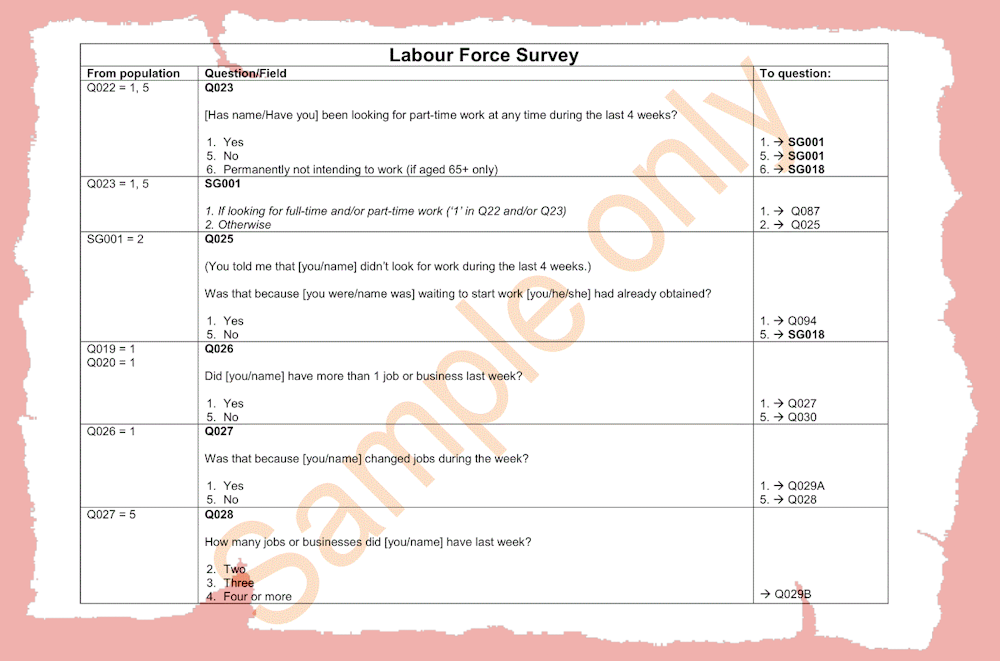
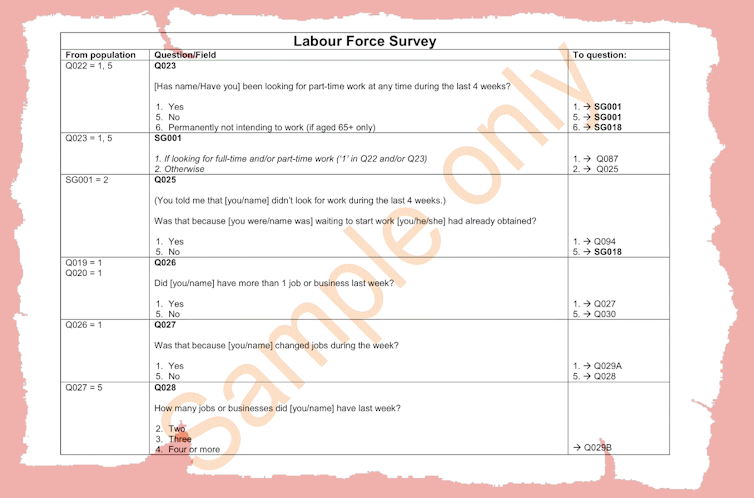
Some of the questions asked in the ABS labour force survey Fewer than 50 of the 50,000 people surveyed each month report working only one hour, meaning the cutoff makes little difference. If the bureau used a different cutoff, such as three hours per week, its employment numbers would be moving in the same direction. It defines being unemployed as not being employed and looking for work. If you are not looking, you are “not in the labour force” and not counted as unemployed. This is a problem when times are tough and people don’t bother to look (or can’t easily look, such as during lockdowns) and can mean that genuine unemployment is higher than the figures suggest. More jobs on offer than ever before But that isn’t a problem at the moment. So many jobs are on offer (423,500 – far more than ever before) that people who want work know it is worth looking. More of the population aged 15 and over is in work than ever before. And almost all of the new jobs are full-time. As would be expected given the shift to full–time work, casual employment (defined by the bureau as employment without paid leave) has fallen in recent years, rather than climbed as the opposition leader’s material suggests. Women have benefited more from the improved jobs market than men, getting 240,000 of the 395,000 new places created over the past year. Every age group up to 65 has more work than it did before. We will get an inkling as to whether things will keep getting better on Thursday when the bureau releases the employment figures for March, and again just two days before the May 21 election, when it releases the figures for April. The Treasury and the Reserve Bank are cautious, expecting unemployment to settle at 3.75% before (in Treasury’s case) gradually climbing back to 4.25%. But private forecasters are bolder. Westpac is forecasting an unemployment rate of 3.25% by year’s end. Citibank is forecasting 3.3% by the end of this year and an extraordinary 3% by the end of 2024 – which would be a 60-year low not seen since 1974. How to keep creating jobs with reopened borders It is tempting to say what has happened with unemployment is the result of closed borders and slower population growth during COVID (more jobs per worker than there would have been). But the banks making those bold forecasts know the borders have been reopened. New Zealand has enjoyed faster (although still slowed) population growth than Australia over a year in which its unemployment rate has slid to 3.2%. Read more: Australia cut unemployment faster than predicted – why stop now? What New Zealand, Australia and the other nations now enjoying unusually low unemployment have in common is out-sized government spending and record low interest rates during COVID to keep the economy afloat. Spending and ultra low rates create jobs. If we keep them in place right up to the point where we create worrying inflation, we will be able to get even more Australians into jobs and, all being well, keep them there. It’s the most important thing to grasp from what’s happened. More important than the exact rate of unemployment. Authors: Peter Martin, Visiting Fellow, Crawford School of Public Policy, Australian National University

Read more https://theconversation.com/forget-the-election-gaffes-australias-unemployment-rate-of-4-is-good-news-and-set-to-get-even-better-by-polling-day-181141

Why Does My Power Keep Tripping? Common Causes Explained by Electricians Sydney

The electrical system is the lifeblood of your home, powering everything from your phones to cooking utensils and more. But from time to time, your po...

Interstate Car Transporter Urges Buyers to Book Early

As the conflict in the Middle East continues to put increasing pressure on local fuel supply, Australian transport companies are experiencing increasi...

Digital Minimalism for Business Owners: Fewer Tools, Better Systems

Be honest. How many apps are open right now? One for scheduling, another for invoices, a third for customer notes, plus a spreadsheet someone email...

The Importance Of Proactive NDIS Renewal Preparation For Sustaining Your Provider Business

Your NDIS renewal notice is not a signal to start preparing. By the time it arrives, preparation should already be well underway. For new providers, s...

Why Fire Extinguisher Testing in Sydney Is Becoming a Records Game, Not Only a Maintenance Job

A fire extinguisher used to feel like one of the simpler parts of building safety. It hung on the wall, wore a service tag, and sat there quietly unle...

The Switchboard Upgrade Question Every Melbourne Renovator Should Ask Before the Walls Close Up

Renovations have a funny way of making people think on surfaces first. Splashback, stone, joinery, tapware, paint. Fair enough too. That is the exciti...

Winter Sanitation Gaps in Parramatta Kitchens: A Hidden Pest Risk

Winter brings a host of changes to our homes, from the chill in the air to the cozy warmth indoors. However, this season also introduces sanitation ch...

When to Seek Advice from Employment Lawyers in Melbourne

Australian employment law is detailed and, at times, complex, with rights and obligations that aren't always obvious to employees or employers witho...

7 Benefits of Professional Gutter Cleaning for Australian Homeowners

Gutters aren't exactly glamorous. They sit up there on the edge of your roof, doing their job quietly - until they stop working. Clogged, overflowing ...

Pipe Floats Strengthening Pipeline Performance In Demanding Environments

Pipelines often travel through environments that are anything but predictable, water currents shift, terrain changes, and materials keep moving unde...

Why Ceiling Fans Are Essential For Comfort, Efficiency, And Modern Living

Creating a comfortable indoor environment is not just about temperature; it is about how air moves, how a room feels, and how efficiently energy is ...

Why Duct Cleaning In Melbourne Is A Smart Investment For Healthier Living Spaces

Behind your walls, ceilings, and vents lies a network quietly working every day to keep your home comfortable. Yet over time, this system can become...

Disability Service Providers Supporting Inclusive And Independent Living

Finding the right support system can feel like assembling a puzzle where every piece must fit just right. For individuals and families navigating di...

A Beginner's Guide to Owning a Caravan in Australia

Owning a caravan opens up a style of travel that's hard to match for freedom and flexibility. However, for those just starting out, the process of c...

Preparing Your Air Conditioner for Summer: What Most Homeowners Overlook

As temperatures rise, many homeowners switch on their air conditioning for the first time in months — only to find it’s not performing the way i...

What Actually Adds Value to Properties in Newcastle

Newcastle has seen steady growth over the past few years, with more buyers looking beyond Sydney for lifestyle, space, and long-term value. As dema...

What is Design and Build in Construction?

Imagine you’re about to start a new construction project, maybe it’s a custom home or a commercial building. You’ve got the idea, the land, an...

Commercial roof leak detection: why early action protects your building

Water ingress is one of the most disruptive and costly issues facing commercial properties. For property managers and facilities teams, even a minor...
















