Modern Australian
The Times

Technically our unemployment rate now begins with a '3'. How do we keep it there?

  • Written by Jeff Borland, Professor of Economics, The University of Melbourne
Technically our unemployment rate now begins with a '3'. How do we keep it there?

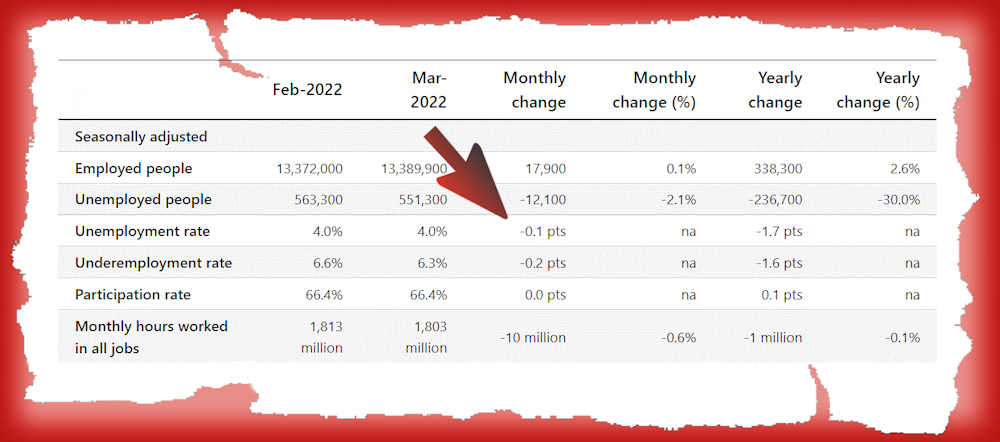
The official employment figures say the unemployment rate for March was 4.0%, exactly the same as a month earlier.

But if you’re prepared to download the spreadsheet and work it out, you’ll find that expressed to two decimal places the rate actually fell, from 4.04% to 3.95%.

The Bureau of Statistics confirms this by saying on its website that the unemployment rate fell by 0.1 percentage points between February and March while also (apparently inconsistentlly) saying it was 4.0% in both months.

Australian Bureau of Statistics This result, clearly below 4%, is the lowest rate of unemployment Australia has seen since the monthly series of labour force statistics began in February 1978, and the lowest since the November quarter of 1974, almost 50 years ago, when the figures were quarterly. After the decade up to March 2020 in which the rate hardly moved above 6% or below 5%, the new rate of 3.95% is an enormous step in the right direction. But we need to worry about more than unemployment. Workers can be underemployed (getting less hours than they would like) and people who would like to work but think they won’t get work, may stop searching and not get recorded as unemployed. There’s good news on both counts. Less underemployment, fewer hidden unemployed The proportion of workers underemployed has fallen from 9.3% prior to COVID in March 2020 to 6.6%. And rather than people withdrawing from the labour force and not looking for work, the rate at which people are either working or looking is up half a percentage point on before COVID. As well, in an instance of the adage that a rising tide lifts all boats, young Australians who in the 2010s lost out as the economy slowed, now seem to be benefiting most from the pick-up. Read more: Forget the election gaffes: Australia's unemployment rate is good news – and set to get even better by polling day The proportion of young Australians who are employed is an extraordinary 4.6 percentage points higher than in March 2020. This compares with an improvement of 1.9 percentage points for Australians aged 25 to 64 years, and 0.4 percentage point for Australians aged 65 years and over. A rate of unemployment below 4% is certainly a positive. It means more of the nation’s productive resources are being used. It has improved the living standards of the 170,000 people employed today who would have not been, had unemployment remained where it was before COVID. But those benefits will only stay in place as long as unemployment remains low. Our objective ought to be to keep it as low as possible for as long as possible. How can we keep unemployment below 4%? Unemployment fell below 4% because more of the population found work. The economic stimulus the government provided to respond to COVID was built for a worst case that didn’t materialise – people generally kept their jobs. As a result it added to employment growth, and established that it was easier to get unemployment down than had been generally realised. Read more: Australia cut unemployment faster than predicted – why stop now? This suggests that keeping unemployment below 4% will depend on being committed to that goal. Much of the COVID stimulus has been saved and has yet to make its way into spending. This, and the new spending measures in the 2022 budget, are likely to maintain the impetus needed to keep unemployment low for the months ahead. Beyond that, what happens to unemployment will depend on the next government’s decisions. That 1.3 million extra jobs pledge All this must mean the Coalition’s pledge to create 1.3 million extra jobs in the next five years is what’s needed. Well, maybe. Certainly, employment has to grow for the rate of unemployment to stay low. But the absolute number of jobs only has relevance for the rate of unemployment when we also know what is happening to the number of people who want to work. Depending on whether the keenness of Australians to get jobs (participation) increases at a faster or slower rate than employment, 1.3 million extra jobs could either cut the rate of unemployment or be insufficient to stop it climbing. Read more: Despite record vacancies, Australians shouldn't expect big pay rises soon Suppose 1.3 million jobs are created in the next five years as the Coalition has pledged, and all of them increase employment. And suppose also that the working age population and labour force participation rate grow at the same pace as for the past five years. Then Australia’s rate of unemployment in five years time will be about 4.4%, which is higher rather than lower than it is today. Ultimately what we care about is the proportion of the population that is in work, rather than the number of jobs created, which can be related to population. A more meaningful pledge would be to keep unemployment at the lowest possible rate below 4% without causing excessive wage inflation. Authors: Jeff Borland, Professor of Economics, The University of Melbourne

Read more https://theconversation.com/technically-our-unemployment-rate-now-begins-with-a-3-how-do-we-keep-it-there-181242

Chatswood Tutoring And Its Role In Academic Achievement

Academic success often requires more than classroom attendance alone. Students face increasing expectations as they progress through school, particu...

Why Laser Hair Removal Treatments Continue Growing In Popularity

Managing unwanted hair can become time-consuming and frustrating for many people, especially when shaving, waxing, and other temporary methods requi...

Choosing the Right Devices for a Flexible Workplace

For IT leaders managing large fleets, the device layer is where workforce productivity and security policy meet. The shift towards flexible and hybrid...

How Business Advisory Services Help Companies Achieve Sustainable Growth

Every business owner aims to build a profitable and sustainable organisation. While dedication, innovation, and hard work are important, achieving l...

Why Body Contouring Has Become A Popular Cosmetic Treatment

Many people maintain healthy lifestyles through regular exercise and balanced eating habits but still struggle with stubborn areas of fat that are d...

How to Choose the Right POS Hardware for Your Business in Australia

A lot of Australian business owners spend weeks researching POS software but buy hardware almost as an afterthought. That's a mistake. The wrong har...

Why Material Handling Hose Is Critical for Industrial Efficiency

A high-performance material handling hose is an essential component in industries that transport abrasive, dry, or bulk materials on a daily basis...

How to Choose the Right Lawyer in Melbourne for Your Situation

Choosing legal support can feel difficult, especially when the stakes are personal or business-related. The right lawyer in Melbourne should underst...

Hoteliers Look to Clever Value Adds to Increase Revenue

The Australian hospitality industry is still in recovery mode after a notoriously rough patch in recent years. While there has been a post-COVID tra...

Moving to Queensland? Here’s How to Prep Your Car for the Big Move North

There’s no sign of the northern migration slowing down, with thousands of southerners fleeing from chaotic lifestyles and cooler climates for a brig...

Diesel Shortage to Impact Trades and Contractors

Strait of Hormuz blockage affecting all major parts of trades and construction Trades and construction across residential, commercial and industria...

Why Holiday Home Owners Turn to Rental Management Agents

The Allure — and the Reality — of Renting Out Your Property Owning a holiday home is a dream for many Australians. Whether it's a beachside sha...

Why Finding Reliable Doctors In Bundoora Is Important For Long-Term Health

Access to quality healthcare plays an important role in maintaining overall wellbeing and managing health concerns early. Trusted Doctors in Bundoor...

Understanding the Different Types of Car Services: Minor vs Major

When it comes to car maintenance, one of the most important things every vehicle owner should understand is the difference between a minor and a maj...

How Superannuation and TPD Insurance Work Together

Superannuation is an essential part of financial planning in Australia. It is designed to provide individuals with income during retirement, helping...

Tiny Towns funding granted for Mt Hotham and Mt Buller upgrades

Alpine Resorts Victoria (ARV) has welcomed funding support from the Victorian Government’s  Tiny Towns Fund, with both Mt Hotham and Mt Buller se...

Locksmith Services: Why Professional Security Solutions Matter More Than Ever

Security is a critical concern for homeowners, businesses, and vehicle owners alike. Whether it involves protecting a property, replacing damaged lo...

Why Tooth Fillings Are Important For Protecting Damaged Teeth

Cavities and minor tooth damage are common dental problems that can worsen if left untreated. Professional tooth fillings help restore damaged teeth, ...