

Modern Australian
The Times

What should happen to the private health insurance rebate this election? A $7 billion question

  • Written by Henry Cutler, Director, Centre for the Health Economy, Macquarie University

What should happen to the private health insurance rebate this election? A $7 billion question

The private health insurance rebate costs Australian taxpayers nearly A$7 billion per year, and has cost over $100 billion since its introduction.

Yet the rebate’s return on investment has never been estimated.

In the middle of an election campaign and with a record budget deficit, it’s worth reflecting on why the rebate was introduced and whether it represents value for money.

Read more: INFOGRAPHIC: A snapshot of private health insurance in Australia

What is the private health insurance rebate, who gets it, and why was it brought in?

The private health insurance rebate is money paid by the Australian government to people who buy private patient hospital cover.

Eligibility depends on policy type (single or family) and annual income. Singles or families within incomes classified as Tier 3 do not receive any rebate.

The rebate rate is based on age and income. It is calculated as a percentage of the premium paid, so the more spent, the more money the government will provide, either through lower premiums or through your tax return.

The Australian government introduced a means-tested rebate to singles and families in 1997 to encourage people to buy private health insurance.

It thought an increase in private hospital cover would take pressure off public hospitals.

Read more: The debate we're yet to have about private health insurance

Cover had significantly declined due to premium increases of 75% between 1989 and 1996.

Around the same time, the government introduced the Medicare Levy Surcharge. This penalises higher income people for not owning private hospital cover.

It also introduced lifetime health cover loading, which makes people aged over 30 pay higher premiums if they decide to purchase private hospital cover for the first time, or drop their cover for three years or more (with exemptions for people going overseas).

A nurse waits for a blood sample analysis in the COVID-19 intensive care unit.
The Australian government thought increasing private hospital cover would ease the strain on public hospitals. Daniel Cole/AAP

Means testing on the rebate was removed in 1999, and a flat 30% rebate was applied to all policies. This formed part of the government’s support for cost of living pressures given the goods and services tax was being introduced.

At the time, there were several supporters of the rebate, such as the peak bodies for the private health insurance sector and private hospitals.

There were also strong opponents.

The Industry Commission (now the Productivity Commission) concluded the rebate would not help the public hospital system. A Senate Standing Committee concluded the rebate runs “counter to the Medicare principles of universality, equity and access”.

Changes to rebate policy settings over time

The then Coalition government increased the rebate in 2005 from 30% to 35% for people aged 65-69 years and 40% for people aged 70 years and over. This was to “reward older Australians for contributing to private health insurance costs for most of their adult lives”. It had little effect on membership and has been interpreted by some researchers and academics as a wealth transfer to older Australians.

The then Labor government reduced the rebate and increased the Medicare levy surcharge for high income earners in 2012, to limit government expenditure growth, after concerns the rebate provided “windfall gains” to high income earners. This policy increased private hospital cover.

A supplied image of ICU staff caring for COVID-19 positive patients in the ICU of St Vincent’s Hospital in Sydney.
The peak bodies for the private health insurance sector and private hospitals supported the rebate. Kate Geraghty/AAP, CC BY

The government has gradually reduced the rebate since 2014.

Does the rebate achieve its intended purpose?

The federal government now spends the same on the rebate each year as the South Australian government spends on its whole health system.

The purpose of the rebate was to increase private health insurance membership to reduce public hospital pressure. On these measures, it seems to have failed.

While private hospital cover increased dramatically from 31% to 45% just after the 30% rebate was introduced, most studies attribute the increase to the lifetime health cover policy.

There is also no strong evidence increasing private hospital cover takes pressure off the public hospital system, with data suggesting little, if any, impact. Public hospital elective surgery waiting times for three popular surgeries increased despite the dramatic increase in private hospital cover at the start of the millennium.
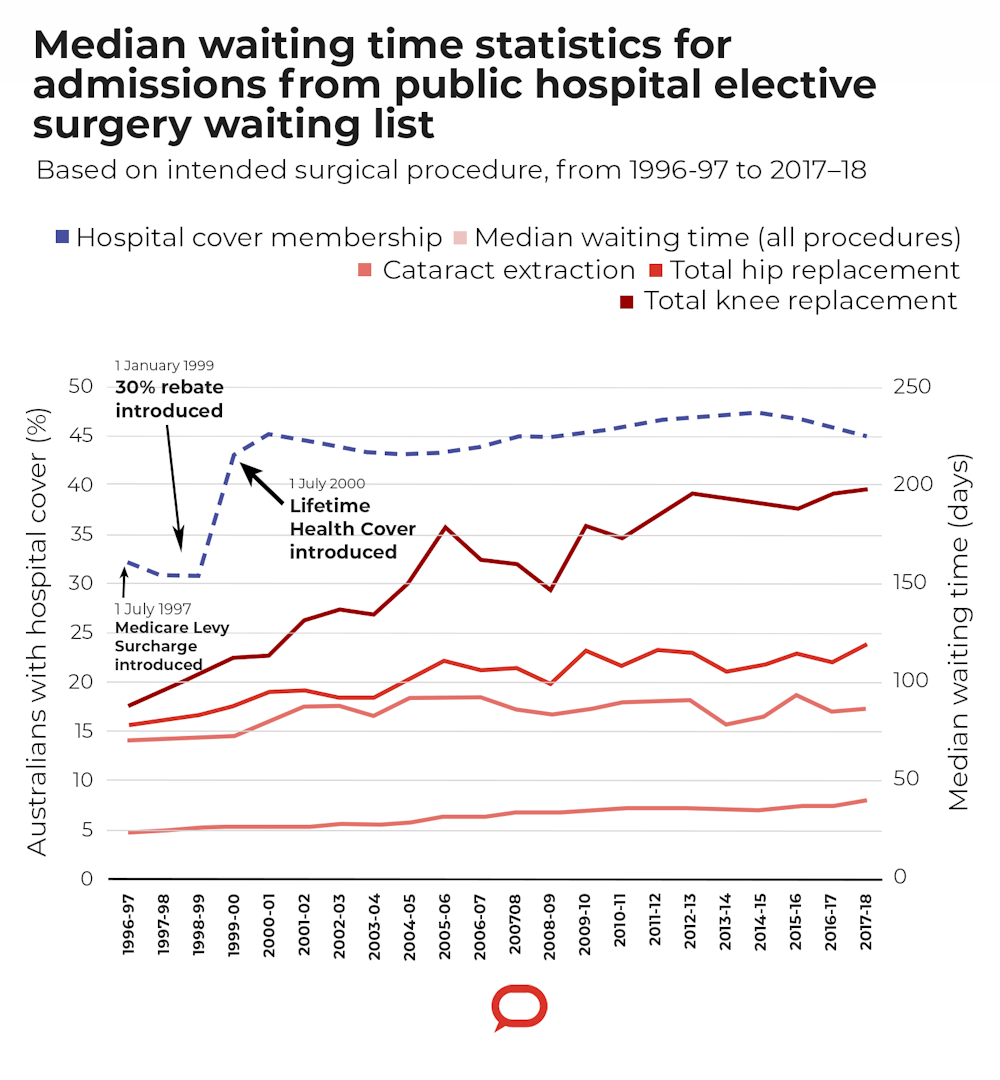
Source: Australian Prudential Regulatory Authority Some studies suggest increased private hospital cover could increase public hospital waiting lists. Shifting patients into private hospitals decreases demand for public hospital elective surgery, but the supply of surgeons also shifts to private hospitals, which means fewer resources for public hospitals. Many people have also downgraded their cover because of systemic premium increases. This means members may still use the public system to avoid large out-of-pocket costs. So what should the major parties do this election? Both major parties should commit to reviewing the rebate’s return on investment and ditch the rebate if taxpayers are not getting value for money. Removing the rebate would be politically challenging. Some members would experience a premium increase of between 8 and 33%, adding to their cost of living. Older Australians with low incomes would experience the greatest premium increases. Read more: Private health insurance 'carrot and stick' reforms have failed – here's why That doesn’t mean there would be a collapse in membership but there would be some decline, potentially below 40% of the population. Removing the rebate should be popular among Australians without private health insurance, which is more than half. They don’t receive any benefit from the rebate yet their tax is used to cover its cost. A drop in membership means some people would get their elective surgery in public hospitals instead. But the money saved from the rebate would be more than enough to cover those extra costs in the public system, with funds left over. Savings could be reinvested into the public system, where every Australian can benefit. Authors: Henry Cutler, Director, Centre for the Health Economy, Macquarie University

Read more https://theconversation.com/what-should-happen-to-the-private-health-insurance-rebate-this-election-a-7-billion-question-181264

Chatswood Tutoring And Its Role In Academic Achievement

Academic success often requires more than classroom attendance alone. Students face increasing expectations as they progress through school, particu...

Why Laser Hair Removal Treatments Continue Growing In Popularity

Managing unwanted hair can become time-consuming and frustrating for many people, especially when shaving, waxing, and other temporary methods requi...

Choosing the Right Devices for a Flexible Workplace

For IT leaders managing large fleets, the device layer is where workforce productivity and security policy meet. The shift towards flexible and hybrid...

How Business Advisory Services Help Companies Achieve Sustainable Growth

Every business owner aims to build a profitable and sustainable organisation. While dedication, innovation, and hard work are important, achieving l...

Why Body Contouring Has Become A Popular Cosmetic Treatment

Many people maintain healthy lifestyles through regular exercise and balanced eating habits but still struggle with stubborn areas of fat that are d...

How to Choose the Right POS Hardware for Your Business in Australia

A lot of Australian business owners spend weeks researching POS software but buy hardware almost as an afterthought. That's a mistake. The wrong har...

Why Material Handling Hose Is Critical for Industrial Efficiency

A high-performance material handling hose is an essential component in industries that transport abrasive, dry, or bulk materials on a daily basis...

How to Choose the Right Lawyer in Melbourne for Your Situation

Choosing legal support can feel difficult, especially when the stakes are personal or business-related. The right lawyer in Melbourne should underst...

Hoteliers Look to Clever Value Adds to Increase Revenue

The Australian hospitality industry is still in recovery mode after a notoriously rough patch in recent years. While there has been a post-COVID tra...

Moving to Queensland? Here’s How to Prep Your Car for the Big Move North

There’s no sign of the northern migration slowing down, with thousands of southerners fleeing from chaotic lifestyles and cooler climates for a brig...

Diesel Shortage to Impact Trades and Contractors

Strait of Hormuz blockage affecting all major parts of trades and construction Trades and construction across residential, commercial and industria...

Why Holiday Home Owners Turn to Rental Management Agents

The Allure — and the Reality — of Renting Out Your Property Owning a holiday home is a dream for many Australians. Whether it's a beachside sha...

Why Finding Reliable Doctors In Bundoora Is Important For Long-Term Health

Access to quality healthcare plays an important role in maintaining overall wellbeing and managing health concerns early. Trusted Doctors in Bundoor...

Understanding the Different Types of Car Services: Minor vs Major

When it comes to car maintenance, one of the most important things every vehicle owner should understand is the difference between a minor and a maj...

How Superannuation and TPD Insurance Work Together

Superannuation is an essential part of financial planning in Australia. It is designed to provide individuals with income during retirement, helping...

Tiny Towns funding granted for Mt Hotham and Mt Buller upgrades

Alpine Resorts Victoria (ARV) has welcomed funding support from the Victorian Government’s  Tiny Towns Fund, with both Mt Hotham and Mt Buller se...

Locksmith Services: Why Professional Security Solutions Matter More Than Ever

Security is a critical concern for homeowners, businesses, and vehicle owners alike. Whether it involves protecting a property, replacing damaged lo...

Why Tooth Fillings Are Important For Protecting Damaged Teeth

Cavities and minor tooth damage are common dental problems that can worsen if left untreated. Professional tooth fillings help restore damaged teeth, ...
















