Modern Australian
The Times

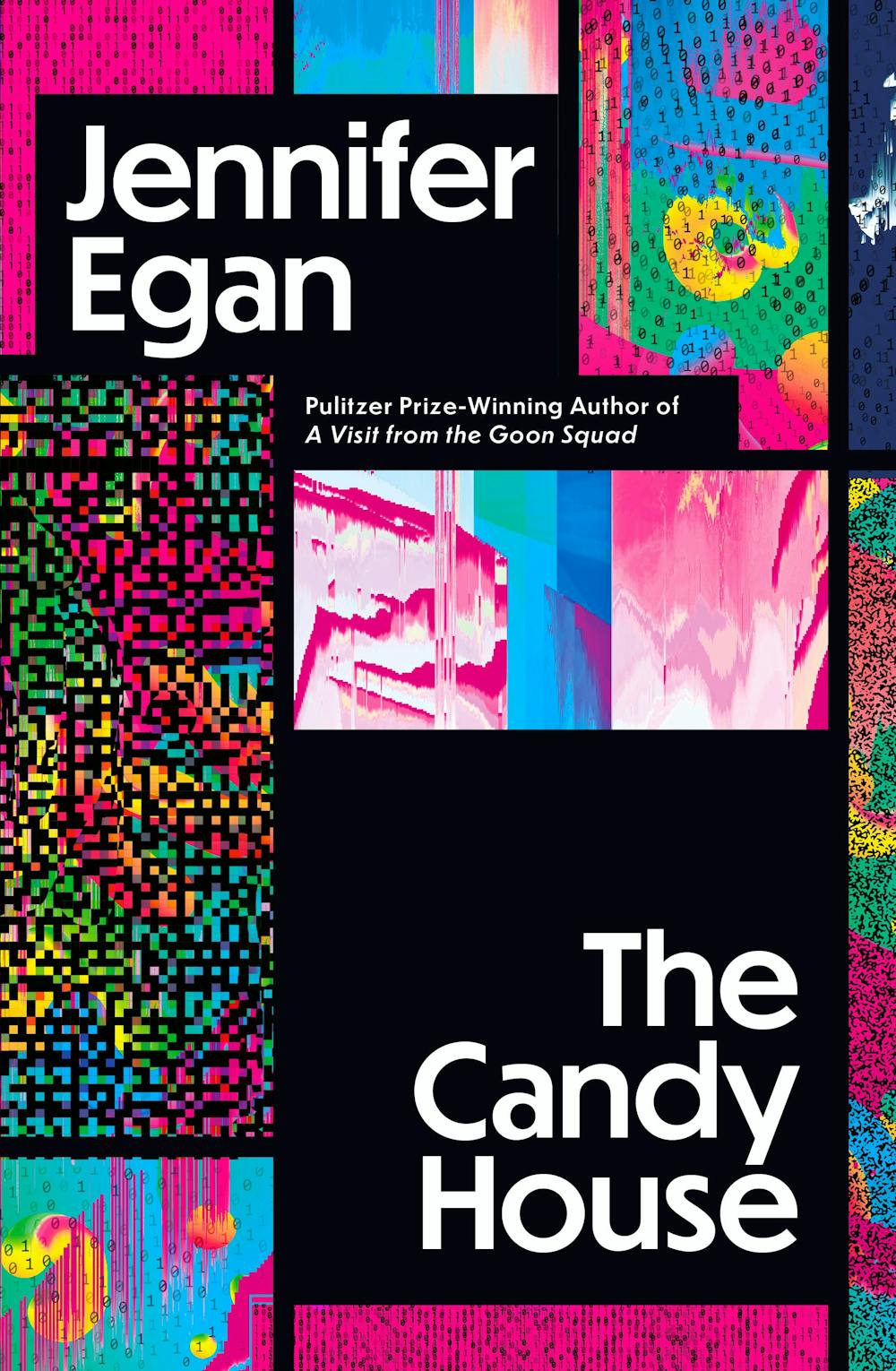
In The Candy House, Jennifer Egan delivers an inventive novel for a digital age

  • Written by Anthony Macris, Associate Professor of Creative Writing, University of Technology Sydney
In The Candy House, Jennifer Egan delivers an inventive novel for a digital age

In her typically inventive fashion, Jennifer Egan calls The Candy House, the follow-up to her Pulitzer Prize winner A Visit from the Goon Squad (2011), a “sibling novel”.

Is this new book smarter, better-looking, more charismatic than its older sister or brother? I don’t think it is a question worth posing: it’s easy to love these two fascinating children just the same.

Review: The Candy House – Jennifer Egan (Corsair)

According to Egan, The Candy House

follows a number of [A Visit from the Goon Squad’s] peripheral characters into their own futures and pasts to create an independent work with a new set of preoccupations and center of gravity, but equal affinity for technology, humor, and structural freedom.

In this bustling, multifaceted report on contemporary consciousness, Egan more than delivers on her claims. In particular, she shows herself to be both shrewd and adept at assembling the right characters to develop her themes. She opens a window not just to the America that is, but the America that may very well come to be. Among the novel’s teeming ensemble of players is Bix Bouton, tech entrepreneur and helmsman of Mandala, the company he has formed to realise his vision of the next quantum leap in social media and virtual reality. Mandala’s flagship products include Own Your Unconscious and The Collective Unconscious, programs that allow people to upload the content of their minds, which can then be shared on a global online platform that allows subscribers to relive memories and experiences. Then there is the reclusive Miranda Kline, the late-blooming anthropologist whose research on “affinity and trust”, based on her study of a Brazilian tribe, is appropriated to drive Mandala’s social media revolution, in a way that is the perverse opposite of her intention. There are also characters we might call quantifiers, for want of a better term. One is Lincoln, a “senior empiricist and metrics expert”, whose world view has become so dominated by quantification that he subjects his courtship of a female co-worker to an ongoing analysis that involves units of attractiveness and odds of success in relation to his rivals. Another is Chris Salazar, who works for a start-up entertainment company that is attempting, in a tradition stretching back to the Russian Formalists, to reduce movie storytelling to standardised elements – stockblocks – which he converts into algebraic equations. At first blush, it would appear the main concern of The Candy House is digital technology. But such a narrow term does a disservice to Egan’s nuanced treatment of the theme. Sure, the novel brims with characters and through-lines (I hesitate to call them storylines) that bear witness to the rise of the internet since the 1990s. One example is the reaction of a music mogul to the long-forgotten Napster, the free music-sharing platform. Unsurprisingly, he is horrified at what it will do to his bottom line. What interests Egan is not technology for its own sake, but how it has transformed human experience at both the individual and social level. In particular, she is concerned with how we struggle to find our place in the world, and form and maintain meaningful relationships with others. Read more: What my students taught me about reading: old books hold new insights for the digital generation No neat arcs, no pat lessons In the tradition of the realist novels of the 19th century, the cast of The Candy House is wide and varied. The way Egan deploys her cast, however, does not conform to the two dominant patterns we are familiar with: the hero narrative, where a single character provides a framing narrative arc that pulls the whole together, and the standard ensemble cast, where we see a several main characters, of more or less equal dramatic importance, affecting each other’s lives. Egan disrupts the associated conventions: there are no neat character arcs to resolve, no pat lessons to be learned. Rather, she creates a finely woven mesh of resonant experiences – some epiphanic, some wryly comical – exchanged between people variously connected: by work, by sexual attraction, by chance, and above all by family. Family ties are everywhere in The Candy House. Egan’s emotional worlds are peopled by fathers trying to connect with their children, wives wrangling their troublesome spouses, individuals trying to recalibrate their identities to some workable setting in relation to their wildly unpredictable siblings. But in spite of all the angst (or maybe because of it), there are sections of great emotional beauty throughout the novel. The chapter titled “The Mystery of our Mother” is a minor tour de force of family dysfunction and tenderness. In it, a divorce is narrated from the point of view of one of the daughters in the second-person plural. The use of “we” and “our” pronouns creates a rich, multidimensional, siblings-as-collective perspective. The chapter “The Perimeter: After”, narrated in the first-person by a young teenage girl named Molly, conjures a transformative late afternoon in the life of Molly and her teenage friends (including a couple of boys). In one poignant scene, they fall asleep on a pier near their parents’ country club. It is a transcendent moment charged with the complexities of friendship and attraction, yet full of innocence and restraint. Read more: Review: Satin Island by Tom McCarthy High modernism and the 21st century postmodern Much will be made of The Candy House’s formal innovations. Like A Visit from the Goon Squad, the novel relies on a grammar of what we could call the 21st-century postmodern. It makes use of standard novelistic tropes like pastiche, fractured time and metafiction, mediated by the more recent narrative possibilities of the digital age. Thus in The Candy House we see the usual mixture of high and low (the speculative fiction of Own Your Unconscious contrasting with the “literary” modes of the lyrical and epiphanic), discontinuous narrative (the novel’s time progression is non-linear, influenced in part by digital temporalities), and variations of text types (a chapter in emails, a chapter in interior monologue lite, a chapter in stylishly oblique aphorisms reminiscent of Renata Adler that originated as tweets, and so on). But it is clear that Egan is also calling in an older tradition of literary innovation: postmodernism’s domineering big brother, high modernism. James Joyce’s Ulysses (1922) is name-checked at two telling points: in the beginning, where we learn that Bix Bouton “kept Ulysses as a romantic artefact”, and towards the end, where it is revealed that Bix once showed his son Gregory, a creative writing masters graduate, his crumbling copy of Joyce’s novel to convince his son of his “literary seriousness”. Read more: James Joyce's Ulysses is an anti-stream of consciousness novel In The Candy House, Jennifer Egan aligns herself with the spirit of high modernism. James Joyce, photographed by Man Ray, September 1922. Public domain There is calculated ambiguity in Egan’s referencing of Joyce, but it is hard not think that she’s aligning herself with the spirit of the high modernists. It is a risky move to associate yourself with a text as canonical as Ulysses, but I think it is justified. The Candy House’s inventiveness points a way forward for the novel as a genre. It suggests how the novel can be made new again – not just formally, but in its depiction of human existence in a technologically mediated world. In Ulysses, Leopold Bloom is, like the wandering Odysseus, on a journey home. Egan’s novel has no single hero, no underlying epic narrative that links it to a greater history, and home seems very hard to find. Her characters and the world in which their struggles and triumphs occur seem to have been decoupled from history. They are set adrift on a vast sea that is one part memory, one part sensation. They live suspended between the virtual and the material, with neither gaining ascendancy. Yet for all the unstable ontologies and splintered subjectivities that Egan captures so well, her sensibility manages to evoke a great sense of vitality and energy. In Egan’s universe, people never stop trying to love, to learn, to help, to discover, to seek joy and wonder. I finished reading The Candy House feeling apprehensive about the pitfalls and dangers of the world we have unleashed, but excited that I was caught up in some great, exhilarating adventure that is at the very core of what it means to be human. Authors: Anthony Macris, Associate Professor of Creative Writing, University of Technology Sydney

Read more https://theconversation.com/in-the-candy-house-jennifer-egan-delivers-an-inventive-novel-for-a-digital-age-181151

Sunshine Coast Baby Classes Prove Big Hit Among First-Time Mums

There's a movement gaining traction on the Sunshine Coast, providing a village of support, socialisation and relief for first-time mothers and babie...

Father's Day Gift Ideas for Men Who Are Hard to Buy For

Some dads are easy to buy for. Others do not want anything, already have everything, or give you the classic "don't worry about me" answer every yea...

Top 5 Mistakes That Wear Out Your Brakes Faster

Brakes don't need frequent replacements like oil changes do.   But a lot of the wear happens quietly, over months, because of habits most drivers...

Plantation Shutters vs Curtains: Which Is Better for Your New Home?

Moving into a new home is an exciting opportunity to personalise your space and make it your own. While many homeowners focus on furniture, flooring...

Celebration of Life vs Traditional Funeral: What's the Difference?

When saying goodbye to someone you love, there is no single way to honour their life. Every family has different traditions, beliefs, and preference...

Building Approval for Roofing Projects: What Homeowners Need to Know

Roofing projects are an important part of maintaining and protecting your home. Whether you're repairing storm damage, replacing an ageing roof, or ...

Chatswood Tutoring And Its Role In Academic Achievement

Academic success often requires more than classroom attendance alone. Students face increasing expectations as they progress through school, particu...

Why Laser Hair Removal Treatments Continue Growing In Popularity

Managing unwanted hair can become time-consuming and frustrating for many people, especially when shaving, waxing, and other temporary methods requi...

Choosing the Right Devices for a Flexible Workplace

For IT leaders managing large fleets, the device layer is where workforce productivity and security policy meet. The shift towards flexible and hybrid...

How Business Advisory Services Help Companies Achieve Sustainable Growth

Every business owner aims to build a profitable and sustainable organisation. While dedication, innovation, and hard work are important, achieving l...

Why Body Contouring Has Become A Popular Cosmetic Treatment

Many people maintain healthy lifestyles through regular exercise and balanced eating habits but still struggle with stubborn areas of fat that are d...

How to Choose the Right POS Hardware for Your Business in Australia

A lot of Australian business owners spend weeks researching POS software but buy hardware almost as an afterthought. That's a mistake. The wrong har...

Why Material Handling Hose Is Critical for Industrial Efficiency

A high-performance material handling hose is an essential component in industries that transport abrasive, dry, or bulk materials on a daily basis...

How to Choose the Right Lawyer in Melbourne for Your Situation

Choosing legal support can feel difficult, especially when the stakes are personal or business-related. The right lawyer in Melbourne should underst...

Hoteliers Look to Clever Value Adds to Increase Revenue

The Australian hospitality industry is still in recovery mode after a notoriously rough patch in recent years. While there has been a post-COVID tra...

Moving to Queensland? Here’s How to Prep Your Car for the Big Move North

There’s no sign of the northern migration slowing down, with thousands of southerners fleeing from chaotic lifestyles and cooler climates for a brig...

Diesel Shortage to Impact Trades and Contractors

Strait of Hormuz blockage affecting all major parts of trades and construction Trades and construction across residential, commercial and industria...

Why Holiday Home Owners Turn to Rental Management Agents

The Allure — and the Reality — of Renting Out Your Property Owning a holiday home is a dream for many Australians. Whether it's a beachside sha...