

Why some beaches, including in Queensland, are getting bigger despite rising sea levels
- Written by: Daniel Harris, Senior Lecturer in Geography, The University of Queensland
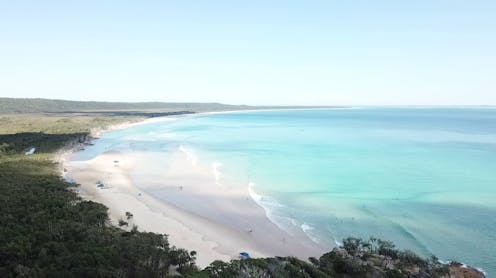
In a warmer world, rising sea levels could render many coastlines, beaches, and reef islands uninhabitable, or destroy them altogether. The 1.09℃ Earth has warmed since pre-industrial times has already heightened seas by 20 centimetres.
But curiously, research shows some coastlines and even low-lying coral reef islands are actually growing rather than eroding in the face of rising sea levels. This is happening on some beaches in Queensland and New South Wales, along with coastlines in Asia and Africa.
This goes against the general understanding of how climate change impacts the coast and has led to confusion that has been, in part, deliberately sown into public discourse by climate change deniers. So what’s going on?
To examine the phenomenon, we investigated coastal changes using historical aerial photographs and satellite records. We found the observed growth of coastlines is largely linked to the “coastal sediment budget” – the amount of sand, rocks and other sediment moving into and out of the beach over time.
Our results show just how dynamic and complex the coast is, highlighting a need for greater understanding of local coastal changes, even down to individual beaches, when making coastal management plans.
Understanding sediment budgets
To make sense of this phenomenon, we first need to understand sediment budgets. A “positive” sediment budget is when more sand comes to the beach than leaves. A “negative” budget the opposite, when more sand leaves than arrives.
Over time a positive sediment budget drives growth on the coast – and beaches expand further into the ocean.
Sea level rise, on the other hand, erodes sand from the beach and places it elsewhere on the coast. This can lead to a loss of sand from the beach – and the shoreline retreats inland.
Read more: From enormous tides to millions of shells, here are 6 unique beaches for your summer road trip
So if sea levels are rising across the planet, why are some beaches still getting bigger?
The answer is that for growing beaches, the positive sediment budget currently has a greater impact than erosion from sea level rise. In other words, the amount of sand coming to the coast is greater than the amount lost to sea level rise.
Beaches in Queensland
We investigated change on the coast of Queensland at 15 beaches stretching from north of Cooktown to Coolangatta, using the aerial photograph record from the 1930’s to present. We also investigated shoreline change globally using the satellite record since 1984.
Despite global sea levels rising 20 centimetres over this time, every beach we investigated in Queensland was growing.
When we looked at coastal changes on at a global scale, we found large parts of entire continents, such as Africa and Southeast Asia, were also growing. This suggests that net positive sediment budgets on the coast are common.
It may be explained by two things. In natural settings, extra sand likely arrives from either deeper sediment located on the continental shelf or from rivers. Human intervention, in the form of coastal development, also drives coastal growth.
In Queensland, for example, Bucasia Beach has grown due to the natural input of sediment over time, likely from a nearby river. Meanwhile, Coolangatta Beach in the Gold Coast has grown due to human intervention that placed additional sand on the beach to mitigate and reverse trends of erosion.
At a global scale, parts of China’s coast have grown due to human development on the coast. Other regions, such as Suriname, South America, have grown due to large or fast rivers transporting enormous quantities of sediment to the coast.
These results show that sediment budgets and human intervention can be much greater drivers of coastal change than a relatively small rise in sea level.
However, this doesn’t mean sea level rise driven erosion isn’t a real risk in the future. Instead, we should ask: what happens when, as forecasted, the rate of sea level rise continues to accelerate?
What does this mean for the future?
The Intergovernmental Panel on Climate Change (IPCC) forecasts sea levels to reach up to 1.01 metres higher (relative to the 1995-2014 level) by 2100 if global emissions continue unabated.
What’s more, sea level rise is getting faster. The IPCC found it rose 1.3 millimetres per year during 1901-1971, 1.9mm per year during 1971-2006, and 3.7mm per year during 2006-2018.
Read more: Sea-level rise has claimed five whole islands in the Pacific: first scientific evidence
This increase in sea level may drive a loss of sediment to the beach that current positive sediment budgets can no longer offset. This could trigger erosion in beaches presently growing.
So it’s important coastlines presently growing aren’t seen as evidence that sea level rise does not drive coastal erosion. Nor that such coasts are free from future erosion risk.
Even if there’s enough sediment to maintain growth on the coast, hazardous erosion and inundation due to storms and cyclones can still occur.
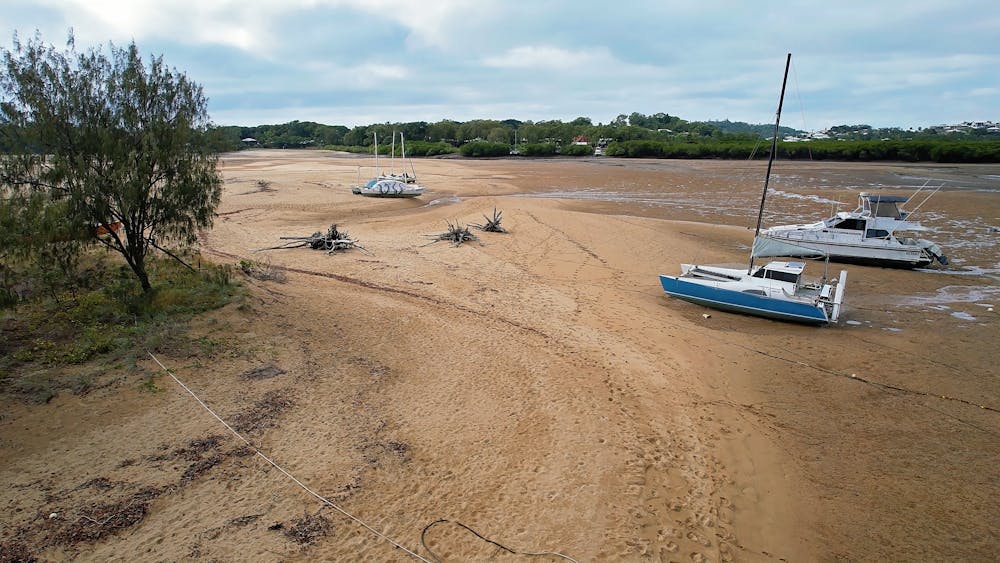
When we seek to understand and mitigate the future impact of sea level rise on the coast we should also ask: when does coastal erosion become hazardous?
Coastal erosion is, by itself, a natural process and is only a problem when human infrastructure or livelihoods are at risk.
The sediment budget and decisions we make on the coast – where we build, where we intervene, and where we don’t – are just as critical as sea level rise in the future.
Read more: The seas are coming for us in Kiribati. Will Australia rehome us?
Most of Australia’s coast is undeveloped and the positive sediment budget on many beaches will limit future erosion.
If we continue to leave them alone, the risk of future hazardous erosion under climate change is low. If, however, we place people and infrastructure too close to the shoreline and disrupt coastal sediment budgets, we will increase our future climate risk.
Authors: Daniel Harris, Senior Lecturer in Geography, The University of Queensland

















