

Using BMI to measure your health is nonsense. Here's why
- Written by: Nicholas Fuller, Charles Perkins Centre Research Program Leader, University of Sydney
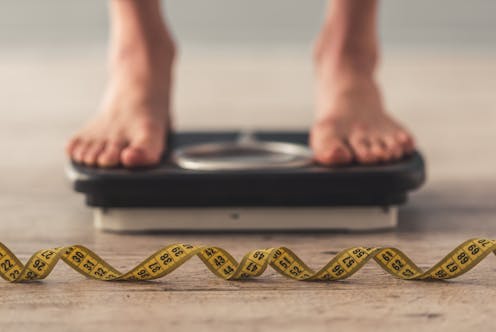
We’re a society obsessed with numbers, and no more so than when managing our health.
We use smartwatches to count steps and track our daily activity, creating scores for our fitness, and monitor our heart rate and sleep quality to measure our health and well-being.
Doctors can be just as obsessed with numbers, relying on measurements and equations to create scores for our health, one of the most popular of which is the Body Mass Index (BMI).
But BMI – a measure of the relationship between your weight and height – is increasingly under scrutiny. More and more experts are questioning its accuracy and health practitioners’ fixation on using it as a single indicator of health and healthy weight.
Here’s everything you need to know about BMI – and why using it as the sole measure of your health is nonsense, starting with a quick history lesson.
Where did BMI come from, and why is it associated with health?
The concept of BMI was developed in 1832 (yes, almost 200 years ago!) by Belgian statistician Lambert Adolphe Quetelet, who was called on to create a description of the “average man” to help the government estimate obesity numbers among the general population.

Fast-forward 100 years to the United States, where life insurance companies had started comparing people’s weight to an average population weight for similar individuals to calculate insurance premiums based on a predicted risk of dying.
Annoyed by this somewhat unscientific approach, US physiologist Ancel Keys completed research with 7,000 healthy men using Quetelet’s measure, finding this method was a more accurate and simpler predictor of health that was also inexpensive.
Quetelet’s calculation was subsequently renamed BMI and adopted as a primary indicator of health, thanks to subsequent studies confirming increased risks of heart disease, liver disease, arthritis, some cancers, diabetes and sleep apnoea with increased BMI.
Read more: Explainer: overweight, obese, BMI – what does it all mean?
Its use soon became widespread, and today, BMI is found everywhere, from the doctor’s surgery to the gym.
How is BMI measured, and what do the scores mean?
The BMI formula is simple, and easy to calculate thanks to the many free BMI calculators available online.
To calculate BMI:
take your weight in kilograms
to get your index, divide your weight by the square of your height in metres.
Your result classifies you into one of four categories describing your body weight in a single word:
• underweight – a BMI of less than 18.5
• normal – a BMI between 18.5 and 24.9
• overweight – a BMI between 25.0 and 29.9
• obese – a BMI of 30 or above.
Read more: The numbers don't have it: why measuring won't lead to better health
So is BMI an accurate measure of health?
In short: no.
While BMI is an accessible and affordable way to screen a person’s health, it shouldn’t be relied on as a single measure of health.
Here’s why.
1. BMI misses a more important measure – body fat percentage
BMI is based on body weight, but a person’s disease risk is linked to body fat, not weight.
While body weight can be a proxy for body fat, there’s an important reason it doesn’t always tell an accurate story: muscle is much denser than fat.
Because BMI calculators can’t differentiate fat from muscle, people can be easily misclassified. At the extreme, BMI has classified athletes in peak fitness condition, such as sprinter Usain Bolt, as almost overweight, and American footballer Tom Brady as obese.
2. BMI does not measure body fat distribution
Numerous studies have found people with the same BMI can have very different disease risk profiles, primarily driven by where fat is distributed in their bodies. This is because not all fat is equal.
If you have fat stored around your stomach, your risk of chronic disease is much higher than people who have fat stored around their hips, because this is an indicator of how much visceral fat you have – the type of fat deep inside the belly that increases your risk of stroke, type 2 diabetes and heart disease.
In white populations, a waist circumference of more than 80cm for women and more than 94cm for men is associated with an increased risk of chronic disease, and for Asian populations it is more than 80cm for women or 90cm for men.
3. BMI does not account for demographic differences
The BMI is something none of us like – racist and sexist.
When Quetelet created and Keys validated BMI, they studied largely male, middle-aged Anglo-Saxon populations. Their method prevails, even though BMI’s calculations and classifications are used universally today.
Our bodies, by nature, have some distinct characteristics driven by our gender, including that females generally have less muscle mass and more fat mass than males. We also know muscle mass decreases and shifts around the body as we age.
Read more: Too fat, too thin? How do you work out your ideal weight?
Research has also confirmed significant differences in body weight, composition and disease risk based on ethnicity. This includes findings from the early 2000s that found on measures for optimum health, people of Asian ethnicity should have a lower BMI, and people of Polynesian ethnicity could be healthier at higher BMIs.
This issue has led to suggested redefined BMI cut-off points for people of Asian ethnicity (where a healthy BMI is less than 23) and Polynesians (where a healthy BMI is less than 26).
So what should we be using instead?
To be clear: weight and health are related, with countless studies demonstrating people who are obese or overweight have an increased risk of disease.
But while BMI can be used as a screening tool, it shouldn’t be the only tool relied on to assess a person’s health and healthy weight.
Instead, we need to focus on measures that tell us more about fat in the body and where it’s distributed, measuring weight circumference, waist-to-hip ratios and body fat to get a better understanding of health and risk.
 Waist circumference is a better predictor of health than BMI.
Shutterstock
Waist circumference is a better predictor of health than BMI.
Shutterstock
We also need to consider the many other ways to measure your health and likelihood of disease, including levels of triglycerides (a type of fat found in your blood), blood pressure, blood glucose (sugar), heart rate, presence of inflammation, and stress levels.
As a single measure, BMI is not a good measure of health – it lacks accuracy and clarity and, in its current form, misses measuring the many important factors that influence your risk of disease.
Although BMI can be a useful starting point for understanding your health, it should never be the only measurement you use.
Authors: Nicholas Fuller, Charles Perkins Centre Research Program Leader, University of Sydney
Read more https://theconversation.com/using-bmi-to-measure-your-health-is-nonsense-heres-why-180412

















