

'It's shown me how independent I can be' – housing designed for people with disabilities reduces the help needed
- Written by: Jacinta Douglas, Professor of Acquired Brain Injury, La Trobe University
The federal government has been warning that the rising cost of the National Disability Insurance Scheme (NDIS) is unsustainable. More than a third of NDIS funding is spent on in-house support provided to 5% of NDIS participants with the highest needs.
Fresh data, released Friday, shows there are 3,435 people under 65 living in aged care, and each month another 44 enter. While there has been a 21% drop in younger people living in aged care, the decline is mostly due to people either dying (562 people) or remaining in aged care until they turn 65, and “ageing out” of the cohort. During 2021, only 30 younger people left aged care to live in Specialist Disability Accommodation (SDA).
Well-designed homes that foster more independent living and increase community connection can potentially reduce support costs and the need for younger people to live in aged care.
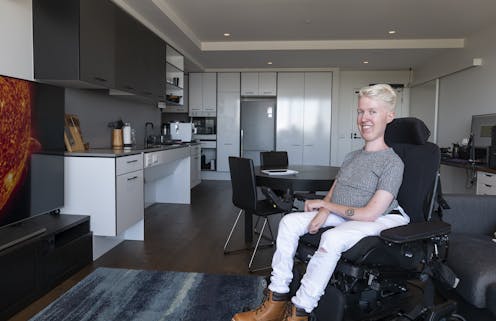
Our new research found specialist housing, that incorporates technology and communication tools, improves independence, health, well-being and community integration. New disability housing has enormous potential to improve the effectiveness of paid support and address housing and workforce issues.
Read more: Labor vows to tackle the NDIS crisis – what's needed is more autonomy for people with disability
Old homes, vulnerable residents
Adequate housing is recognised as a human right.
Up to two-thirds of disability housing in Australia is old stock that is not fit for purpose and does not meet current standards or foster independence.
Group homes are the main model of housing in Australia for people with disability. Up to six people with disability live together, but they have little or no say in where or with whom they live. They are often separated from the community with few opportunities to engage or belong.
Some group homes resemble “mini-institutions” where the structure of the residents’ daily life is determined by staff rosters, routines and priorities.
The current Royal Commission has found people with disability are vulnerable to neglect and abuse when they are segregated and only engage with paid workers. Independence is not fostered, and there is no drive to reduce paid support over time.
Housing that meets needs
In 2016, the NDIS began to address the shortage of contemporary disability housing in Australia by introducing Specialist Disability Accommodation (SDA payments. These are only for the 6% of NDIS participants with the most specific housing needs.
Disability housing is expected to boom with a A$12 billion hoped sector to deliver housing for over 28,000 NDIS participants.
SDA housing might have extra wide doorways, a hoist in the bathroom and concierge support on call.The policy has seen a significant increase of new housing for people with disability. Of 2,399 new dwellings built, 50% were apartments integrated into mainstream developments. A further 1,033 apartments are under construction – mostly for single occupants, with a small number grouped together making delivering disability support more efficient.
Housing makes a difference
New research published by La Trobe University and the Summer Foundation supports these efforts.
We interviewed 15 people people with disability (neurological disorder or cerebral palsy) and complex needs before and six months to two years after they moved into specialist housing. We found designing with the tenant in mind leads to better outcomes.
Before moving into new SDA apartments, study participants lived in a range of housing including group homes, residential aged care, private rentals and with ageing parents.
After they moved they used an average of 2.4 hours less paid support per person per day.
After moving into her own apartment, Amy told us:
‘The day I moved in, I went from room to room thinking: It’s all mine. It’s all mine.’Moving in here has been the biggest change in my life since the onset of my disability. It’s been daunting but also shown me how independent I can be.
To date there has been a lack of evidence on the impact suitable housing has on NDIS participants. Without an evidence-based approach, government and housing providers may invest in housing stock that is not fit for purpose but will be with us for decades.
We estimate $1.1 billion would be saved each year in disability support costs if NDIS participants were living in suitable housing, because they would enjoy increased independence and more efficiently delivered support.
Challenges remain
Despite the thousands of accessible homes built so far, the SDA market is being thwarted by the poor administration of the SDA payments by the National Disability Insurance Agency (NDIA).
Some 63% of the anticipated 28,000 NDIS participants have SDA in their NDIS plans and mostly not at the level of support they’d need to move to new housing.
Bureaucratic delays within the NDIA remain the biggest barrier to a thriving SDA market and achieving the federal government’s Younger People in Residential Aged Care targets.
Potential tenants take months or years to navigate the process of requesting SDA and then appealing unfair decisions, the majority of which are overturned. Many NDIS participants give up as they lose hope along the way.
New specialist disability accommodation is part of the solution to a sustainable NDIS, not part of the problem. Our research confirms the NDIA should focus efforts on innovation and evidence-based solutions informed by the needs, preferences and outcomes for NDIS participants.
Read more: 'It felt like a prison' – too many young Australians are still stuck in nursing homes
Authors: Jacinta Douglas, Professor of Acquired Brain Injury, La Trobe University

















