

Politicians in high-vis say they love manufacturing. But if we want more Australian-made jobs, here's what we need
- Written by: Jesse Adams Stein, Senior Lecturer & ARC DECRA Fellow, School of Design, University of Technology Sydney
Most politicians vocally support Australian-made products. Manufacturing certainly provides excellent opportunities for candidates in high-vis to make election campaign announcements.
Labor has promised to make Australia “a country that makes things again”. It has emphasised locally-made transport, NBN infrastructure, apprenticeships and defence-related production.
The Coalition has spruiked the federal government’s modern manufacturing strategy. It highlights technology investment and six priority areas (minerals, food, medical, clean energy, defence and space).
But despite the seemingly endless announcements, Australian manufacturing remains a problem for the major parties. Whoever wins the federal election will need to do things very differently if they genuinely want to boost local production.
Read more: Don’t be too quick to dismiss ‘dying trades’, those skills are still in demand
Another way forward for manufacturing
In the mid-1960s, Australian manufacturing employed around 25% of the working population; it’s now down around 6.4%.
Manufacturing’s share of GDP is also in decline, now sitting at around 6%. Jobs continue to drift offshore.
Leaving things to the “free market” clearly isn’t working for Australian manufacturing. But patriotic argument we must get back to the “good old days” where everything was supposedly made in Australia is also unrealistic.
There is another way: a coordinated and targeted national industry policy that favours long-term planning over a short-term, scattergun approach.

Tapping into the global green economy
What Australia needs is coordinated national industry policy supporting niche, specialist manufacturing.
This policy would drive an ecosystem of industries and sectors geared towards emissions reduction and skills development. It would help Australia take its place in the booming global “green” technology economy.
For example, policy cleverly targeting gaps in national and international supply chains could support expansion of renewable energy technology manufacturing.
This targeted approach requires manufacturing policy to be developed in step with policy on education, energy, mining, research and development, and emissions reduction.
Done right, the international evidence shows tailored support for niche industries can be very successful.
Germany, for example, has a coordinated policy emphasising technical skills, generous funding for research and development, and energy sector decarbonisation. This approach supports high-end vehicle manufacturing.
Switzerland has specialised in luxury consumer products, precision instruments and food items. In Denmark the policy focus has been on high-quality consumer and industrial products – from bespoke furniture to aircraft – for international markets.
Australia can’t do everything. But boosting ecologically and socially responsible industries is a good start. It would also help attract investment by shoring up economic certainty around Australia’s energy future.
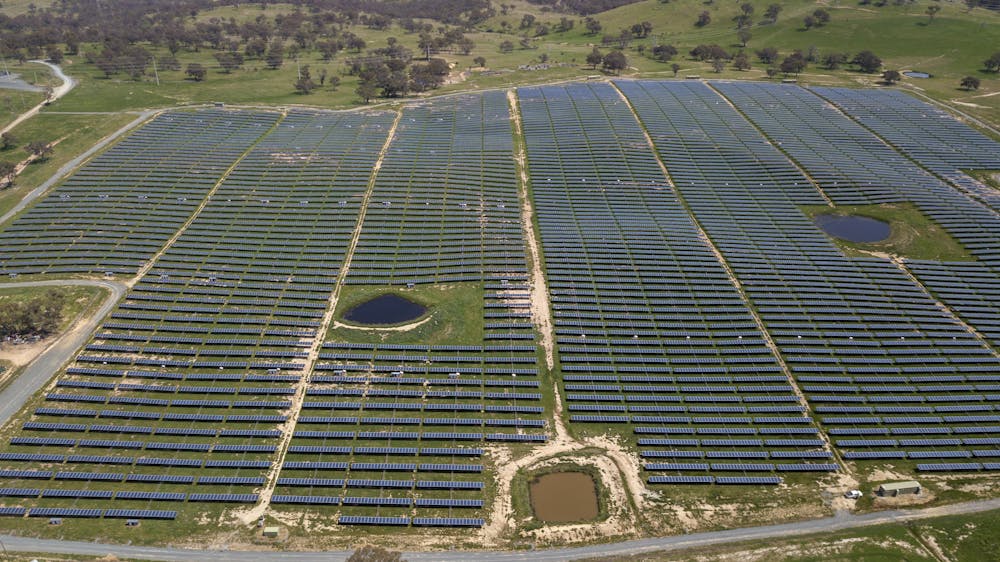 Good policy could support expansion in manufacturing associated with renewable energy.
AAP Image/Mick Tsikas
Good policy could support expansion in manufacturing associated with renewable energy.
AAP Image/Mick Tsikas
What can governments do to help?
Direct financial benefits to manufacturers certainly help, if they require manufacturers to remain onshore.
The federal government could also offer tax-related “carrots and sticks” requiring foreign-owned companies to establish production sites in Australia, so as to avoid tariffs.
Government procurement policies that more overtly favour local manufacturing can also be effective, given the influential size of state and federal governments as consumers themselves. Opting for overseas-made tenders, such as Sydney’s crack-riddled light rail sets, can prove very expensive in the long run.
When governments commit to onshore production, Australia can produce excellent products meeting international demand. Take, for example, the Bushmaster armoured vehicles produced by Thales Australia in Bendigo and requested by Ukraine. Thales spent A$1.9 billion on Australian suppliers between 2018 and 2020, generating a significant local return on government spending.
For employers in manufacturing, skills shortages can impede expansion.
As I argue in my book Industrial Craft in Australia, Australia can learn from countries that put long-term technical education at the heart of their industrial policy.
The German vocational training sector, for example, involves industry employer associations, unions and work councils collaborating with a publicly subsidised training system. This produces a highly skilled workforce with scholarly and technical knowledge.
At the very least, Australia could do more to directly support apprentice uptake and pay 50% of their wages. This must occur alongside substantial reinvestment in TAFE, rather than supporting unreliable private training providers.
Electric opportunities for Australia
Two examples show what’s possible: electric vehicles (EVs) and solar batteries.
The conventional thinking is that Australian car manufacturing is “dead”. But recent research published by the Carmichael Centre and Per Capita suggests EVs and/or EV component manufacturing remains viable, especially as local demand for EVs outstrips supply.
Much of Australia’s existing automotive-manufacturing infrastructure is lying unused, and could be revamped for component manufacturing and assembly.
On solar batteries, Australia could capitalise on soaring global demand for battery storage of renewable energy.
Australia has its own lithium and zinc reserves – key battery ingredients. So it makes more sense to add value to our mineral resources than to ship raw materials offshore and buy back overseas-produced batteries at inflated prices.
Currently, very few companies completely manufacture solar batteries in Australia.
One exception is sonnen, based at an old Holden plant in South Australia. Sonnen is now owned by Shell – even fossil fuel giants can see where global industry is going.
How can we afford all this?
Australian taxpayers subsidised the fossil fuels sector to the tune of $11.6 billion in 2021-2022. The Morrison government just promised $250 million to oil refineries alone.
Supporting fossil fuels comes with dire climate consequences. But it’s also worth asking whether it makes sense to heavily subsidise low value-add extractive industries.
Australia can afford to transform manufacturing into an economically viable, environmentally sustainable and job-creating sector. For that, we need a strategic and long-term approach.
Read more: Design and repair must work together to undo our legacy of waste
Authors: Jesse Adams Stein, Senior Lecturer & ARC DECRA Fellow, School of Design, University of Technology Sydney


















