

Whose ‘identity’ are we preserving in Auckland’s special character housing areas?
- Written by: Carolyn Hill, Teaching Fellow, Environmental Planning, University of Waikato
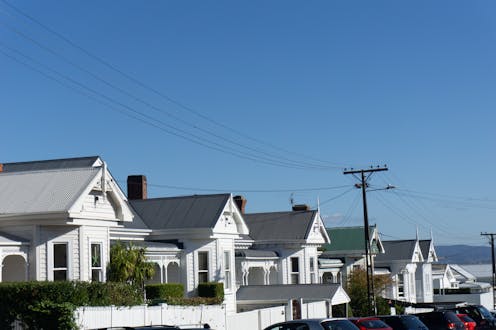
A minor culture war has broken out over Auckland’s urban identity since Auckland Council responded to the government’s new housing rules: on one side, defenders of “special character” areas of historic housing; on the other, advocates for higher-density development with fewer constraints.
The debate can be heated, as people identify with their city in different ways and want different outcomes for its future.
To recap, the recently passed Resource Management (Enabling Housing Supply and Other Matters) Amendment Act seeks to ease the housing crisis by setting “medium-density residential standards” (MDRS) across all of Aotearoa’s major cities. This allows three storeys and three dwellings per site in all residential areas – except where councils can demonstrate “qualifying matters” apply.
In response, Auckland Council has identified “special character” as a qualifying matter that would shield parts of the city from MDRS intensification. But it also reduced special character coverage by about 25% to carve out room for inner-suburban intensification.
A key line of argument against reducing special character protection involves the importance of Auckland’s old housing neighbourhoods – with their Victorian and Edwardian villas and bungalows – to the city’s “identity”.
Appeals to collective identity can pack a pretty powerful punch when it comes to influencing urban decision-making, so they need to scrutinised whenever they’re asserted.
Identity politics
The preservation of our cities’ built form is not a politically neutral remembrance of yesteryear for future generations. Just as history is written by the victors, decisions about what is important to collective identity have always been made by those with the power to decide.
It’s worth remembering that Auckland’s first formal protection of historic places in the 1950s occurred in the same decade as the Crown seized the last papakāinga (Māori housing on ancestral land) of Ngāti Whātua Ōrākei at Ōkahu Bay, part of preparations for a visit from the queen.
Read more: Using valuable inner-city land for car parking? In a housing crisis, that just doesn’t add up
Buildings like Mission Bay’s Melanesian Mission were preserved and Ngāti Whātua Ōrākei’s remaining ancestral homes were demolished for closely related reasons – preserving “historical interest and natural beauty” on the one hand, and removing “an eyesore” on the other.
Two decades later, as Auckland Council first created zoning controls to protect “areas of special character”, Ngāti Whātua Ōrākei protesters were occupying Takaparawhau/Bastion Point to oppose the Crown’s plans to develop high-income housing on their remnant rohe (tribal district).
While it may be convenient to hold these two legacies separately, it’s an important reminder that buildings have the power to reinforce dominant expressions of identity – and to silence others.
New kinds of heritage
Uneven power is nothing new for Māori in Aotearoa’s cities, and it increasingly plays a role in intergenerational tension as young adults excluded from home ownership – or even an affordable place to rent – challenge the entitlement of those invested in the status quo.
It’s telling that young adults are commonly identifying what used to be called “historic” houses as “colonial” houses, a deliberate word shift from neutral to political. It’s also a recognition that built form, like identity itself, does not have a fixed meaning.
Auckland’s population is getting younger and more culturally diverse. These trends present an opportunity for new ways of making a future heritage for the city. Cultures, communities and different age groups need be celebrated by more than just festivals, arts and sports. They must be built into new neighbourhoods that can permanently house and home them.
This is already happening in projects such as Ngāti Whātua Ōrākei’s Kāinga Tuatahi residential development on tribal land, and COHAUS, a high-density co-housing development in Grey Lynn. Special character may be a part of Tāmaki Makaurau’s identity, but it’s time for other versions of urban life to be recognised too.
What identity are we celebrating?
After all, what are now considered special character areas largely began as part of Auckland’s “ordinary” story – places on the tramlines where people built a house, put down roots, aspired to a stable and prosperous future.
According to Auckland Council, their built character “shows past social values, influences, fashions and philosophies that have shaped Auckland over time”. What they now most obviously highlight, however, is Auckland’s divide between rich and poor.
Read more: How a bias towards built heritage threatens the protection of cultural landscapes in New Zealand
It’s no coincidence special character suburbs are some of Tāmaki Makaurau’s most expensive, commanding a price premium precisely because of the expectation their historical look and feel will be retained.
Also, because of its emphasis on pre-1940s housing, the “special character” designation is almost entirely absent from the city’s poorer areas.
According to the council, special character areas “have importance to people beyond those who live there” due to the role they play in illustrating the history of the city. That may be true, but it’s also important to acknowledge that urban areas are overwhelmingly experienced by those who live there, not by those passing through.
Read more: Auckland is the world's 'most liveable city'? Many Māori might disagree
A city for all
While historic residential neighbourhoods may be part of the city’s broad identity, it is the residents of special character areas who really get to experience their qualities. The good tree cover, proximity to the central business district, high-quality outdoor spaces and access to public transport are in stark contrast to other parts of Tāmaki Makaurau.
And yet most of the densification burden will be directed into communities already lacking nature, amenity and infrastructure.
The next two decades will decide Auckland’s future identity. The council’s response to the government’s new directives go some way to opening up new possibilities, but more will be needed to stop social and spatial fragmentation being baked into its character.
Making space, in both the decision-making and the built environment, for radical priorities – housing people, transport reform, reforesting urban spaces – will be essential in forging an identity that brings meaning and security for more people who call Tāmaki Makaurau home.
Authors: Carolyn Hill, Teaching Fellow, Environmental Planning, University of Waikato


















