

How plate tectonics, mountains and deep-sea sediments have maintained Earth's 'Goldilocks' climate
- Written by: Dietmar Müller, Professor of Geophysics, University of Sydney
For hundreds of millions of years, Earth’s climate has warmed and cooled with natural fluctuations in the level of carbon dioxide (CO₂) in the atmosphere. Over the past century, humans have pushed CO₂ levels to their highest in 2 million years – overtaking natural emissions – mostly by burning fossil fuels, causing ongoing global warming that may make parts of the globe uninhabitable.
What can be done? As Earth scientists, we look to how natural processes have recycled carbon from atmosphere to Earth and back in the past to find possible answers to this question.
Our new research published in Nature, shows how tectonic plates, volcanoes, eroding mountains and seabed sediment have controlled Earth’s climate in the geological past. Harnessing these processes may play a part in maintaining the “Goldilocks” climate our planet has enjoyed.
From hothouse to ice age
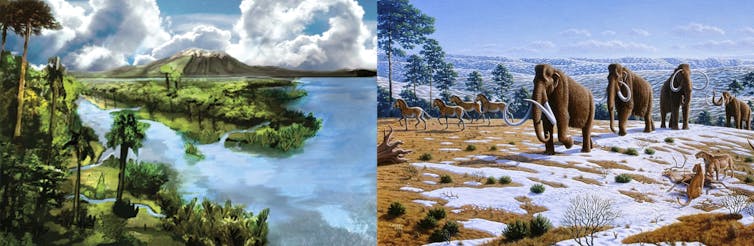
Hothouse and icehouse climates have existed in the geological past. The Cretaceous hothouse (which lasted from roughly 145 million to 66 million years ago) had atmospheric CO₂ levels above 1,000 parts per million, compared with around 420 today, and temperatures up to 10℃ higher than today.
But Earth’s climate began to cool around 50 million years ago during the Cenozoic Era, culminating in an icehouse climate in which temperatures dropped to roughly 7℃ cooler than today.
What kickstarted this dramatic change in global climate?
Our suspicion was that Earth’s tectonic plates were the culprit. To better understand how tectonic plates store, move and emit carbon, we built a computer model of the tectonic “carbon conveyor belt”.
The carbon conveyor belt
Tectonic processes release carbon into the atmosphere at mid-ocean ridges - where two plates are moving away from each other - allowing magma to rise to the surface and create new ocean crust.
At the same time, at ocean trenches - where two plates converge - plates are pulled down and recycled back into the deep Earth. On their way down they carry carbon back into the Earth’s interior, but also release some CO₂ via volcanic activity.
Our model shows that the Cretaceous hothouse climate was caused by very fast-moving tectonic plates, which dramatically increased CO₂ emissions from mid-ocean ridges.
In the transition to the Cenozoic icehouse climate tectonic plate movement slowed down and volcanic CO₂ emissions began to fall. But to our surprise, we discovered a more complex mechanism hidden in the conveyor belt system involving mountain building, continental erosion and burial of the remains of miscroscopic organisms on the seafloor.
The hidden cooling effect of slowing tectonic plates in the Cenozoic
Tectonic plates slow down due to collisions, which in turn leads to mountain building, such as the Himalayas and the Alps formed over the last 50 million years. This should have reduced volcanic CO₂ emissions but instead our carbon conveyor belt model revealed increased emissions.
We tracked their source to carbon-rich deep-sea sediments being pushed downwards to feed volcanoes, increasing CO₂ emissions and cancelling out the effect of slowing plates.
This video shows plate motions, carbon storage within tectonic plates and carbon degassing along mid-ocean ridges and subduction zones through time. Our carbon model shows these processes alone cannot explain global cooling in the Cenozoic Era. The effects of rock erosion, not shown here, played a key role. Arrows indicate plate motion speed.So what exactly was the mechanism responsible for the drop in atmospheric CO₂?
The answer lies in the mountains that were responsible for slowing down the plates in the first place and in carbon storage in the deep sea.
As soon as mountains form, they start being eroded. Rainwater containing CO₂ reacts with a range of mountain rocks, breaking them down. Rivers carry the dissolved minerals into the sea. Marine organisms then use the dissolved products to build their shells, which ultimately become a part of carbon-rich marine sediments.
As new mountain chains formed, more rocks were eroded, speeding up this process. Massive amounts of CO₂ were stored away, and the planet cooled, even though some of these sediments were subducted with their carbon degassing via arc volcanoes.
Rock weathering as a possible carbon dioxide removal technology
The Intergovernmental Panel on Climate Change (IPCC) says large-scale deployment of carbon dioxide removal methods is “unavoidable” if the world is to reach net-zero greenhouse gas emissions.
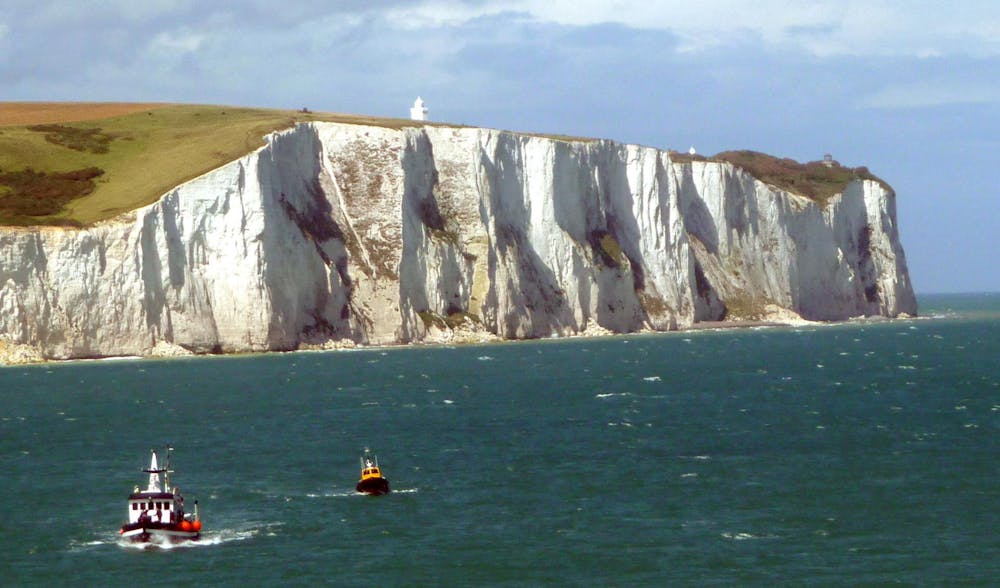
The weathering of igneous rocks, especially rocks like basalt containing a mineral called olivine, is very efficient in reducing atmospheric CO₂. Spreading olivine on beaches could absorb up to a trillion tonnes of CO₂ from the atmosphere, according to some estimates.
The speed of current human-induced warming is such that reducing our carbon emissions very quickly is essential to avoid catastrophic global warming. But geological processes, with some human help, may also have their role in maintaining Earth’s “Goldilocks” climate.
This study was carried out by researchers from the University of Sydney’s EarthByte Group, The University of Western Australia, the University of Leeds and the Swiss Federal Institute of Technology, Zurich using GPlates open access modelling software. This was enabled by Australia’s National Collaborative Research Infrastructure Strategy (NCRIS) via AuScope and The Office of the Chief Scientist and Engineer, NSW Department of Industry.
Authors: Dietmar Müller, Professor of Geophysics, University of Sydney



















