

Albanese will bring a different style of leadership to the PM's office –– can Australia make the adjustment?
- Written by: Paul Strangio, Professor of Politics, Monash University
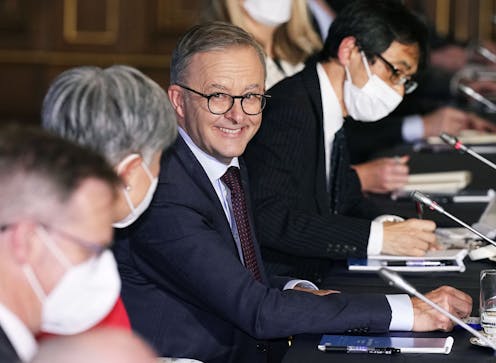
One of the fundamental questions that emerges from the election of Anthony Albanese’s Labor government is whether Australia will put behind it a decade and a half of instability in the prime ministership.
With Scott Morrison’s defeat, the country now boasts the dubious record of having whirled through five prime ministers – Kevin Rudd, Julia Gillard, Tony Abbott, Malcolm Turnbull and Scott Morrison – since the fall of John Howard’s long-term Coalition government in 2007. Morrison was the longest serving of those national leaders, surviving for three years and nine months.
It might be surprising to readers that since the birth of the federation, the average incumbency of prime ministers is only around four-and-a-half years. In other words, high office has always been relatively precarious: the “stayers” such as Robert Menzies, John Howard and Bob Hawke have been the exceptions rather than the rule.
Read more: He's Australia's 31st prime minister. So who is Anthony Albanese?
Even so, the current run of short-term prime ministers is striking. It has been the equivalent of five successive single-term administrations. We have to go back to the early Commonwealth for a more topsy-turvy political time: a period before the settlement of the party system.
There are at least two competing explanations for why prime-ministerial office has become so confounding in recent years. The first and simplest explanation is that it is a product of human fallibility. In short, we have had a sequence of poor-quality leaders.
There is some evidence for this thesis. Rudd was a victim of his narcissism, of the folly that he was always the smartest man in the room, together with his inability to run an orderly government. Gillard, while the most competent administrator of this group of leaders, was hampered by her wooden communication performance.
Abbott, a brutally effective opposition leader, proved incapable of transitioning to the task of governing. He could not contain idiosyncrasies in his character, exemplified by the bizarre act of knighting Prince Philip.
Pusillanimous in standing up to conservative elements of the Coalition, Turnbull never lived up to his promise. Morrison was brought undone by his fetish for marketing rather than constructive action, and a streak of untrustworthiness recognised by the electorate.
Yet the weaknesses of the recent incumbents are alone not sufficient an explanation for the rapid turnover in prime ministers. There are also systemic changes that are rendering governing more problematic.
The election result dramatically illustrated perhaps the most important of those developments: the fact that our major parties no longer command a reliable base as the electorate fractures along complex and multiple lines.
For decades, Labor has struggled to reconcile twin constituencies: its traditional working-class base and middle-class, highly educated progressives who gravitated to the party from the era of Gough Whitlam’s leadership. An element of that latter constituency has hived off to support the Greens, tantamount to a de facto split.
The Liberal Party ruthlessly exploited Labor’s dilemma, wedging it on issues like climate change and asylum seekers, while raiding its opponent’s working-class base by adopting conservative populist positions.
This was a strategy that carried its own risk, which has been vividly exposed by the revolt against the Liberals in their inner-urban electorates. The phenomenon of declining primary vote support has previously principally afflicted Labor: now it has caught up with the Liberal Party.
Read more: Did Australia just make a move to the left?
As the support bases of the major parties splinter and shrink, it renders them vulnerable to confusion about their identity and philosophical uncertainty. Amid this flux, leaders play a greater role in defining parties. In the minds of the public, leaders stand in for the parties and become an important cue for voting behaviour. It is a situation abetted by the media with its preoccupation with personalities.
The heavy emphasis on leadership has been a mixed blessing for leaders. It has the potential to provide them with greater autonomy and authority, yet parties have shown themselves to be merciless once the appeal of a leader wanes or when they push their autonomy beyond tolerable limits.
How will Albanese cope in this changing environment? In some ways he represents the antithesis of the direction in which politics is trending. In a landscape in which traditional party loyalties are breaking down, he is a quintessential old party creature: a life-long member of the ALP and a quarter-century-long Labor representative in the parliament.
On the other hand, Albanese has a demeanour and skill set that seem compatible with building coalitions of support and reaching out beyond partisan barricades.
Arriving late at a view of himself as a leader, he has an unusually unobtrusive persona for a prime minister. He lacks the bombast that characterised his predecessor, instead exuding a disarming modesty. He is more dogged than Olympian. He has signalled he wants to be a collaborative prime minister, a leader who does not assume he has all the answers, a leader who forges consensus from alternative viewpoints.
It is a type of leadership that can demand patience from followers. Especially in times of significant challenge, there is a reflexive hankering for “strong” leaders who paper over complexities and run roughshod over differences. For a bulldozer.
Albanese has come to power at a moment of pent-up reform demand – of impatience for movement on big issues like climate change that languished under the Coalition. Responding to that sense of urgency while being true to collegial leadership will require a delicate balancing act by the new prime minister.
Yet it may not only be a test of Albanese’s abilities but of our openness to a governing style in which inclusion and dialogue trump command and control.
Authors: Paul Strangio, Professor of Politics, Monash University


















