

Changing the Australian Constitution is not easy. But we need to stop thinking it's impossible
- Written by: Anne Twomey, Professor of Constitutional Law, University of Sydney
Supporters of an Indigenous Voice to Parliament have celebrated the commitment of the new Albanese government to put the issue to a referendum. But is government support enough?
It’s a start, but the road to referendum success is a hard one, as it was always meant to be.
The Constitution was meant to be hard to change
When the Constitution was being written in the 1890s, the initial expectation was that it would be enacted by the British and they would control the enactment of any changes to it, just as they did for Canada.
But the drafters of the Commonwealth Constitution bucked the system by insisting they wanted the power to change the Constitution themselves. They chose the then quite radical method of a referendum, which they borrowed from the Swiss.
While it was radical, because it let the people decide, it was also seen as a conservative mechanism. British constitutional theorist A.V. Dicey described the referendum as “the people’s veto”, because it allowed the “weight of the nation’s common sense” and inertia to block “the fanaticism of reformers”.
The drafters of the Commonwealth Constitution were divided on the issue. Some supported the referendum because it would operate to defeat over-hasty, partisan or ill-considered changes. Others were concerned that change was hard enough already, and voters would have a natural tendency to vote “No” in a referendum because there are always objections and risks that can be raised about any proposal. Fear of the new almost always trumps dissatisfaction with the current system, because people do not want to risk making things worse.
In this sense, the referendum is conservative – not in a party-political sense, but because it favours conserving the status quo.
Another concern, raised by Sir Samuel Griffith, was that constitutions are complex, and a large proportion of voters would not be sufficiently acquainted with the Australian Constitution to vote for its change in an informed way. He favoured using a United States-style of constitutional convention to make changes.
The democrats eventually won and the referendum was chosen. But to satisfy their opponents, they added extra hurdles. To succeed, a referendum has to be approved not only by a majority of voters overall, but also by majorities in a majority of states (currently four out of six states).
Read more: An Indigenous 'Voice' must be enshrined in our Constitution. Here's why
A Constitution frozen in time
The predictions were right. The referendum at the federal level has indeed turned out to be the “people’s veto”. Of 44 referendum questions put to the people, only eight have passed. No successful Commonwealth referendum has been held since 1977. We have not held a Commonwealth referendum at all since 1999.
There are many suggested reasons for this. Some argue that the people have correctly exercised their veto against reforms that were proposed for party-political advantage or to unbalance the federal system by expanding Commonwealth power. If reforms are put because they are in the interests of the politicians, rather than the people, they will fail.
Questions asked in referendums have been poorly formulated and often load too many issues into the one proposed reform. If a voter objects to just one aspect of a proposal, they then vote down the entire reform.
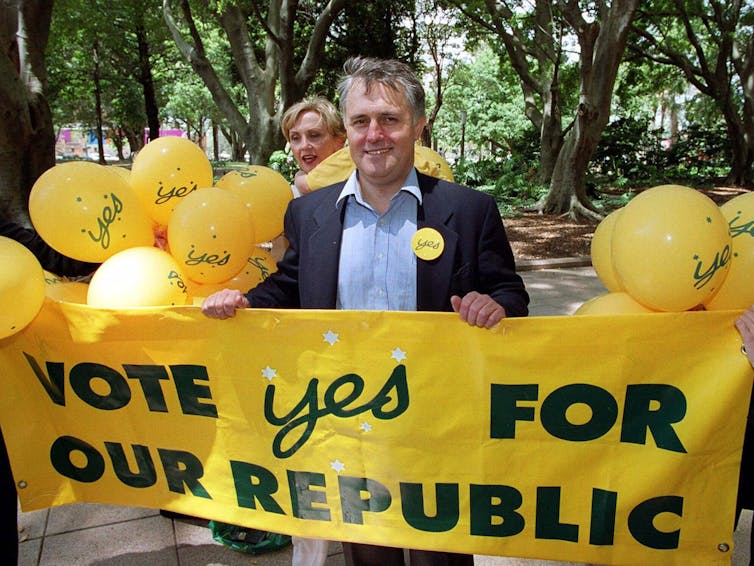
Another argument is that, as Griffith anticipated, the people know little about the Constitution and are not willing to approve changes to it if they are unsure. The mantra “Don’t know – Vote No” was extremely effective during the republic campaign in 1999.
Of course, if you don’t know, you should find out. But the failure to provide proper civics education in schools means most people don’t feel they have an adequate grounding to embark on making that assessment.
Decades of neglect of civics has left us with a population that is insufficiently equipped to fulfil its constitutional role of updating the Constitution.
Vulnerability to scare campaigns
The biggest threat to a successful referendum is the running of a “No” campaign by a major political party, or one or more states, or even a well-funded business or community group.
Scare campaigns are effective even if there is little or no truth behind them. It is enough to plant doubt in the minds of voters to get them to vote “No”. Voters are reluctant to entrench changes in the Constitution if they might have unintended consequences or be interpreted differently in the future, because they know how hard it will be to fix any mistake.
If a referendum campaign ends up focused on technical issues about the future operation or interpretation of particular amendments, then it is likely lost.
Campaigns tend to be more successful if they focus on principles or outcomes, such as the 1967 referendum concerning Aboriginal people. That referendum had the advantage of not being opposed in the Commonwealth parliament. The consequence was that there was only a “Yes” case distributed to voters, as a “No” case can only be produced by MPs who oppose the referendum bill in parliament.
Read more: ‘Right wrongs, write Yes’: what was the 1967 referendum all about?
Overcoming the malaise
While recognising these difficulties, perhaps the greatest risk is becoming hostage to the belief the Constitution cannot be changed and referendums will always fail. It will become a self-fulfilling prophecy.
Instead, we need to face constitutional reform as being difficult but achievable and worthwhile. The Constitution should always serve the needs of today’s Australians, rather than the people of the 1890s.
The key elements for success include a widespread will for change, the drive and persistence of proponents, good leadership, sound well-considered proposals and building a broad cross-party consensus. Not every element is necessary, but all are helpful.
As incoming Indigenous Affairs Minister Linda Burney recently noted, there is still a lot of work to be done in building that consensus in relation to Indigenous constitutional recognition, but the work has commenced.
Authors: Anne Twomey, Professor of Constitutional Law, University of Sydney


















