

Modern Australian
The Times

the enterprise bargaining system is broken, and in terminal decline

  • Written by Anthony Forsyth, Distinguished Professor of Workplace Law, RMIT University
the enterprise bargaining system is broken, and in terminal decline

Real wages in Australia have been stagnating for the better part of a decade. Now, with higher inflation, they’re declining. So what can the new Albanese government, having campaigned hard on the previous government’s failures, do about it?

Making a submission to Australia’s industrial relations umpire, the Fair Work Commission, to lift the minimum hourly wage from A$20.33 to A$21.36, is one thing. If that push is successful, it would help the 2% of workers paid the minimum wage, as well as the 23% (about 2.2 million workers) on awards, whose rates would also lift.

Read more: Lifting the minimum wage is anything but reckless – it's what low earners need

But there’s a bigger systemic problem the Albanese government needs to address – a flaw designed and implemented by a previous Labor government. Enterprise bargaining, the mechanism introduced 30 years ago for workers to collectively negotiate better wages and conditions, is broken.

It’s failing low-paid workers lacking bargaining power in particular, and is a big part of the reason for such poor wages in female-dominated professions such as aged care and child care.

Origin of enterprise bargaining agreements

Enterprise bargaining was introduced during the Hawke-Keating Labor era in the early 1990s, in partnership with the Australian Council of Trade Unions and the support of employer groups.

The Business Council of Australia had lobbied strongly for an enterprise focus for negotiating employment conditions, on the basis it`was the best way to tie wage claims to gains in productivity.

Prime Minister Paul Keating extols enterprise bargaining in parliament on June 24 1992.

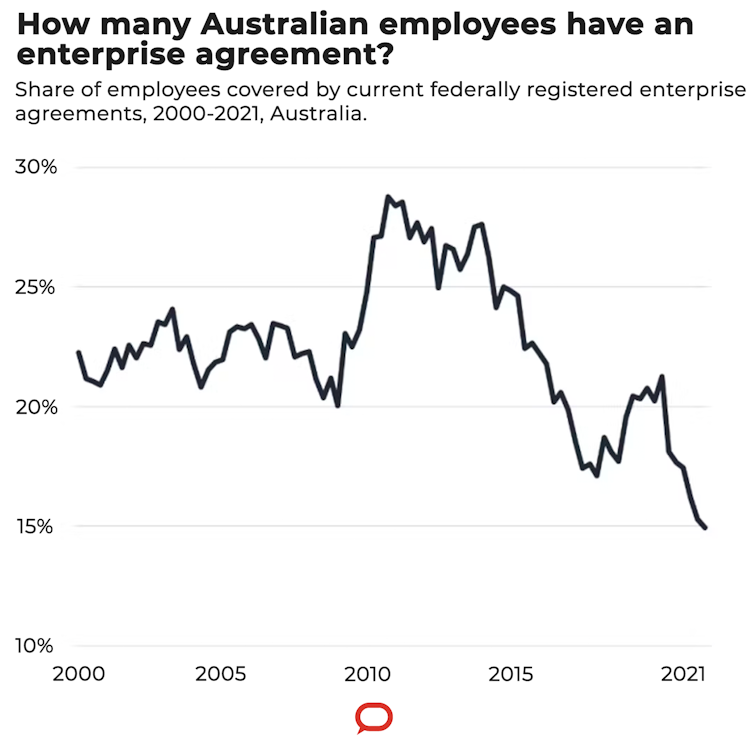
After 30 years, though, enterprise bargaining is in terminal decline, with ten years of shrinking agreement coverage in line with stagnant wages growth.

Research by labour law and policy experts Andrew Stewart, Jim Stanford and Tess Hardy published in May shows the total number of enterprise agreements fell by more than half between 2013 and 2021 (from 23,500 agreements to 10,000).

Worse, the share of employees covered by a current enterprise agreement declined from an average of 27% in 2012 to just 15% by late 2021. This is shown in the following graph.

Australia Institute, The Wages Crisis Revisited, CC BY-ND The Australian Industry Group and other business representatives blame this on the Fair Work Commission’s strict approach to the “better off overall test” and other statutory protections of employees’ interests in agreement-making. Unions see it differently. In their view, the reason enterprise bargaining is in free-fall is because of design flaws in the current laws, meaning workers have very limited negotiating power and employers can “game” the system to avoid their obligation to bargain. The main problem: enterprise bargaining was designed for an economy that no longer exists. Read more: Cabinet papers 1992-93: the rise and fall of enterprise bargaining agreements Workplaces have changed Allowing employees and unions to only bargain and take industrial action for an agreement with a single business, or part of a business, works fine with large worksites, such as factories, with hundreds or thousands of workers with the same employer. But these types of workplaces are increasingly rare. Now, many employers in sectors such as food production, logistics, warehousing, building management and “big box” retail stores have hived off large parts of their operations, and workers, to other entities. They’ve used labour hire, independent contracting and outsourcing to distance themselves from responsibility for minimum employment standards – and collective bargaining. To lift wages, workers need the boost to bargaining power that comes from being able to negotiate – and strike – across entire industries. Labour hire workers must be able to bargain not just with the agency that technically employs them, but with the business for whom they are working – such as Amazon, which has relied heavily on outsourced labour in its Australian operations. Workers who clean and provide security services in commercial buildings need to have the capacity to pursue pay increases from the lead firms that ultimately control labour’s share of profits. What Labor has promised to do Federal Labor’s 2021 national policy platform contains a commitment to “improve access to collective bargaining, including where appropriate through multi-employer collective bargaining”. It notes this access is a particular issue for low-paid employees lacking industrial power, and that the Fair Work Act does not adequately facilitate it. These points, however, were not mentioned in the run-up to the election. Nor did the Australian Council of Trade Unions make an issue of it, in contrast to its “Change the Rules” campaign between 2017 and 2019. ACTU general secretary Sally McManus addresses a 'Change the Rules' rally in Brisbane, November 20 2018.
ACTU general secretary Sally McManus addresses a ‘Change the Rules’ rally in Brisbane, November 20 2018. Glenn Hunt/AAP

Instead, Labor pledged to address other problems in the enterprise bargaining system: the weak requirements for employers to negotiate in “good faith”, and the ease with which employers can have agreements terminated.

However, the Albanese government may well be pushed to “go bolder” – not just by unions but also the Australian Greens, whose 2022 election policy states:

Workers should be free to collectively bargain at whatever level they consider appropriate and with whoever has real control over their work, whether at a workplace, industry, sector or other level.

The Greens’ platform also states:

Workers should have the right to engage in industrial action, including the right to strike, consistent with international law and not limited to artificially restricted bargaining periods.

The government may not need Greens’ support to pass legislation in the House of Representatives, but it will need it in the Senate.

So expect the future of enterprise bargaining, along with properly tackling insecure work, to be a hot topic for the government’s planned jobs summit.

With employers already talking up the need for productivity gains to underpin any changes, we’ll have to wait and see how serious the new government is about fixing a broken bargaining system.

Authors: Anthony Forsyth, Distinguished Professor of Workplace Law, RMIT University

Read more https://theconversation.com/theres-one-big-reason-wages-are-stagnating-the-enterprise-bargaining-system-is-broken-and-in-terminal-decline-183818

7 Signs It's Time to Upgrade Your Piston Air Compressor

If you run a workshop, panel shop, or fabrication business anywhere around Perth, you already know what heat and dust do to equipment over a few sum...

How Long Do Bathroom Renovations Melbourne Take? Step-by-Step Process Explained

Planning a bathroom renovation is exciting, but one of the biggest questions homeowners ask is, "How long will it take?" While every project is uniq...

Why Your Skin Breaks Out: The Science of Acne Explained

Acne is the most common skin condition in the world. An estimated 85% of people experience it at some point between the ages of 12 and 24, and a gro...

10 Swimwear Trends Australian Women Are Wearing This Summer

Every Australian summer brings a fresh wave of swimwear trends, but some styles have much greater staying power than others. While fashion constantly ...

Why Regular Skills Updates Are Essential for Licensed Security Officers

A guard at a Brisbane shopping centre gets a call about a shoplifter who's turned aggressive.  They’ve done the job for six years. But their de-...

10 Benefits of Choosing Professional Tutoring Penrith Services

Every student has unique learning strengths, challenges, and academic goals. While classroom teaching provides essential knowledge and structure, so...

Sunshine Coast Baby Classes Prove Big Hit Among First-Time Mums

There's a movement gaining traction on the Sunshine Coast, providing a village of support, socialisation and relief for first-time mothers and babie...

Father's Day Gift Ideas for Men Who Are Hard to Buy For

Some dads are easy to buy for. Others do not want anything, already have everything, or give you the classic "don't worry about me" answer every yea...

Top 5 Mistakes That Wear Out Your Brakes Faster

Brakes don't need frequent replacements like oil changes do.   But a lot of the wear happens quietly, over months, because of habits most drivers...

Plantation Shutters vs Curtains: Which Is Better for Your New Home?

Moving into a new home is an exciting opportunity to personalise your space and make it your own. While many homeowners focus on furniture, flooring...

Celebration of Life vs Traditional Funeral: What's the Difference?

When saying goodbye to someone you love, there is no single way to honour their life. Every family has different traditions, beliefs, and preference...

Building Approval for Roofing Projects: What Homeowners Need to Know

Roofing projects are an important part of maintaining and protecting your home. Whether you're repairing storm damage, replacing an ageing roof, or ...

Chatswood Tutoring And Its Role In Academic Achievement

Academic success often requires more than classroom attendance alone. Students face increasing expectations as they progress through school, particu...

Why Laser Hair Removal Treatments Continue Growing In Popularity

Managing unwanted hair can become time-consuming and frustrating for many people, especially when shaving, waxing, and other temporary methods requi...

Choosing the Right Devices for a Flexible Workplace

For IT leaders managing large fleets, the device layer is where workforce productivity and security policy meet. The shift towards flexible and hybrid...

How Business Advisory Services Help Companies Achieve Sustainable Growth

Every business owner aims to build a profitable and sustainable organisation. While dedication, innovation, and hard work are important, achieving l...

Why Body Contouring Has Become A Popular Cosmetic Treatment

Many people maintain healthy lifestyles through regular exercise and balanced eating habits but still struggle with stubborn areas of fat that are d...

How to Choose the Right POS Hardware for Your Business in Australia

A lot of Australian business owners spend weeks researching POS software but buy hardware almost as an afterthought. That's a mistake. The wrong har...
















