

'I said no' – Nie's refusal and the troubling question of Pacific slavery in Australia
- Written by: Penny Edmonds, Matthew Flinders Professor, Flinders University
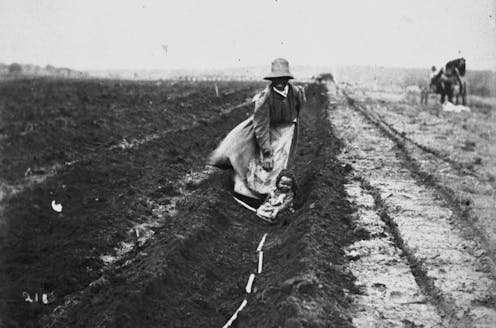
In 1881 Nie (also known as Nai), a Pacific Islander woman, walked off “Virginia” plantation, south of Maryborough, in the colony of Queensland.
Crossing through cane fields, she fled in the thick tropical heat to nearby “Gootchie” plantation to take up work as a domestic servant.
Walking off the plantation was a courageous act. Yet within two weeks, Nie was violently retrieved by her former employer, British planter Theodore Wood.
Wood believed Nie had broken a verbal contract with him. He arrived at Gootchie with another man, Harry, where they found Nie working in the kitchen of the main house alongside Irish servant Annie O’Leary.
When Nie refused to go with the men, they took hold of her by force. As Annie looked on in dismay, the men dragged Nie across the floor, tied her hands up, put her into a cart and returned with her to Virginia plantation.
Nie was a ni-Vanuatuan woman. Her age is unknown and so far no images of her can be found. Wood and his wife had hired Nie as a domestic servant and nursemaid for their daughter in Fiji. When the family moved to Queesland, Nie was “imported” with them to continue this domestic work without any documentation.
It is not clear how Nie had journeyed from Vanuatu to Fiji. She may have travelled voluntarily or been blackbirded (trafficked) in the Pacific labour trade.
After Nie was abducted by Wood and Harry at Gootchie, The Polynesian Inspector (or Government Protector), Mr H. M. Hall, was alerted to the incident. The matter soon went to court, where Wood was charged with assault.
The legal case drew intense public interest. The Bundaberg Star reported on the incident with the sensational headline “A Female Slave in Queensland”. Nie had not been paid by Wood and was clearly not free to leave Virginia.
The Star invoked both Nie’s “rights” and the much broader and sensitive political context around matters of bonded labour, and the spectre of slavery in Queensland at this time.
 ‘Garden, Hambledon’, near Cairns, Queensland, 1880s. A Pacific island woman nursemaid with European children in the garden, Hambledon sugar plantation.
John Oxley Library, State Library of Queensland.
‘Garden, Hambledon’, near Cairns, Queensland, 1880s. A Pacific island woman nursemaid with European children in the garden, Hambledon sugar plantation.
John Oxley Library, State Library of Queensland.
Read more: Friday essay: beyond 'statue shaming' — grappling with Australia's legacies of slavery
Hidden histories
Why did Nie walk off the plantation? Was this really a case of slavery? And, who was her “master” Theodore Wood? Rare moments in the archives like these open vistas on to the hidden histories of Pacific Islander women in Queensland’s many plantations and homes in the late 19th century.
As I’ve discovered, such cases also prompt new questions around the conditions of consent for workers, women’s lives and their legal personhood, on a highly mobile and fluid trans-Pacific labour frontier. All of this occurred in the shadow of the “new” Pacific slavery, as it was then termed, after planters from Europe and North America moved their capital to Queensland after the American Civil war. Their demands for cheap workers led to the indenture and blackbirding of thousands of Islanders.
These histories also give us pause to think on how the past may shape the present. Today Pacific Islander seasonal workers in Queensland are decrying their conditions, with men and women severely underpaid and housed in squalid and crowded conditions. Over 1000 Pacific Islander workers fled their jobs in 2020-21, from a system which subjected people to abuse and “inhumane conditions”.
Australia’s seasonal worker schemes are being likened to modern slavery, and some say that “blackbirding” has not finished in this country.
In February this year, a federal parliamentary inquiry was held into the treatment of Pacific seasonal workers, where they gave testimony. Nationals senator Matt Canavan likened the then government’s controversial Pacific Island seasonal worker program to “indentured labour and a cartel”, calling the scheme “tantamount to slavery”.
 Even Matt Canavan called the previous government’s seasonal worker scheme ‘tantamount to slavery’.
Lukas Coch/AAP
Even Matt Canavan called the previous government’s seasonal worker scheme ‘tantamount to slavery’.
Lukas Coch/AAP
Nie’s testimony: ‘I held onto leg of table’
Remarkably, in 1881 Nie testified about her assault and abduction by her “master” Wood in the Court of Petty Sessions in the small Queensland town of Tiaro.
Clearly Nie spoke and understood some English and was deemed to have enough religious knowledge that she was able to take an oath, and to speak for herself in the court – something an Aboriginal person at that time was not permitted to do.
Nie’s testimony is therefore extraordinary. We can hear her voice, albeit mediated by the Maryborough Chronicle in December 1881. In court, “Nai, being duly sworn” said:
[I] Am Polynesian from Star Peak; [I] know defendant; saw him first in Fiji; he was my master and brought me here; had agreement has been finished three months; remember leaving Mr Wood at Virginia and going to Gootchie, he [Mr Wood] said, ‘I tell you straight you come along with me’; I said, ‘No’; Mr Wood and Harry (a white man) fastened my hands behind me; pulled me along the floor, and put me in a cart; I sang [out]; I held on to leg of table before my hands were fastened, because I did not want to go, was taken in a cart to Virginia.
When Nie was cross-examined, she replied:
When he [Wood] came to Gootchie, told me several times if I did not go he would take me; [I] did not walk to the [cart]; you carried me; after my agreement was finished, I did not promise to stop until after Mrs Wood returned from England.
Clearly Nie was adamant about leaving Virginia; she said “no” to the prospect of returning to the plantation. She physically fought to stay at Gootchie and did not walk with her own volition to the cart. Importantly, Nie asserted that she did not make any “promise” – that is, she did not make a verbal agreement or contract to stay on. Nor did she consent.
The original Tiaro court records were burned in a fire and no longer exist, but such court reports in the newspapers offer valuable archival traces on women’s lives and the long shadow of Pacific slavery.
Slavery’s legacies and women-centred stories
After the passing of legislation to free the enslaved in British settlements in 1833, British slave owners (but not the enslaved) in the Caribbean, Cape Colony (South Africa), and Mauritius were awarded the equivalent of £17 billion in compensation ($A31 billion). This capital from slave compensation was funnelled into the Australian colonies via these new settlers, who established themselves on Aboriginal lands.
Plantations, slavery and entitlement to be served ran in the blood of Nie’s employer, Theodore Wood. Born in Sri Lanka, his grandfather had been a plantation owner in Grenada, growing coffee and sugar using many slaves. The Wood family was directly related to the Selbourne and Palmer families, British aristocracy who were deeply involved with empire, the East India company, and with slavery in the Caribbean.
We know from the Legacies of British Slavery project’s “Slave Compensation Database” that Theodore’s mother, Eleanor Wood (nee Palmer), received an inheritance based on compensation from the British government, as did her brothers, after the abolition of slavery for the loss of the family’s Grenada plantations.
The Queensland plantation named “Virginia” is unsettlingly reminiscent of north American plantation culture. As a plantation owner and young Oxford-trained lawyer, Wood was likely well acquainted with the laws governing the procurement and transport of Pacific Island labourers to Queensland, and accustomed to the privilege and power that came with his station in life.
My aim is to place Nie’s experience – and those who were unfree, coerced or in slave-like conditions – at the centre of stories about legacies of slavery in Australia. Unearthing the hidden histories of Pacific Islander women is also important.
Some 4000 Pacific Islander women were brought to Queensland as domestic and field workers, but their voices in the archives are precious and fleeting.
 Pacific island women working on the sugar cane plantation at Hambledon plantation. Queensland, c 1891.
John Oxley Library, State Library of Queensland.
Pacific island women working on the sugar cane plantation at Hambledon plantation. Queensland, c 1891.
John Oxley Library, State Library of Queensland.
It is estimated that between 62,000 and 65,000 Pacific Islander workers were brought to Queensland to labour in cane, cotton and other plantations, and as domestic servants and farm hands, between around 1860 and 1900.
These workers, both men and women, came from the nearby Melanesian Islands including Vanuatu, the Solomons, New Caledonia and Papua New Guinea. They were a cheap labour force whose hard work provided the economic backbone for the development of Queensland. In Vanuatu some refer to the thousands of blackbirded people as “Vanuatu’s stolen generation”.
Pacific Islander women, seemingly invisible and yet in plain view, had either migrated voluntarily or were moved by force between various Pacific islands and colonies, and between plantations in Queensland and northern New South Wales.
The bonded and unfree domestic and plantation labour of Pacific Islander and Aboriginal women was used extensively in these colonies. As historian Tracey Banivanua Mar has observed,
only a handful of historians have focused on […] the histories of this labour trade and fewer still have considered the experiences and treatment of [Pacific] women or explored the gendered nature of their work. Theirs is a story that can be painstaking to access in the archives, for if Islanders were a subaltern group written out of colonial memory, Islander women were doubly so.
Between Fiji and Queensland
How did Nie arrive in Queensland? Two years before the court case, Wood and his wife lived in Fiji where he was assessing the Fijian plantation industry. The couple hired Nie there.
Although some newspapers presumed that Nie was Fijian, she stated in court that she was from “Star Peak”, or Star Island. This is the small volcanic island called Mere Lava near the northern province of Vanuatu (or the New Hebrides as Europeans referred to it then).
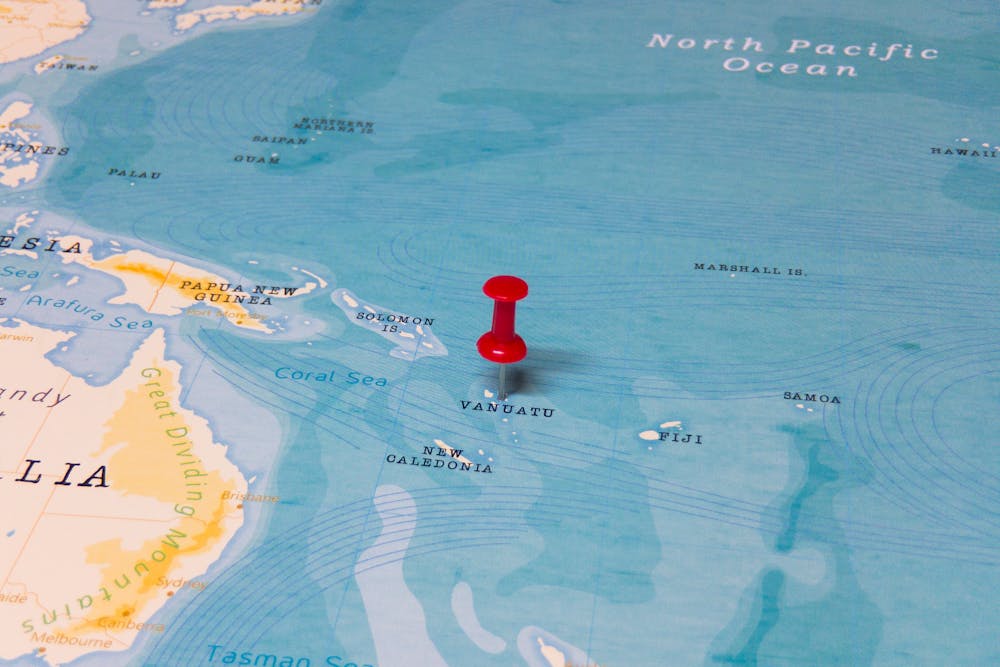 Nie came from a small island near the northern province of Vanuatu.
Shutterstock
Nie came from a small island near the northern province of Vanuatu.
Shutterstock
It seems that she had already travelled far, leaving her home at Mere Lava, and then perhaps travelling on to the main port of Vanua Lava, Vanuatu, which was the terminal point of the Burns, Philp & Co. steamer line.
Arriving in Queensland without documentation, and imported by Wood, Nie slipped through the cracks of legislation between the British sugar colonies of Fiji and Queensland. Nie was doubly, and perhaps triply, displaced.
When Mrs Wood and her daughter chose to travel back to England, Nie was apparently left to take their place, remaining with Mr Wood without payment.
This status of unpaid domestic and housekeeper, and ersatz wife with its perhaps tacit intimation of other forms of wifely service, was clearly not acceptable to Nie, and, asserting her autonomy, she left the employ of Wood.
Acts of defiance and refusal
I interpret Nie’s determined departure from Virginia plantation as a potent and sovereign act of refusal. Islander workers were faced with brutal labour conditions, which they were rarely able to fully negotiate, and this led to various forms of resistance.
As historian Kay Saunders has observed, in strategic acts of defiance these “troublesome servants” resisted violent overseers by refusing to work, damaging the masters’ property and the plantation itself. Nie must have been in fear or deeply unhappy to seek to leave Virginia plantation. At this time in Queensland, such flight would only expose a Pacific woman to further risk.
When Nie declared “I said, ‘No’”, she spoke out in a court that was a highly unfamiliar space, a legal space that while offering her the opportunity to testify could at the same time reproduce the dynamics of colonisation. Voices such as hers are a crucial part of our postcolonial and cultural history that should not be ignored.
In the court of public opinion, the editor of the Bundaberg Star judged that Nie was a “female slave”. It is clear that she was trapped in slave-like conditions, unpaid and without a formal contract. To what extent did Nie consent or accept to be imported, if at all, and did she form and then break a verbal labour contract with Wood to remain in his employ?
The Nie case, where a perpetrator was put on trial and a Pacific Islander woman could speak in her own right under oath in a colonial court may appear, at first glance, to be a triumph of the law over the persistence of slavery and the violation of human liberty as suggested by the news headlines.
Yet the conditions in which consent could be freely given by a female Pacific Islander labourer in Queensland at this time were far from simple.
The limits of consent
Significantly, whether Wood’s attempt to reclaim Nie was assault and whether she had consented to go back to Gootchie were not the only questions before the Tiaro Court of Petty Sessions.
The case presented a problem of great legal ambiguity for the court. Was Nie subject to Fijian or Queensland laws? To add to this legal conundrum, Nie existed “unattached”, since by this time Queensland law only allowed women to be imported and indentured if their husbands accompanied them.
For the editor of the Queenslander, “Finally the case was narrowed down to this point: When the first agreement (made in Fiji) ended, was the woman [Nie] a free agent to make an agreement with anyone?” The answer seems to be no.
Ultimately, the court fined Wood the sum of £1 16s 4d for assault, but not abduction. The question of slavery was not raised. The court also made a finding “by mutual consent” – yet this consent had little to do with Nie or her bold testimony. Nie was transferred to another plantation to serve up to three years in the colony, in addition to the two or more years she had already served in Fiji.
This “mutual consent” then was not between Nie and Wood, nor between Nie and Inspector Hall, but between Wood as employer and Inspector Hall as the government representative.
Legally Nie was not a “free agent”, and under the protective measures of Queensland’s new Pacific Labourers Act 1880 her status was akin to a ward of the state. As a mobile labourer, and a colonised ni-Vanuatuan woman, her ability to consent and make her own future agreements was severely limited.
The trail goes cold
What became of Nie? Did she leave her family or children behind at Star Peak, or in Fiji? Did she ever return home? It is likely that she lived out her life on one of Queensland’s large plantations. The trail goes cold, and I have not yet found her in the archives.
Displaced, she was apparently alone in Queensland, although she may have connected with others from Star Peak and Vanuatu, forming new bonds and family.
Nevertheless, Nie’s determined action to walk off the plantation, to say “no” and to testify in court, stands as a sovereign act of refusal in a settler state dependent on the exploitation of Pacific labour.
This is part of a series of articles The Conversation is publishing exploring legacies of slavery in Australia.
Authors: Penny Edmonds, Matthew Flinders Professor, Flinders University


















