

What does China want in the Pacific? Diplomatic allies and strategic footholds
- Written by: Denghua Zhang, Research fellow, Australian National University
By the time Chinese Foreign Minister Wang Yi’s ten-day tour of the Pacific is over in early June, he will have met with leaders from all ten Pacific island countries that have diplomatic relations with China.
This tour is the second of its kind since 2006 (his predecessor Li Zhaoxing visited the region that year). It follows a meeting of Pacific foreign ministers with China last year.
But what does China want from the region and why is it showing such strong interest in the Pacific?
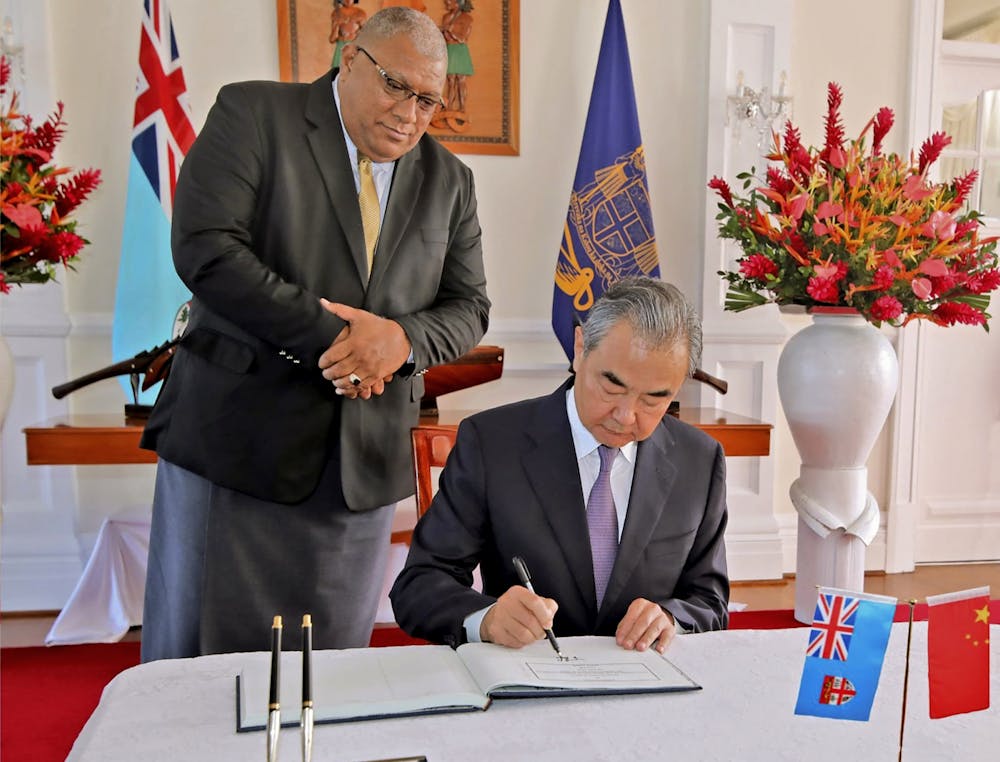
China wants two main things
China seeks two main things from the region – one diplomatic and one strategic.
Diplomatically, it needs the voting support of Pacific islands at the United Nations. These countries, most of which are small, have an equal vote at the UN.
Their support – on issues such as Taiwan, Tibet, Xinjiang, Hong Kong, South and East China Seas, and human rights – matters to China.
For example, during Wang’s visit, Pacific leaders pledged to stick to the “One China” policy. This means they will recognise the People’s Republic of China over the Republic of China (Taiwan).
However, the China-Taiwan diplomatic battle is far from over. In the Pacific, Palau, Marshall Islands, Tuvalu and Nauru still recognise Taiwan.
Strategically, China sees Pacific islands as a target of what’s known as “South-South co-operation” – partnerships between developing countries.
China’s mistrust of developed countries is deep rooted and has persisted since the founding of the communist regime in 1949. To reduce the strategic pressure from developed countries, China strives to forge close ties with the developing world.
In this sense, Wang’s Pacific visit is largely prompted by recent heightened competition between China and the US-led traditional powers.
The Quad countries (Australia, India, Japan, and the United States) recently released a joint leaders statement promising to increase their support to countries in the Indo-Pacific region.
It is hardly a coincidence that on the same day, China’s ministry of foreign affairs revealed the itinerary for Wang’s Pacific visit. Details of concrete achievements arising from the provinces of Chinese Guangdong, Fujian and Shandong’s engagement with Pacific islands were released the following day.
China is signalling it will not recede in its competition with traditional powers. It also wants to send a message that a closer relationship with China will benefit Pacific islands.
Security significance for China
In the long run, the Pacific islands have great security significance for China.
China’s People’s Liberation Army, especially the navy, has aimed to break the “island chains” (in particular, there are a series of military bases on islands near China and in the Pacific, which Beijing believes the US and its allies are using to encircle China).
The Pacific islands sit along one of these island chains. Little wonder, then, the Chinese military is keen to gain a foothold in the Pacific in the long run – this would be crucial if competition between China and the US deteriorates into rivalry and even military conflict.
This is why traditional powers are alarmed by the China-Solomon Islands security pact – despite clarification from Beijing and Honiara China will not establish a military base in Solomon Islands.
To achieve these objectives, China has worked hard to foster a closer relationship with Pacific islands. In particular, it has highlighted its respect of Pacific islands as equal partners, economic opportunities for Pacific commodities to enter the massive Chinese market, and the benefits of Chinese aid for the region.
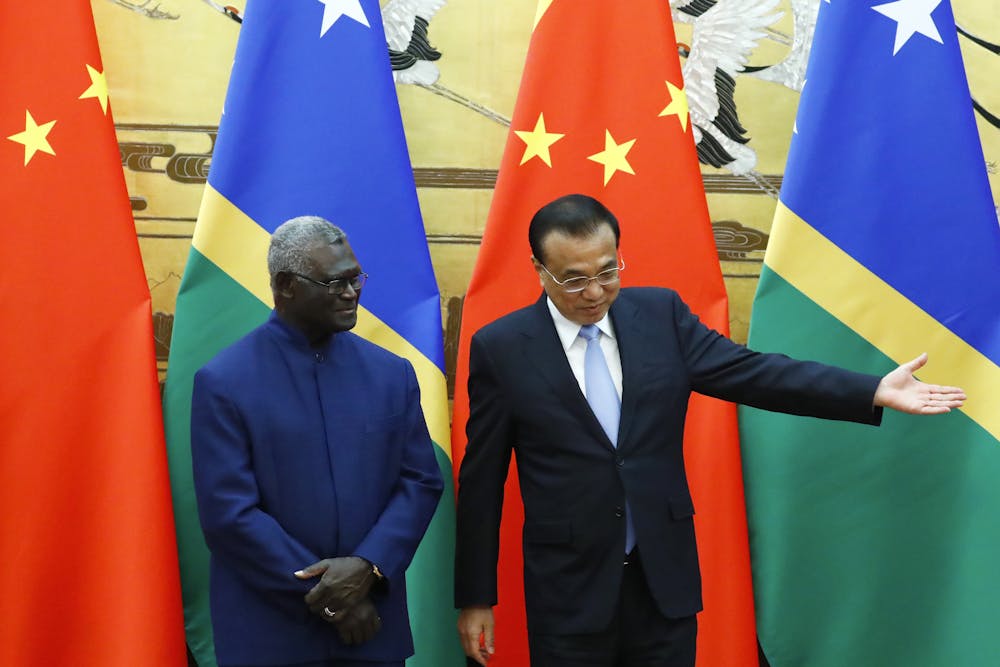 Chinese Premier Li Keqiang shows the way to Solomon Islands Prime Minister Manasseh Sogavare, left, as they attend a signing ceremony in 2019.
Thomas Peter/Pool Photo via AP, File
Chinese Premier Li Keqiang shows the way to Solomon Islands Prime Minister Manasseh Sogavare, left, as they attend a signing ceremony in 2019.
Thomas Peter/Pool Photo via AP, File
Proposed agreements
In this context, China proposed two broad agreements to be signed by all its Pacific partner countries during Wang’s visit.
However, this plan was shelved due to the lack of consensus among Pacific leaders on the nature of these agreements and potential negative implications for regional security.
For example, prior to Wang’s visit, President of the Federated States of Micronesia David Panuelo wrote to leaders of all Pacific island countries and territories warning that signing these agreements may drag Pacific islands into conflicts between China and the US in future.
This may have taken China by surprise; President Panuelo paid a successful state visit to China in 2019 and lauded his country’s relationship with China as “great friendship taken to a new high”.
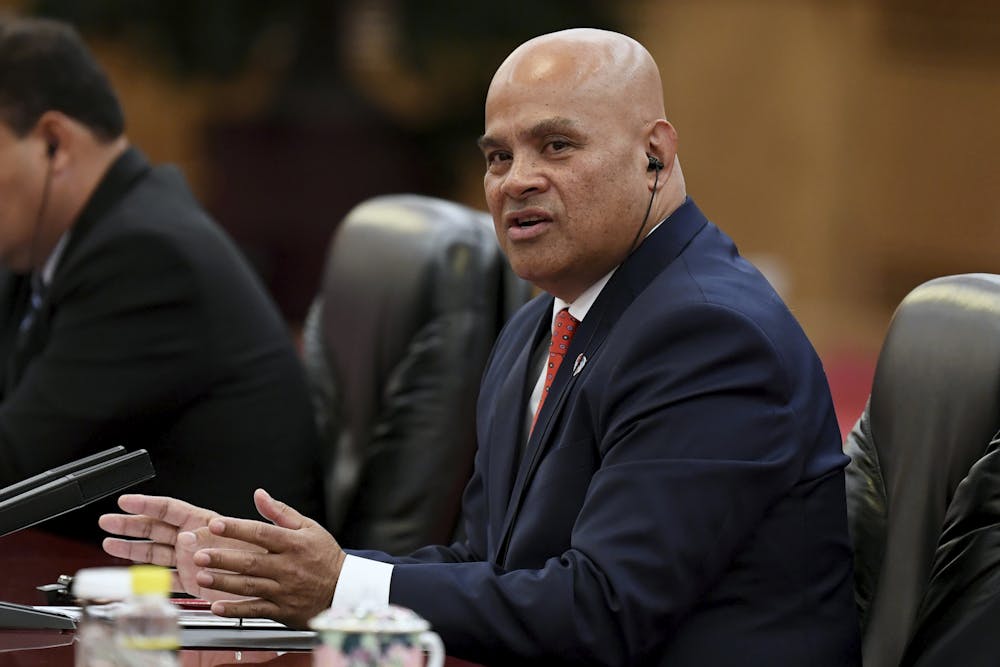 Micronesia’s President David Panuelo sits at a table during a meeting with Chinese President Xi Jinping in 2019.
Noel Celis/Pool Photo via AP
Micronesia’s President David Panuelo sits at a table during a meeting with Chinese President Xi Jinping in 2019.
Noel Celis/Pool Photo via AP
This was a clear setback for China. As a suboptimal solution, China’s ministry of foreign affairs turned the two agreements into a position paper and published it on May 30.
A main difference is that in the position paper, China only briefly states its readiness to co-operate with Pacific islands to promote regional security, combat transnational crimes and tackle non-traditional security threats.
By contrast, the original two agreements had more details on security co-operation such as providing police training for the region and strengthening co-operation on cyber security.
Apparently, China has learnt to downplay its planned co-operation with Pacific islands on security, an increasingly sensitive area amid the competition.
Looking into the near future, it is likely China will be more cautious in expanding its engagement with the Pacific region.
It will likely focus on pragmatic co-operation in less sensitive areas like climate change, poverty reduction, agriculture and disaster relief.
China will lobby for more support from Pacific islands before it is willing to reintroduce the broad agreements.
Authors: Denghua Zhang, Research fellow, Australian National University


















