

Expect the RBA to go easy on interest rate hikes from now on – we can't afford rates to climb as steeply as the market expects
- Written by: Peter Martin, Visiting Fellow, Crawford School of Public Policy, Australian National University
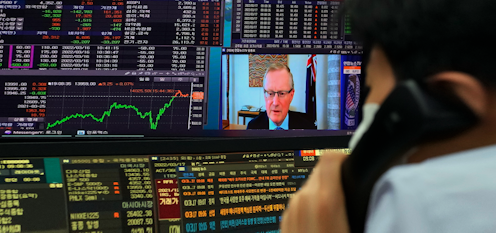
By lifting its cash rate by 0.5 points, from 0.35% to 0.85%, the Reserve Bank has added about another $120 per month in payments for a A$500,000 mortgage.
If financial markets are to be believed, by the end of this year it will have added a total of $800 per month – and, by the end of next year, a total approaching $1,000 per month.
Those figures are for variable mortgages, but homeowners on fixed rates won’t escape them long. Those rates are typically fixed for up to three years.
Many of the fixed-rate mortgages were taken out during COVID at annual rates as low as 2%. When those fixed rates end (and many will end in the next year or so) those homeowners will find themselves paying 5% or 6% per year, shelling out as much as $3,000 per month instead of $2,000.
Unless financial markets are wrong. The good news is, I think they are.
The pricing of deals on the futures market factors in an increase in the Reserve Bank’s cash rate from 0.10% to 3.5% by June next year, enough to push up the standard variable mortgage rate from around 2.25% to 5.65%.
We couldn’t afford the rates the market expects
One reason for suspecting it won’t happen is that many homeowners simply couldn’t afford the extra $1,000 per month. Most of us don’t have that much cash lying around.
US President Richard Nixon had an economic adviser by the name of Herbert Stein with an uncommonly-developed sense of common sense. In his later years he wrote an advice column for Slate magazine.
To a reader wanting a cure for unrequited love, he wrote that the best solution was “requited love”. To a reader concerned about her inability to make small talk, he wrote that what people want most is a “good listener”.
In economics, Stein is best known for Stein’s Law, which says: “if something cannot go on forever, it will stop”.
Read more: The housing game has changed – interest rate hikes hurt more than before
Mortgage rates can’t keep climbing to the point where homeowners pay an extra $1,000 per month.
For new homeowners, it’s worse. The typical new mortgage taken out to buy a home in NSW has climbed to $700,000. In Victoria, it has climbed to $585,000. These people will be paying a good deal more than an extra $1,000 per month if the bets on repeated rate hikes made on the futures market come to pass.
The Reserve Bank says it lifted its cash rate from 0.35% to 0.85% today to withdraw the “extraordinary monetary support” put in place during the pandemic.
But the bank says from here on it will be guided by data, and, in a nod to homeowners concerned about continual rate hikes, said it expected inflation to climb just a bit more before declining back towards its target next year.
The bank will be guided by data
Financial markets don’t see it that way. They have priced in (in other words, bet money on) rate hikes in July, August, September, October, November, December, February, March, April and May.
But there are reasons to believe the bank is right about inflation.
It doesn’t seem that way with electricity prices set to climb 8-18% in NSW, 11% in Queensland, 5% in Victoria, and as much as 20% in South Australia. (The only jurisdiction without an increase in prospect is the Australian Capital Territory, which has 100% renewables and fixed long-term contracts.)
Read more: 4 reasons our gas and electricity prices are suddenly sky-high
Fortunately for overall inflation, electricity accounts for less than 3% of the typical household budget. Gas accounts for less than 1%. Even low earners spend little more than 4% of their income on electricity.
While the price of vegetables is soaring (heads of lettuce are selling for $10), we spend less than 1.5% of our income on vegetables.
The best measure of overall price increases remains the official one of 5.1% for the year to March, calculated by the Bureau of Statistics.
It is a more alarming increase in inflation than Australians are used to. But what matters for the Reserve Bank is whether the 5.1% is set to turn down and head back towards the target of 2-3%, or climb further away from it.
Australia is almost uniquely disadvantaged among developed nations in getting a handle on what’s happening to inflation, being one of only two OECD members (the other is New Zealand) to compile its consumer price index quarterly, instead of monthly.
By the time Australia’s index is published, several of the measures in it are months old, and they don’t get updated for another three months.
It has been said to make the bank’s job like driving a car looking through the rear-view mirror.
Using our rear-view mirror, with caution
Fortunately the Bureau of Statistics is gearing up to produce a monthly index. Meanwhile, in the United States – which is subject to the same international price pressures as Australia – most measures of inflation eased in April.
Wages growth, which the Reserve Bank said last month seemed to be “picking up”, remained dismal in the figures released a few weeks later – at just 2.4% in the year to March. That was well short of the 2.7% forecast in the budget for the year to June, and not enough to do anything to further fuel inflation.
Read more: Memo RBA: we ought to live with inflation, more of it
Australia has a history of aggressive interest rate hikes to tame inflation.
In 1994, Reserve Bank Governor Bernie Fraser rammed up the cash rate from 4.75% to 7.5% in a matter of months. But that was when wage growth was well above inflation and the bank was trying to dampen “demands for wage increases” to prevent a wage-price spiral.
We don’t even have the beginnings of that yet. Unless the bank wants to needlessly impoverish Australians, and keep going until it pushes them out of work, it will increase rates cautiously from here on.
Authors: Peter Martin, Visiting Fellow, Crawford School of Public Policy, Australian National University


















