

Modern Australian
The Times

As women decide Australia's new leaders, what is going on with academic leadership?

  • Written by Angela Carbone, Professor and Associate Deputy Vice Chancellor Learning Teaching and Quality, RMIT University

As women decide Australia's new leaders, what is going on with academic leadership?

Women’s votes may have swayed the federal election result, but will a change in government move the culture towards one of empowering Australian women? In his victory speech, newly elected Prime Minister Anthony Albanese said: “Together we can make full and equal opportunity for women a national economic and social priority.” Can we? Will we?

Despite the role of the women’s movement in the 2022 election, and the prime minister advocating that the time for change is now, evidence shows there is a lack of systemic mechanisms to empower women to become leaders. It’s clearly a problem in the academic institutions where our future leaders are made, as made clear by a recent special issue of the Journal of University Teaching and Learning Practice, Women and leadership in higher education learning and teaching.

Women like Grace Tame and Brittany Higgins have recently put the women’s movement on the national agenda. But for years we have talked about the actions needed to overcome gender disparities, with no measurable change across industries.

Indeed, Australia has slipped backwards in the World Economic Forum’s Global Gender Gap Index from 15th in 2006 to 50th in 2021. The WEF calculates, at the current rate of progress, it will take 135.6 years to achieve gender parity worldwide.

Read more: Time to gender parity has blown out to 135 years. Here's what women can do to close the gap

Academic leadership has a huge gender gap

At a time of heightened awareness of how women are treated in workplaces across Australia, we need to talk about the gender disparity in the academic leadership of universities.

Writing in The Conversation last year, Marcia Devlin noted that men held 54 of the 74 top jobs (chancellors and vice chancellors) in Australian public universities. Women also continue to be under-represented in senior academic positions. They hold barely a third of positions above the level of senior lecturer.
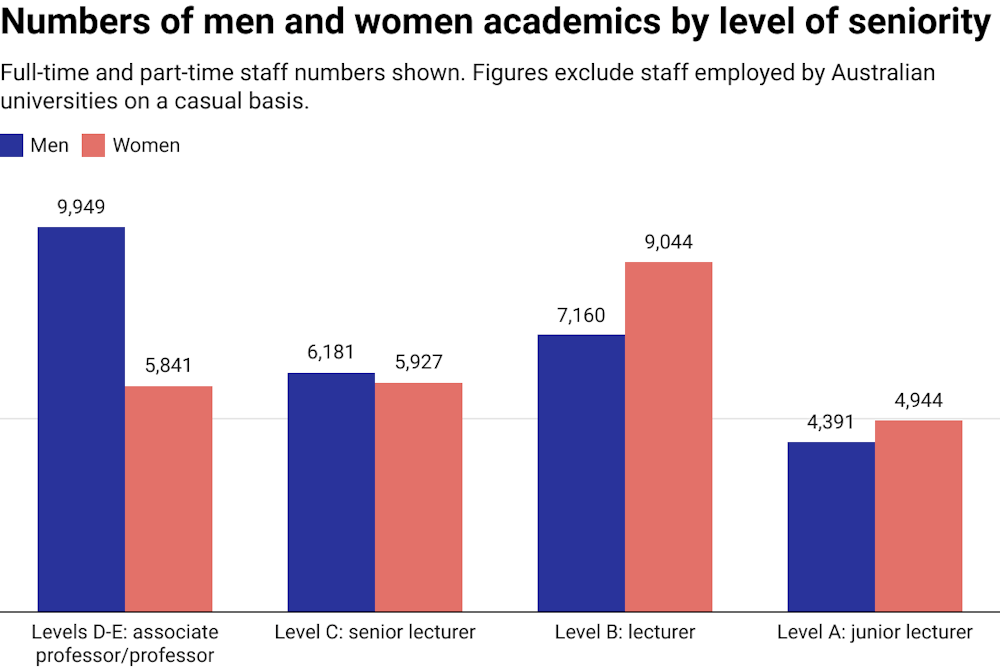
Vertical bar chart comparing numbers of men and women holding academic positions by level of seniority
Chart: The Conversation. Data: 2021 Staff Numbers, Higher Education Statistics, DESE, CC BY Read more: No change at the top for university leaders as men outnumber women 3 to 1 The situation is similar internationally. In the United States, for example, women have earned the majority of PhDs for more than a decade. Yet only 27% of tenured full professors are women. Women’s academic careers have been placed in a holding pattern for too long. While many women juggle many multiple responsibilities, men commonly have a clear run at their career goals. Without awareness of and action on the systemic barriers in higher education, no change will occur to support female leaders of the future. What are the barriers to female leadership? Academia and government are still patriarchal institutions. The patronage of white men grooming and shifting leadership to other elite white men is overlooked as much as the extent of sexual harassment. The nepotism that results in a man being appointed to leadership because of their biological gender persists. And, of course, gender inequity extends beyond leadership appointments in higher education. Rates of casualisation and fixed-term contracts are higher for female academics than for males, both globally and in Australia. We know female academics generally teach large first-year classes, which have excessive administrative duties. While women are left to look after the academic household, men can tend to the garden where things are more likely to grow and bloom (in this analogy, their research and leadership). Women academics have less chance of becoming a professor than men. It takes longer for those who do advance to professorships to get there. Universities still use male definitions of merit criteria, rewarding men’s scholarship over women’s scholarship. It’s known as the “Matilda Effect”. The COVID pandemic added to the barriers female academics must overcome. Increased carer responsibilities and home schooling during lockdowns resulted in lower research outputs and more criticism on student evaluations. As a result, women’s leadership opportunities and promotion prospects were further limited. Read more: Gender bias in student surveys on teaching increased with remote learning. What can unis do to ensure a fair go for female staff? What can be done to develop female leaders? Only 10% of senior leaders in STEM fields are women. However, in organisations where one in ten senior leaders is a woman, nearly 50% of men think women are well represented. This highlights the ongoing unconscious bias in society today. Despite initiatives to attract women into academic careers, professional support to advance their careers is lacking. Early-career female academics have less access to networks, a critical element for career progression, than their male counterparts. There is a lack of structured mentoring opportunities to discuss strategies to overcome the nuanced barriers of the male-dominated environment. Female academics would benefit from sharing strategies for managing challenging situations, designing decision-making processes, applying leadership frameworks, showing resilience and planning for career advancement and leadership growth. Read more: Here's an approach to mentoring that can help close the leadership gender gap The lack of female voice, visibility and advocacy perpetuates the cycle of inadequate time for research activities and higher teaching, service and administrative loads. Systemic mechanisms must be put in place to empower women in higher education to become leaders. This leads us to three key components for the newly elected government and universities to offer full and equal opportunities for academic women in leadership: formalised leadership development programs specifically designed for all women in academia to developing their decision-making capability established leadership mentoring schemes, which make women in leadership positions more visible and support female academics to overcome the individual nuances of the barriers they face increased dialogue among women to create a community where barriers and opportunities can be addressed and explored. Authors: Angela Carbone, Professor and Associate Deputy Vice Chancellor Learning Teaching and Quality, RMIT University

Read more https://theconversation.com/as-women-decide-australias-new-leaders-what-is-going-on-with-academic-leadership-184163

How Osteopathy Supports Recovery from Sciatica and Nerve Pain

Sciatica isn't just annoying. It's genuinely painful. It sits deep in your glute and shoots straight down the back of your leg. It turns something as...

The Winter Jewellery Edit: Five Pieces You'll Wear All Season

As wardrobes shift to cosy knits, tailored coats and rich seasonal textures, jewellery becomes the finishing touch that pulls every winter outfit to...

7 Signs It's Time to Upgrade Your Piston Air Compressor

If you run a workshop, panel shop, or fabrication business anywhere around Perth, you already know what heat and dust do to equipment over a few sum...

How Long Do Bathroom Renovations Melbourne Take? Step-by-Step Process Explained

Planning a bathroom renovation is exciting, but one of the biggest questions homeowners ask is, "How long will it take?" While every project is uniq...

Why Your Skin Breaks Out: The Science of Acne Explained

Acne is the most common skin condition in the world. An estimated 85% of people experience it at some point between the ages of 12 and 24, and a gro...

10 Swimwear Trends Australian Women Are Wearing This Summer

Every Australian summer brings a fresh wave of swimwear trends, but some styles have much greater staying power than others. While fashion constantly ...

Why Regular Skills Updates Are Essential for Licensed Security Officers

A guard at a Brisbane shopping centre gets a call about a shoplifter who's turned aggressive.  They’ve done the job for six years. But their de-...

10 Benefits of Choosing Professional Tutoring Penrith Services

Every student has unique learning strengths, challenges, and academic goals. While classroom teaching provides essential knowledge and structure, so...

Sunshine Coast Baby Classes Prove Big Hit Among First-Time Mums

There's a movement gaining traction on the Sunshine Coast, providing a village of support, socialisation and relief for first-time mothers and babie...

Father's Day Gift Ideas for Men Who Are Hard to Buy For

Some dads are easy to buy for. Others do not want anything, already have everything, or give you the classic "don't worry about me" answer every yea...

Top 5 Mistakes That Wear Out Your Brakes Faster

Brakes don't need frequent replacements like oil changes do.   But a lot of the wear happens quietly, over months, because of habits most drivers...

Plantation Shutters vs Curtains: Which Is Better for Your New Home?

Moving into a new home is an exciting opportunity to personalise your space and make it your own. While many homeowners focus on furniture, flooring...

Celebration of Life vs Traditional Funeral: What's the Difference?

When saying goodbye to someone you love, there is no single way to honour their life. Every family has different traditions, beliefs, and preference...

Building Approval for Roofing Projects: What Homeowners Need to Know

Roofing projects are an important part of maintaining and protecting your home. Whether you're repairing storm damage, replacing an ageing roof, or ...

Chatswood Tutoring And Its Role In Academic Achievement

Academic success often requires more than classroom attendance alone. Students face increasing expectations as they progress through school, particu...

Why Laser Hair Removal Treatments Continue Growing In Popularity

Managing unwanted hair can become time-consuming and frustrating for many people, especially when shaving, waxing, and other temporary methods requi...

Choosing the Right Devices for a Flexible Workplace

For IT leaders managing large fleets, the device layer is where workforce productivity and security policy meet. The shift towards flexible and hybrid...

How Business Advisory Services Help Companies Achieve Sustainable Growth

Every business owner aims to build a profitable and sustainable organisation. While dedication, innovation, and hard work are important, achieving l...
















