

As winter bites, NZ urgently needs a COVID action plan for schools – here’s how to do it
- Written by: Amanda Kvalsvig, Senior Research Fellow, Department of Public Health, University of Otago
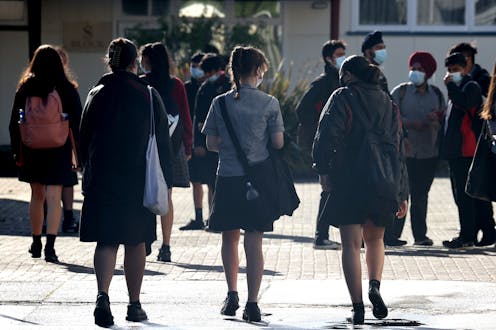
With protections against COVID-19 transmission incomplete in early 2022, the government’s policy of keeping schools open through the Omicron outbreak has left communities exposed to widespread infection and disrupted learning.
With winter here, an action plan for schools is urgently needed to protect children, staff and their families from COVID-19 and other seasonal respiratory infections.
During term one, the Ministry of Education advised schools to reassure parents that transmission in school settings would be low. COVID-19 in children had been described in news reports as an “asymptomatic or mild illness” for most, with full recovery likely after a few weeks.
These assurances seemed overly optimistic. Children aged 5 to 11 only became eligible for their first vaccine dose two weeks before term began, key ventilation and monitoring equipment had not been delivered, child-sized respirator masks like the KF94 were not widely available, and younger school children were not required to wear masks.
Furthermore, the international evidence was clear that longer-term symptoms of COVID-19 infection such as long COVID were a real and rising concern, and that Omicron was spreading in school settings.
Putting school communities at risk
This decision to prioritise school attendance without also providing strong protections and transparent outbreak information has caused significant educational disruption. It has exposed students, staff and families to both immediate and longer-term risks, including long COVID in children and adults.
These disruptions raise serious concerns for the well-being of the country’s pandemic generation now and in the future.
Lack of government leadership has placed an unnecessarily heavy burden on school staff, who have had take on a pandemic management role in addition to their many existing commitments, and on Māori and Pasifika households who are more at risk of severe outcomes.
And, as the recent Human Rights Commission inquiry reports, immune-compromised or disabled people have been put at risk and adversely affected by the lack of support in education settings, including children being unable to attend school.
The current situation is unsustainable. Children with persisting symptoms from Omicron infection are already being seen. Teachers are reported to have higher rates of infection than the general population.
Teachers in the UK are reported to be leaving the profession, citing lack of protective measures in schools and the impact of long COVID on their capacity to work. These reports should be ringing alarm bells in New Zealand.
The change we need to see
Schools play a vital role in protecting the well-being of children, staff and families. An action plan would ensure the right resources and information are in place.
Even during the worst infectious disease outbreak in a century, this would mean children can thrive and learn, school staff are safe and supported, and the risk of bringing infections home to older and younger family members is as low as possible.
We have previously recommended a range of measures to uphold children’s right to health and education. A key point is that resources and support should follow children and whānau, rather than the reverse.
Read more: A year on from the arrival of COVID-19 in NZ: 5 lessons for 2021 and beyond
At the height of an outbreak, some children may be better off in school, others at home. The highly supportive, collective leadership in kōhanga reo shows how much is possible when the pandemic response is centred on people rather than on the school system.
The action plan for schools should provide protection from COVID infection and reinfection and from winter infections such as flu and respiratory syncytial virus (RSV). The plan should prioritise children’s well-being, including supporting mental health and access to learning.
A co-ordinated child data system should be established to close some critical knowledge gaps about direct and indirect impacts of the pandemic on children and their families. This knowledge will enable government, schools and whānau to use the best available science to protect children’s well-being.
Schools as role models
Sending a child into school during an outbreak requires a high level of trust from caregivers that the school environment will be safe. Families have been given repeated reassurances, but the rhetoric hasn’t been backed up with effective action.
Accurate and transparent communication is now needed to restore trust. Currently, school communities lack the information needed to make good risk assessments. For example, many are unaware of long-COVID risk or of reinfection occurring just weeks after an initial infection. And there is no systematised way to inform parents about local case numbers.
Schools should be models of science-informed best practice for their communities. They can empower students to contribute to the pandemic response by modelling key values, such as wearing a mask to protect others.
Building on the success of sun safety and hand washing messaging, schools can lead a transformative change in indoor air quality, with students as citizen scientists helping to monitor CO2 levels in classrooms.
This generation of children will experience recurring pandemics and epidemics during their lifetime. It’s vital they understand how effective public health measures can be.
Read more: Long COVID: vaccination could reduce symptoms, new research suggests
Winter 2022 and next steps
The immediate focus for winter should be on a “vaccines plus” approach that aims to minimise infectious disease transmission in schools. Specific aims include:
Optimal indoor air quality: this includes heating, ventilation and filtration with real-time monitoring to guide action.
Routine (ideally mandated) mask use indoors: high-quality masks provide protection against emerging COVID variants and other respiratory infections, regardless of immune status.
High vaccination coverage: intensive health promotion from trusted community leaders to ensure families are well informed and to counter disinformation; and urgently addressing the high inequities in vaccine coverage.
Effective isolation and quarantine: supporting students and staff to stay at home if they are symptomatic, if they are close contacts of a COVID case or other infection, or if they need to shield whānau during a major outbreak.
Adequate sick leave and testing provision: for all school staff (teaching and non-teaching) to enable them to stay home while infectious and to support a full recovery, with aligned rapid testing strategies; these measures also apply during outbreaks of RSV, measles, meningococcal disease or influenza that are increasingly likely as border protections are removed.
An epidemic management contingency plan: the education system needs to explicitly plan for short circuit-breaker closures when case numbers reach defined thresholds, with a shift to high-quality remote teaching and additional community support as needed.
Monitoring and evaluation: data collection is needed to identify what is working well and what needs improvement, and to guide operational decisions such as intensifying ventilation if CO2 levels are above certain thresholds, or temporary closure if infections and absenteeism reach certain levels.
Timely information, communication and support: school communities need to see evidence that their well-being is paramount and the goal is not simply protecting the status quo.
Overall, the Ministry of Education’s approach needs to shift from insisting on in-person school attendance to supporting the well-being of children, staff and families wherever they are.
Prof Michael Baker, Dr Jennifer Summers, Dr Lucy Telfar Barnard, Dr Andrew Dickson, Dr Julie Bennett, Carmen Timu-Parata and Prof Nick Wilson all contributed to the recent University of Otago Public Health blog drawn on for this article.
Authors: Amanda Kvalsvig, Senior Research Fellow, Department of Public Health, University of Otago


















