

It's time to come clean on Lismore's future. People and businesses have to relocate away from the floodplains
- Written by: Jerry Vanclay, Professor, Southern Cross University
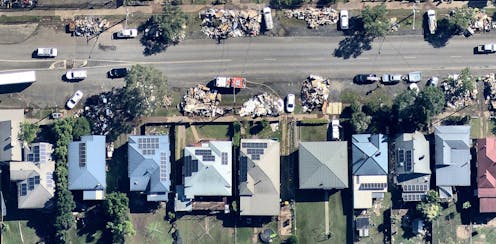
More than three months after the monster floods wrecked much of Lismore, there is still no clarity for the town’s residents and businesses who urgently need to make investment decisions. Should they move to higher ground, make temporary fixes, or renovate for the long haul?
The problem is, authorities differ. “The debate is over – we will be doing engineering work for flood mitigation,” declared Kevin Hogan, the federal member for Page, as he announced a A$10m CSIRO-led project to study flood mitigation.
Lismore Council has since recommended “a planned retreat of residential dwellings” from the highest flood risk areas.
It’s no wonder people in Lismore are confused. Can they stay put and rebuild, confident the government will stop flood devastation? Or should everyone at low elevation – including all businesses in the town centre – move? The city’s 44,000 people need clarity.
My view is stopping floods of this size or larger will simply not be viable. Raising the town’s 10 metre high levee won’t work. To contain the immense volume of water upstream, we would have to build many expensive new dams. Instead, we should move all buildings off the floodplains and work to reforest floodplains upriver to slow the floodwaters.

Lismore is prone to floods. But this year’s were off the charts
My city floods regularly, with 100 floods over the past 152 years. When major rain hits the surrounding mountains, water from many creeks funnel into the Wilsons River, which runs through the centre of town. The town’s levee was built to stop major floods. But in 2017, the floods overtopped the levee for the first time. In February this year, the monster flood came through at 14.4 metres, fully two metres higher than the supposed “1-in-a-100-year” event and 2.3m higher than any previously recorded.
How much water is that? At its peak, Wilsons River at Lismore was flowing at 216 gigalitres per day. That’s an Olympic swimming pool of water every second. That is an unprecedented volume and very difficult to mitigate.
Inquiries and reports after earlier floods have usually been in favour of a gradual withdrawal from vulnerable areas. We had a voluntary acquisition program in 1954, a report in 1980 finding flood mitigation was uneconomic and ineffective, and a 1982 report advocating buy-backs, land swaps and relocation assistance. None of these led to major relocations. Instead, in 2005, a $A19 million levee was constructed to protect against a 1-in-10 year flood. It’s already been overtopped three times. Parts of the town are now effectively uninsurable.
Read more: 'I simply haven’t got it in me to do it again': imagining a new heart for flood-stricken Lismore
Could the controversial proposal for a new dam upriver at Dunoon help, as some suggest? Unlikely, given its catchment only covers 5% of the Lismore basin, and its capacity is only 5% of what would be required to mitigate these floods. We would need 12 such dams, kept empty, to mitigate floods this size. These wouldn’t stack up economically, ecologically, or culturally.
What about raising the levees? This doesn’t work, because water constrained by the levee rises to greater heights. In a wide floodplain, this might not be a problem. But Lismore’s floodplain is narrow. If we had raised the existing levee from 10 to 15m, the February flood would have had its flow restricted by 75%. Water would have backed up and ultimately overtopped the levee.
Raising buildings above flood height is a major undertaking (especially in the CBD), and would substantially alter the character of the city. Renovating buildings for flood tolerance is possible, but this does not address the substantial costs of flood disruptions and the clean-up. Nor does this strategy protect lives from rapid and unexpected flooding.
What would work is restoring vegetation on the floodplains above Lismore, and clear vegetation on the floodplains below Lismore. Why? Because vegetation can make a five-fold difference in water velocity. If we reforest floodplains to the north through projects like tree plantations for koalas, horticulture and rainforest restoration, we would slow the floods significantly. If we clear more areas on the floodplains below Lismore, we would also speed up the clearance of floodwaters from the river. These two methods combined would lower the height of the flood peak. These interventions are also tolerant of imprecise assumptions and extreme situations, and are not prone to sudden failure.
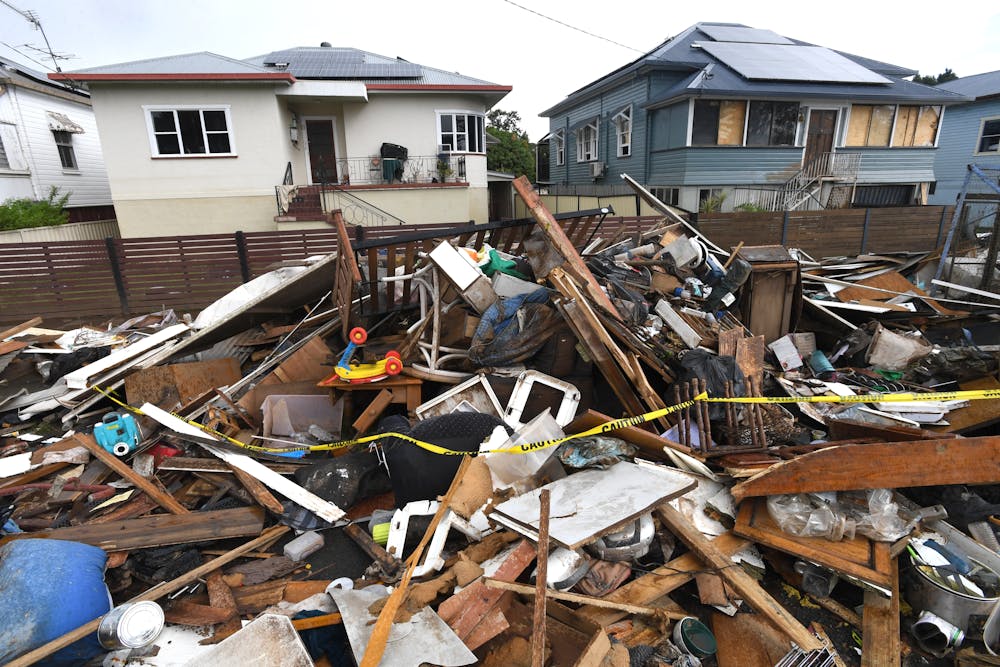 If flooding like this was once in a lifetime, residents might be able to weather it. But floods are getting worse.
Darren England
If flooding like this was once in a lifetime, residents might be able to weather it. But floods are getting worse.
Darren England
We must take relocation seriously
While we might have considered the clean-up and restoration costs tolerable if they occur once in a lifetime, the nature of our floods is changing. Floods once considered rare are now more common, as climate change warms the air and lets it hold more moisture, coupled with ever-increasing hard surfaces such as roofs and roads which cause faster runoff. The reality is we need to prepare for more frequent and more severe flooding.
The logical solution is to relocate our city’s important infrastructure – houses, businesses and factories – away from the floodplain altogether. On a smaller scale, this is what happened in the south-east Queensland town of Grantham after the 2011 “inland tsunami” of water destroyed much of the town. The council pioneered a land-swap to move many of the houses most at risk to higher ground on a nearby cattle property.
The decision to relocate homes and businesses is a big one. We can no longer avoid this difficult discussion, however. Doing nothing will not bring back the old Lismore. Our city has changed, and will never be the same again.
On the positive side, we have a real opportunity to create a new, better version of Lismore. If we delay a decision or keep the idea of mitigation alive, we will create uncertainty and see our city dwindle, as hard-hit businesses and residents drift away and establish elsewhere.
Floodplain residents should not be misled into investing in expensive renovations, when relocation is the better solution.
Read more: Lismore faced monster floods all but alone. We must get better at climate adaptation, and fast
Authors: Jerry Vanclay, Professor, Southern Cross University


















