

residents embrace renewable energy but worry how their towns will change
- Written by: Rebecca Pearse, Lecturer, Australian National University
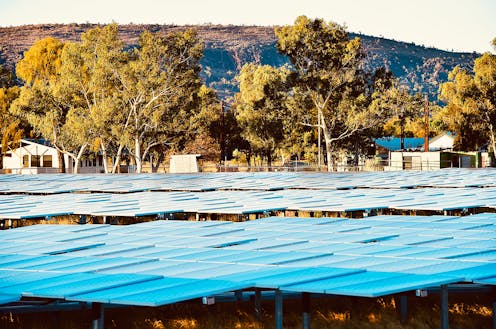
Amid soaring energy costs, the new Labor government is working to deliver a A$20 billion pledge to rebuild and modernise Australia’s electricity grid. It will help deliver a plan for 122 gigawatts of new renewable energy in the National Electricity Market by 2050, eventually replacing coal generation.
The transition will bring significant social, economic and environmental change. Electricity generation in New South Wales, for example, will shift from the concentrated coal power of the Hunter Valley and Central Coast to multiple sites across the state’s centre, north and southwest.
The shift also entails a host of new infrastructure. According to our calculations, the predicted extra renewable energy capacity will require nationally 24,000 large wind turbines or around 2,000 large solar farms, as well as new large-scale batteries.
So, in the first major study of its kind, we travelled to where renewable energy is expanding in NSW to ask communities how they feel about the changes. While their outlook was generally positive, governments can do more to ensure community support for the transition.
What our work involved
Most new energy infrastructure will be concentrated in designated “renewable energy zones”. These are areas where both renewable energy is generated, and the high-voltage poles and wires exist to deliver it where needed.
The national pilot zone will begin in NSW’s Central-West Orana region from 2023, followed by another zone in New England. Three more zones will be established in the Riverina, Hunter-Central Coast and Illawarra regions.
Our research involved travelling to and staying in affected towns including Wellington, Glen Innes, Inverell, and Uralla. New wind and solar farms are already built near these places and many more are proposed in the coming years in the Central-West Orana and New England.
We spoke to a broad range of residents. All together we conducted 44 semi-structured interviews, several group interviews and a community forum. We also visited solar and wind farm sites and landowners’ properties (both hosts of new utilities and their neighbours).
Read more: 3 key measures in the suite of new reforms to deal with Australia's energy crisis
Positive, but unsure what lies ahead
Overall, people were generally positive about the future development of renewable energy zones and the opportunities they presented. One resident told us:
“There are hundreds of small rural communities throughout Australia that are struggling, and most won’t have an opportunity like this development. We want to be part of that movement, we want to grow and evolve in a rapidly changing world.”
But some people were unsure about how the energy transition would affect their communities. This is unsurprising, given the lack of transition planning by the last federal government.
In places where multiple renewables projects have been built or planned, changes to land use and public assets were a concern to some. As one community member said:
“Rural views are a big issue out here. And bush fires. There’s a question mark over the viability of agricultural land, particularly with the solar farms. And wear and tear on the roads and infrastructure.”
State planning review processes will be tested as more closely located projects are proposed. This cumulative problem that needs to be addressed to ensure community support for renewable energy zones.
Local councils have fine-grained knowledge about their areas and should be key to these new planning processes. However, they have little co-ordinating power. As one council officer put it:
“It’s really market forces deciding when [projects] get built, or don’t get built.”
On transmission projects, Labor has said it will require the Australian Energy Regulator to take a broader view of costs and benefits and increase community engagement on transmission decisions.
How are benefits shared?
Landowners are paid to host wind or solar projects and this can form a big part of a farm’s income. One host landholder told us:
“The proposed solar development on our property is a massive positive. It allows us to drought proof our farm and continue as a viable business for the next generation.”
However, renewables projects can cause conflicts with neighbours who may be affected by the development but are only eligible for much smaller payments – or sometimes none at all.
Areas designated as renewable energy zones have a much higher proportion of Aboriginal residents than the NSW average. To maximise socioeconomic benefits and protect heritage during the energy transition, Traditional Owners and other Aboriginal residents should be better included and consulted, in culturally appropriate ways, than they have been in the past.
Communities were generally positive about the broad economic benefits that flow from renewable energy projects during the construction phase. A local worker told us:
“The workers would fill their vehicles [with fuel] in town before they left, or they’d get local caterers, or they’d sponsor local activities, that sort of thing.”
But renewable energy projects have a lifetime of up to 30 years. Ensuring they create local benefits beyond the construction phase requires a broader industrial strategy and more carefully coordinated development to spread out the construction phases over time.
Some renewable energy companies run small grants schemes to contribute to local community organisations. We support proposals to formalise and combine some of these schemes. This would create a very significant pool of funds that could make substantial investments within a renewable energy zone.
Read more: How can Aboriginal communities be part of the NSW renewable energy transition?
Planning for equitable change
The pilot renewable energy zones embody a bold vision for Australia’s clean energy future. They should be used as a policy test-bed to ensure we get the transition right.
In particular, the pilots must ensure all residents can participate and share in the benefits, that socioeconomic development is sustainable and co-ordinated, and projects give back to communities over their full lifespan.
If we can nail all this at the pilot stage, renewable energy zones can bring significant benefits to other host communities and Australia as a whole.
Authors: Rebecca Pearse, Lecturer, Australian National University


















