

How Rising festival brought us dance in times of plague
- Written by: Angela Conquet, PhD Candidate, The University of Melbourne
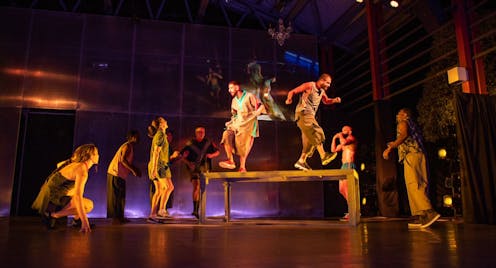
Three years in the making, Rising’s much-anticipated first edition brought to Melbourne’s festival-deprived audiences a rich program featuring 225 events.
With former Chunky Move founder and choreographer Gideon Obarzanek as co-director, it was only natural to expect a dance-heavy presence with eight local and international productions.
The works ranged from incredible local performer Jo Lloyd and her dancers in dialogue with drummer Jim White and guitarist Emmett Kelly, to the exquisite Indonesian dancer and choreographer Rianto’s ritualistic Hijra'h, but there were three works which I felt particularly captured something of this post-pandemic age.
Jurrungu Ngan-ga/Straight Talk
Marrugeku’s productions have often been straight talk – powerful invitations to reflect on the devastating effects of ongoing colonialism as experienced daily by Indigenous people and other marginalised communities.
Their works are almost always the result of intercultural collaborations, expressed through complex choreography expanding into spoken text, multimedia installations and diverse styles of dance.
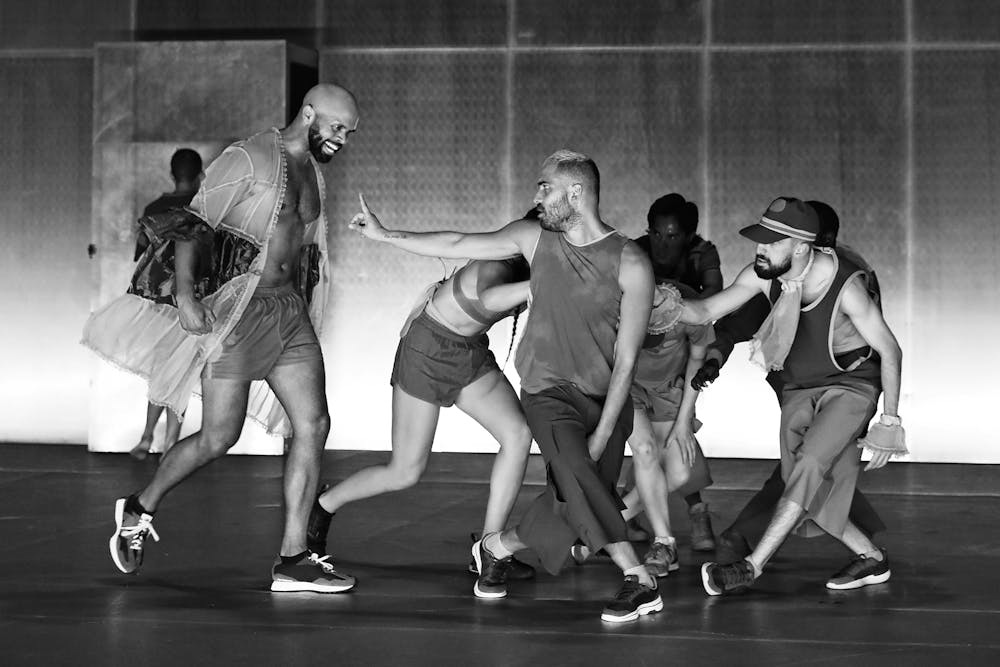
This production is no different, inspired by ideas and experience contributed as material by choreographer Dalisa Pigram’s own grandfather Yawuru leader and senator Patrick Dodson, Kurdish Iranian writer and former Manus Island detainee Behrouz Boochani and Iranian-Australian scholar-activist Omid Tofighian.
Jurrungu Ngan-ga tackles the devastating consequences of Australia’s entrenched, government-sanctioned fixation with punishment through detention and incarceration.
The show brings together a cast of nine dancers of multiple backgrounds (from First Peoples, refugee, transgender and settler communities) who also contribute their embodied stories and histories to the piece.
It starts with a subtly exquisite solo, the dancer embracing the space with ample movement flowing freely. As it unfolds, movement becomes cagier, as if restrained, constrained by invisible barriers. It prefaces the next solo, a man pacing in a cell of light watched by a camera. He is in turn surveying by us watching the camera footage.
This is a man caged in a prison, caged in a body, and the movement – no longer ample – pulsates with repressed anger.
From here, the choreography grows into dizzying ensemble moments, including a surreal moment when the dancers navigate their way through a stage occupied by glowing crystal chandeliers lowered to the ground.
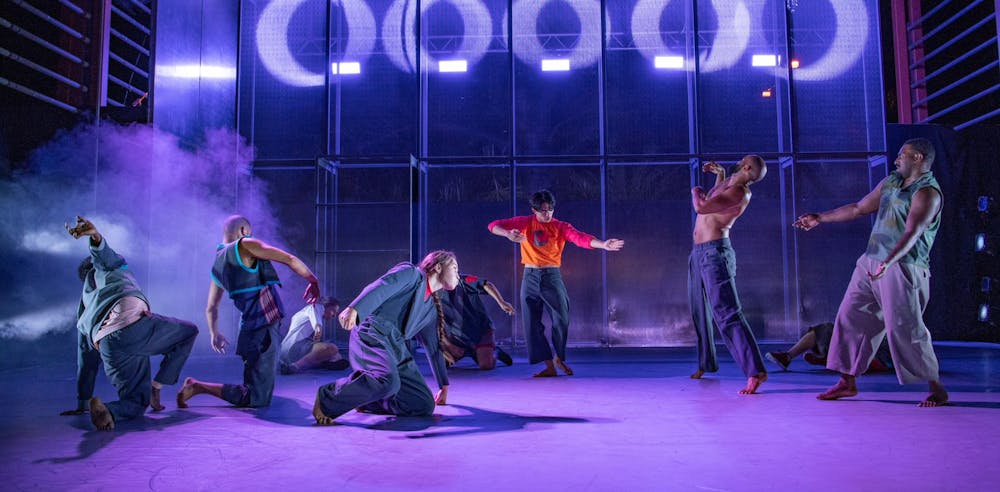 The choreography grows into dizzying ensemble moments.
Abby Murray/Rising
The choreography grows into dizzying ensemble moments.
Abby Murray/Rising
There is everything in this piece, from police abuse to spit-hoods to video surveillance, to naked bodies dumped on the floor with a muffled thump, to names of those who have perished in police custody or in detention. There is abuse and humiliation and moments of protest, of fury, and joy, wild and unapologetic.
The choreography is a breathtaking tour de force delivered by fierce bodies telling their dire stories. Although nothing is accusatory here, there is no breathing space for the audiences but to take it all in. As the final solo arrives, soothing and somewhat majestic, ears still resonate with the powerful rapping “this is Australia”.
This is Australia at its ugliest, in its fear of everything not from here, of everyone “not like us”, a mirror talking back at us.
Jurrungu Ngan-ga is truly a piece of its plagued times, viscerally sharp and brutally raw, so raw that it cuts to the bone, and the call to action at the end may well be the only way to catch the breath.
Read more: Comic anticlimax in Nat Randall and Anna Breckon’s Set Piece
The Dancing Public
Danish choreographer Mette Ingvartsen’s The Dancing Public is also a piece about plagued times and as visceral as Marrugeku’s, yet very different.
We step into the dimly lit space. The music is raving and Ingvartsen, mingling with the audience, is inviting everyone to spread around. Some are starting to move with the music as they inspect the space. Then Ingvartsen gets up on one of the three platforms placed here and there, and starts to dance.
Furiously, relentlessly, her body pulses, throbs, possessed by the beats, convulsing in trance-like gestures.
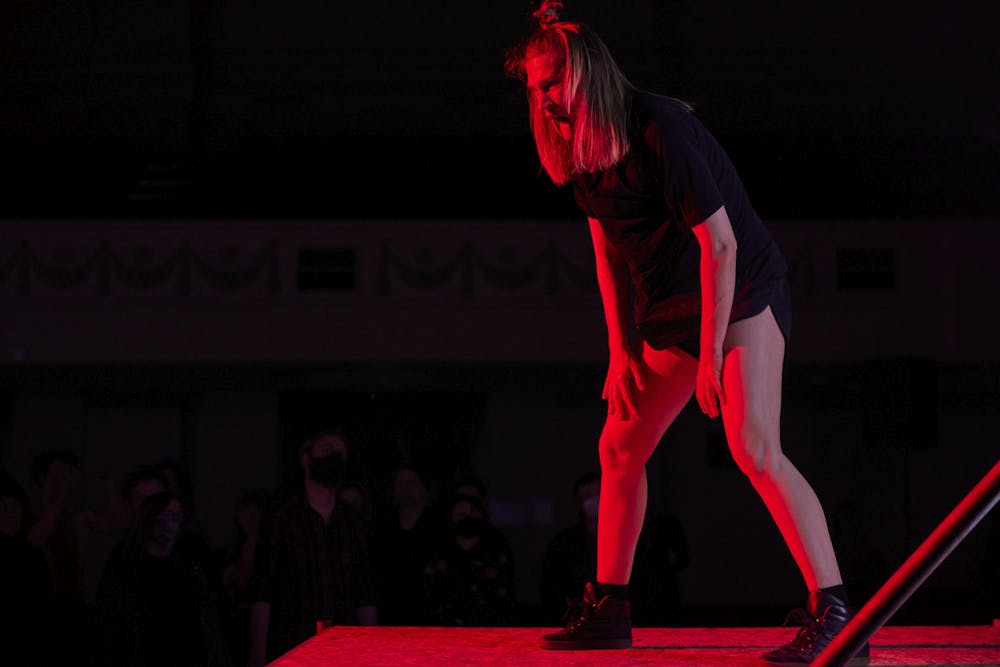 Furiously, relentlessly, her body pulses, throbs, possessed by the beats, convulsing in trance-like gestures.
Michael Pham/Rising
Furiously, relentlessly, her body pulses, throbs, possessed by the beats, convulsing in trance-like gestures.
Michael Pham/Rising
As she dances, she chants about the unexplained hysterical mass dancing episodes that started in the 1300 in south of France and continued over time. People danced till they dropped, their feet covered in blood and their minds covered in fog. It was the time of mediaeval plaques and poverty.
She joins the crowds again and dances with anyone as she swirls her way to the other platform to tell us some more. She keeps dancing. There is no sweat dripping off her body, no heavy breathing. She is fury unleashed and it is mesmerising to watch. We forget about dancing.
Suddenly, she hurls her body over the platform railing and leaves it hanging there, in a rare moment of stillness, no sweat dripping, and we, with her, suspend our breath. And the dancing kicks off again, and goes on and on and at the end, she leaves us alone, to dance… or not.
If Dancing Public is about the public dancing it fails. The contagion from one body to the other does not take. Participatory dance shows are always tricky – they really depend on the audience mood and the dramaturgical tricks giving the cues. They also depend on who is in the room, and in Melbourne, given the ticket price, it wasn’t exactly the crowd most inclined to dance.
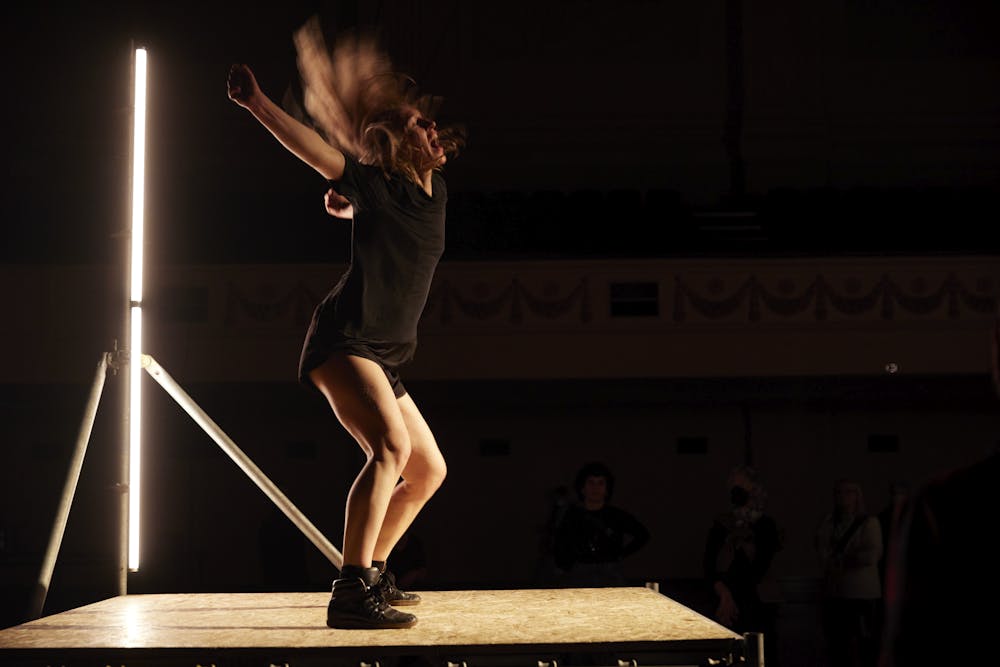 She is fury unleashed and it is mesmerising to watch. We forget about dancing.
Michael Pham/Rising
She is fury unleashed and it is mesmerising to watch. We forget about dancing.
Michael Pham/Rising
Dancing Public is indeed an experiment that needs to be experienced with the body, through the body. It is all that we have missed during these last two years. And here lies the merit of this show, in it turning a story from the past into some important questions for today: would we have all taken to the streets dancing if confinement had continued?
Could this be a new form of protest in our heavily policed socially-distanced post pandemic reality? Dancing manias were considered a threat to public order as crowds could be neither controlled nor explained.
In this sense, this show is more an invitation to consider our relationship to social norms, to being together, to acting collectively. How we respond to this invitation will depend on who is ready to let go.
Read more: From creepy clowns to the dancing plague – when phobias are contagious
Multitud
At the start of Multitud, from the Uruguayan choreographer Tamara Cubas, the 72 volunteer performers are part of the audience – then, they step onto the stage, one by one, facing us. Bodies standing tall, lit by discreet fluoro lights.
Suddenly one bends, like a broken puppet, then another. Some fall to the ground, some crouch. Some rise back up, some don’t.
Later, they start running in circles. The circles grow into a spinning whirlwind.
They all coalesce into a vortex of piled, panting bodies, pulsing like magma, until they breathe as one: one single breath. A pause, and they erupt into a thunderous laughter. It is hilarious. It is hysterical, too, as they come together again into a crowd, frenzied and threatening this time, out of control, taking aim and tugging ferociously at a teenager in a green jumper.
They are vile.
 They step onto the stage, one by one, facing us. Bodies standing tall.
Michelle Li/Rising
They step onto the stage, one by one, facing us. Bodies standing tall.
Michelle Li/Rising
The teenager stares at us as we witness what may turn into a public lynching. But the crowd calms down and there is silence and stillness again as they all watch us, the teenager and the attackers. In this suspended moment, one piercing cry is made of everyone’s cry. There is fury and anger and tears, real tears.
One wonders if we have caused them, placid witnesses of someone’s misery. Appeased, the crowd slowly disintegrates and retreats in the shadows backstage. In their final coming together, somehow they have lost their clothes. No, they have exchanged their clothes, nonchalantly at first, with sharper precision as they take or give, some are naked, some wear the wrong shoes, clothes fly everywhere, scattered now on the floor, some keep searching, some let go.
Multitud places the directions and the power of the actual choreography in the hands of the group – they decide where to start, what to do, how to end. They can opt out too. Every night is different. Every time is different.
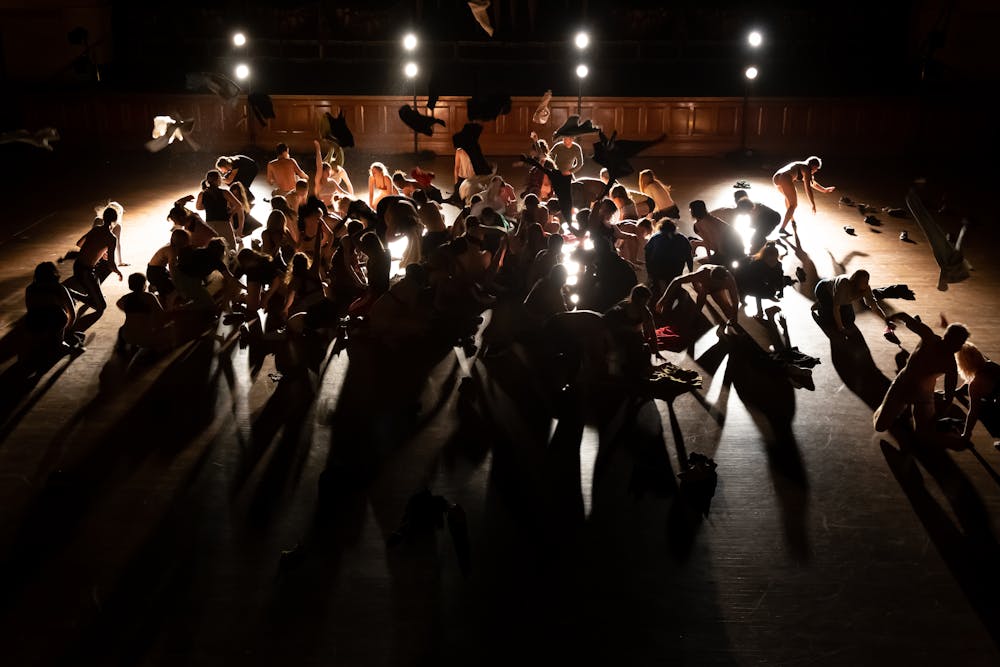 Multitud RISING.
Michelle Li/ RISING
Multitud RISING.
Michelle Li/ RISING
Multitud succeeds where The Dancing Public fails. This, too, is an exquisite reflection on being together and acting collectively, yet this is about what holds us together as a collective.
This is not choreography for the masses, rather it is a multitude of relations between individual bodies, each affecting or being affected by the other. It is about being in communion; attentive, alert, attuned to the other. Then we become responsible for what we do collectively.
Multitud is fiercely political and delicately poetic, a tribute to what dance can (still) do in times of plague.
Read more: Writing movement: why dance criticism matters
Authors: Angela Conquet, PhD Candidate, The University of Melbourne
Read more https://theconversation.com/how-rising-festival-brought-us-dance-in-times-of-plague-183642


















