

Yet again, the census shows women are doing more housework. Now is the time to invest in interventions
- Written by: Leah Ruppanner, Professor of Sociology and Founding Director of The Future of Work Lab, The University of Melbourne
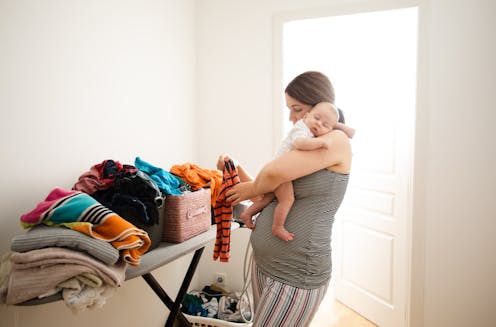
The Australian Census numbers have been released, showing women typically do many more hours of unpaid housework per week compared to men.
It’s not a new development. In 2016, the “typical” Australian man spent less than five hours a week on domestic work, while the “typical” Australian woman spent between five and 14 hours a week on domestic work. Before that, the 2006 census showed, again, that more of the domestic workload is shouldered by women.
So, in the 15 years since the Australian Census started collecting unpaid housework time, women are shown to do more than men. Every. Single. Time.
What is unique about these latest census numbers is Australians filled out their surveys during one of the greatest disruptors to work and home life – the COVID pandemic.
Pandemic pressures
We have a breadth of research showing the pandemic disrupted women’s – especially mothers’ – work and family lives, in catastrophic ways.
Economic closures knocked women out of employment at higher rates to men, forcing them to rely more heavily on their savings and stimulus payments to make ends meet. All this while managing intensified housework, childcare and homeschooling.
The transition to remote and hybrid learning meant mothers, not fathers, reduced their workloads to meet these newfound demands.
Fathers picked up the slack in the home – doing more housework at the start of the pandemic and holding it over time.
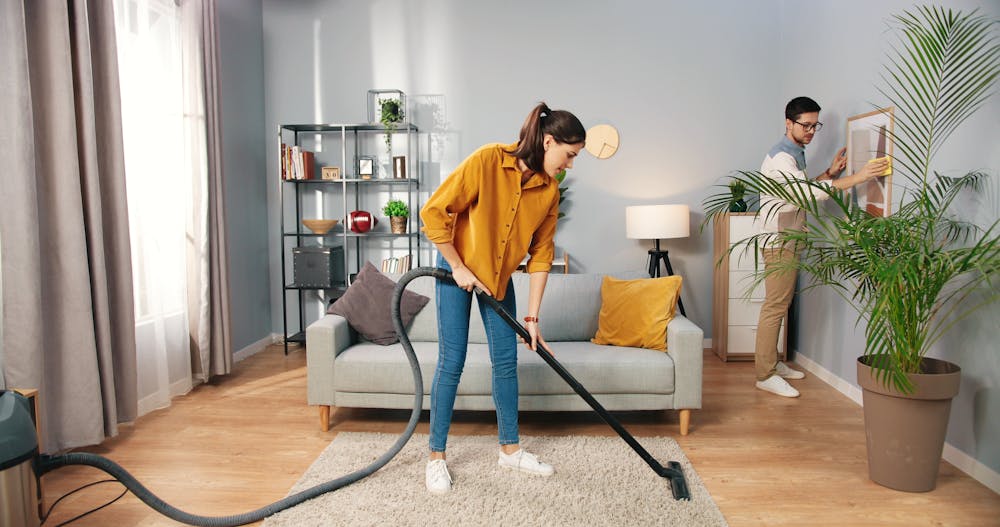
Yet, as my colleagues Brendan Churchill and Lyn Craig show, fathers increased their housework but so did mothers, meaning the gender gap in that time remained.
So, while men should be applauded for doing more during the unique strains of the pandemic, we show mothers were the true heroes of the pandemic, stepping into added labour at the expense of their health and well-being.
Quite simply, the pandemic placed unparalleled pressures on Australian families. So it is perhaps no surprise our surveys are showing Australians are burnt out.
(As discussed in previous articles, the chore divide in same-sex relationships is generally found to be more equal. But some critiques suggests even then, equality may suffer once kids are involved.)
 In general, fathers increased their housework during the pandemic – but so did mothers, meaning the gender gap remained.
Shutterstock
In general, fathers increased their housework during the pandemic – but so did mothers, meaning the gender gap remained.
Shutterstock
Read more: COVID forced Australian fathers to do more at home, but at the same cost mothers have long endured
Time for action
So, where to now?
We pay upwards of $640 million dollars every five years to document Australia through the census.
And, in each of these surveys we find the same result – women are doing more housework than men.
This parallels decades of research showing women do more housework, even when they are employed full-time, earn more money and especially once kids hit the scene.
Men have increased their housework and childcare contributions over time and younger men want to be more present, active and attentive in the home.
Simply put: men want to step into greater care giving and women are suffering from “doing it all”.
We have documented these trends for decades – enough. Now it is time for action.
 The pandemic intensified housework, childcare and homeschooling demands on women.
Shutterstock
The pandemic intensified housework, childcare and homeschooling demands on women.
Shutterstock
Read more: Flexible work arrangements help women, but only if they are also offered to men
Creating a fair future
These are the critical questions we are asking through The Future of Work Lab at the University of Melbourne – how do we create a future that is fair to everyone, including women and mothers?
A few key projects illuminate some of the next steps towards clear interventions. The first is to provide Australian families with a comprehensive safety net to support their care-giving lives.
All of us will be, at some point, called upon to care for a loved one, friend, family member or colleague. At these moments, work becomes difficult and housework demands soar.
So, providing care-giving resources beyond just paid time off is critical. This underscores the need for
- universal free high-quality childcare
- paid caregiver leave, and/or
- better and longer term cash payments for caregivers.
Second, we need comprehensive policies that allow men to step into care-giving roles without fear of retribution and penalty at work.
Australians work more annual hours, on average, than their Canadian and United Kingdom counterparts, working hours more similar to the overwork culture of the United States. And, only one in 20 Australian fathers take paid parental leave following childbirth, an abysmal rate relative to other high-income countries.
We can do better.
The pandemic created the space for many men to step into larger care-giving roles with great pleasure and showed workplaces that flexible work is feasible.
Next, the Australian workplace must become more supportive of men’s right to care.
 Australian workplaces must become more supportive of men’s right to care.
Shutterstock
Australian workplaces must become more supportive of men’s right to care.
Shutterstock
Unpaid domestic work and the mental load
Finally, we must redress the challenges of unpaid domestic work and the mental load on women’s physical, mental and economic health and well-being.
Perhaps tech holds some solutions.
The demand is clearly there with some super impressive women building out concrete tech solutions to reduce the mental load and unpaid domestic work - like Melo’s mental load app or Yohana’s virtual concierges.
Others are using old tech solutions – like Eve Rodsky’s Fair Play cards – to help couples equalise the often unseen, and undervalued household chores. We are working on a research project to understand the impact of these different resources on families’ unpaid domestic loads and lives more broadly.
The census is valuable in showing us we remain unchanged.
But, now, is a time to invest in intervention and innovation to make us better versions of ourselves into the future.
Authors: Leah Ruppanner, Professor of Sociology and Founding Director of The Future of Work Lab, The University of Melbourne


















