

This giant kangaroo once roamed New Guinea – descended from an Australian ancestor that migrated millions of years ago
- Written by: Isaac Alan Robert Kerr, PhD Candidate for Palaeontology, Flinders University
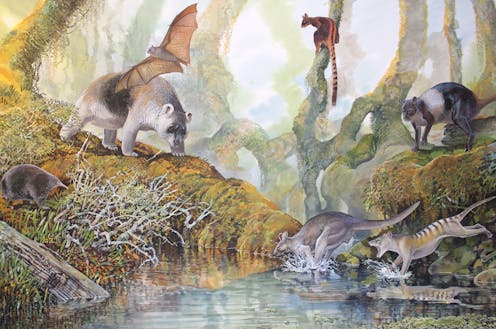
Long ago, almost up until the end of the last ice age, a peculiar giant kangaroo roamed the mountainous rainforests of New Guinea.
Now, research published by myself and colleagues suggests this kangaroo was not closely related to modern Australian kangaroos. Rather, it represents a previously unknown type of primitive kangaroo unique to New Guinea.
The age of megafauna
Australia used to be home to all manner of giant animals called megafauna, until most of them went extinct about 40,000 years ago. These megafauna lived alongside animals we now consider characteristic of the Australian bush – kangaroos, koalas, crocodiles and the like – but many were larger species of these.
There were giant wombats called Phascolonus, 2.5-metre-tall short-faced kangaroos, and the 3-tonne Diprotodon optatum (the largest marsupial ever). In fact, some Australian megafaunal species, such as the red kangaroo, emu and cassowary, survive through to the modern day.
The fossil megafauna of New Guinea are considerably less well-studied than those of Australia. But despite being shrouded in mystery, New Guinea’s fossil record has given us hints of fascinating and unusual animals whose evolutionary stories are entwined with Australia’s.
Palaeontologists have done sporadic expeditions and fossil digs in New Guinea, including digs by American and Australian researchers in the 1960s, ’70s and ’80s.
It was during an archaeological excavation in the early 1970s, led by Mary-Jane Mountain, that two jaws of an extinct giant kangaroo were unearthed. A young researcher (now professor) named Tim Flannery called the species Protemnodon nombe.
The fossils Flannery described are about 20,000–50,000 years old. They come from the Nombe Rockshelter, an archaeological and palaeontological site in the mountains of central Papua New Guinea. This site also delivered fossils of another kangaroo and giant four-legged marsupials called diprotodontids.
Read more: Meet the giant wombat relative that scratched out a living in Australia 25 million years ago
An unexpected discovery
Flinders University Professor Gavin Prideaux and I recently re-examined the fossils of Protemnodon nombe and found something unexpected. This strange kangaroo was not a species of the genus Protemnodon, which used to live all over Australia, from the Kimberley to Tasmania. It was something a lot more primitive and unknown.
In particular, its unusual molars with curved enamel crests set it apart from all other known kangaroos. We moved the species into a brand new genus unique to New Guinea and (very creatively) renamed it Nombe nombe.
A 3D surface scan of a specimen of Nombe nombe, specifically a fossilised lower jaw from central Papua New Guinea. (Courtesy of Papua New Guinea Museum and Art Gallery, Port Moresby).Our findings show Nombe may have evolved from an ancient form of kangaroo that migrated into New Guinea from Australia in the late Miocene epoch, some 5–8 million years ago.
In those days, the islands of New Guinea and Australia were connected by a land bridge due to lower sea levels – whereas today they’re separated by the Torres Strait.
This “bridge” allowed early Australian mammals, including megafauna, to migrate to New Guinea’s rainforests. When the Torres Strait flooded again, these animal populations became disconnected from their Australian relatives and evolved separately to suit their tropical and mountainous New Guinean home.
We now consider Nombe to be the descendant of one of these ancient lineages of kangaroos. The squat, muscular animal lived in a diverse mountainous rainforest with thick undergrowth and a closed canopy. It evolved to eat tough leaves from trees and shrubs, which gave it a thick jawbone and strong chewing muscles.
The species is currently only known from two fossil lower jaws. And much more remains to be discovered. Did Nombe hop like modern kangaroos? Why did it go extinct?
As is typical of palaeontology, one discovery inspires an entire host of new questions.
Strange but familiar animals
Little of the endemic animal life of New Guinea is known outside of the island, even though it is very strange and very interesting. Very few Australians have much of an idea of what’s there, just over the strait.
When I went to the Papua New Guinea Museum in Port Moresby early in my PhD, I was thrilled by the animals I encountered. There are several living species of large, long-nosed, worm-eating echidna – one of which weighs up to 15 kilograms.
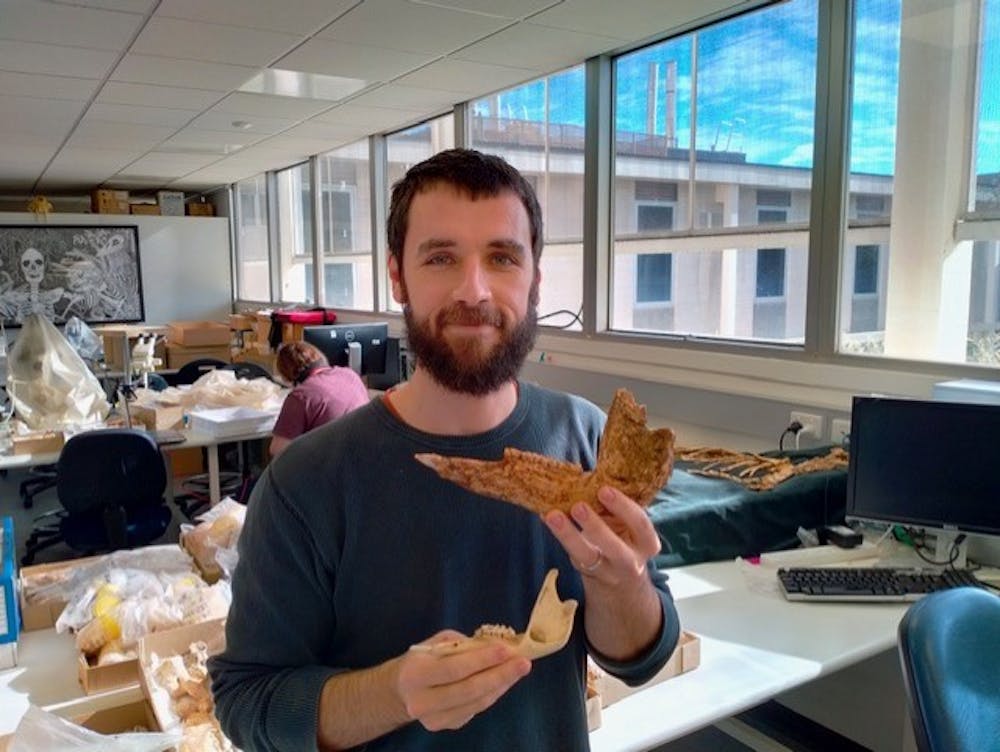
There are also dwarf cassowaries and many different wallaby, tree kangaroo and possum species that don’t exist in Australia – plus many more in the fossil record.
We tend to think of these animals as being uniquely Australian, but they have other intriguing forms in New Guinea.
As an Australian biologist, it’s both odd and exhilarating to see these “Aussie” animals that have expanded into new and weird forms in another landscape.
Excitingly for me and my colleagues, Nombe nombe may breathe some new life into palaeontology in New Guinea. We’re part of a small group of researchers that was recently awarded a grant to undertake three digs at two different sites in eastern and central Papua New Guinea over the next three years.
Working with the curators of the Papua New Guinea Museum and other biologists, we hope to inspire young local biology students to study palaeontology and discover new fossil species. If we’re lucky, there may even be a complete skeleton of Nombe nombe waiting for us.
Authors: Isaac Alan Robert Kerr, PhD Candidate for Palaeontology, Flinders University


















