How soon can I get COVID again? Experts now say 28 days – but you can protect yourself
- Written by Ashwin Swaminathan, Senior Lecturer, Australian National University
My glorious two and a half year run of negative COVID tests came to a shuddering halt last week, after receiving a text confirming I was among the pandemic’s latest catch.
My case adds to the rising slope of the third Omicron wave in seven months, currently rolling across Australia.
While shivering through my mild bout, I’d optimistically thought that at least I would have several months’ reprieve from isolation precautions and testing. But emerging evidence suggests the possibility of reinfection within a shorter timeframe for newer subvariants.
Experts have reduced the protective window of prior infection from 12 weeks to 28 days. This week, the New South Wales, Western Australia and Australian Capital Territory governments all announced those who’ve had COVID before will need to test after 28 days if they experience symptoms. If positive, they’ll be treated as new cases.
Read more: Australia is heading for its third Omicron wave. Here's what to expect from BA.4 and BA.5
Reinfection – testing positive for SARS-CoV-2 (the virus that causes COVID) after having recovered from a prior infection – is on the way up. Reinfection made up 1% of all cases in the pre-Omicron period in England, but in recent weeks it comprised more than 25% of daily cases there and 18% in New York City.
We do not yet have comparative Australian data, but it will likely be a similar story, given the emergence of BA.4 and BA.5 Omicron subvariants here. These are more easily transmitted and able to cause breakthrough infection in those previously vaccinated or infected.
Understanding our risk of reinfection at an individual level is easier if we break it down into four key factors: the virus, each person’s immune response to past infection, vaccination status, and personal protective measures. There is not much we can do about the first two factors, but we can take action on the latter two.
Read more: Got COVID again? Your symptoms may be milder, but this won't always be the case
The virus
Much has been written about the immune system evading characteristics of the Omicron subvariants due to multiple new mutations of the SARS-CoV2 spike protein.
Pre-Omicron, infection with one variant of COVID (Alpha, Beta, Delta) gave long-lasting cross-variant immunity. This also gave effective protection against symptomatic infection.
However, all that changed with the emergence of the Omicron BA.1 subvariant in late 2021, with studies demonstrating reduced cross-protection from prior infection that was linked to less robust antibody responses.
Fast forward several months, and we can see even infection with early Omicron subvariants (BA.1, BA.2) does not necessarily protect us from their newer siblings (BA.4, BA.5).

Read more: Access to a second COVID booster vaccine has been expanded to people 30 years and over
Our response to past infection
How our immune system dealt with the previous COVID infection can influence how it negotiates a future exposure.
We know immune-suppressed individuals are at increased risk of reinfection (or indeed relapse from a persistent infection).
The large UK COVID Infection Survey shows that in the general population, people who report no symptoms or have lower concentrations of virus on their PCR swabs with their prior infection are more likely to be reinfected than those with symptoms or higher viral concentrations.
This indicates that when the body mounts a more robust immune response to the first infection, it builds defences against reinfection. Perhaps a slim silver lining for those who shivered, coughed and spluttered through COVID!
Read more: Could I have had COVID and not realised it?
Vaccination status
When COVID vaccinations were being rolled out in 2021, they provided both excellent protection against severe disease (resulting in hospitalisation or death) and symptomatic infection.
Importantly, protection from severe disease still holds, due to our immune system responses against the parts of the virus that have not mutated from the original strain. But Omicron variants can infect people even if they’re vaccinated as the variants have found ways to escape “neutralisation” from vaccine antibodies.
A new study shows six months after the second dose of an mRNA vaccination (such as Pfizer and Moderna), the antibody levels against all Omicron subvariants are markedly reduced compared with the original (Wuhan) strain. That is, the vaccine’s ability to protect against infection with the subvariants drops off more quickly than it does against the original strain of the virus.
Antibody levels across all variants rose again two weeks after participants had a booster shot, but BA.4 and BA.5 showed the smallest incremental gains. Interestingly in this study (and relevant to our highly immunised population), there were higher antibody levels in subjects who had been both infected and vaccinated. Again, the gains were smaller for the newer Omicron subvariants.
Personal protection
Most of the discussion of late has been about the immune-evading prowess of COVID. But don’t forget the virus still has to get into our respiratory tract to cause reinfection.
SARS-CoV-2 is spread from person to person in the air by respiratory droplets and aerosols, and by touching contaminated surfaces.
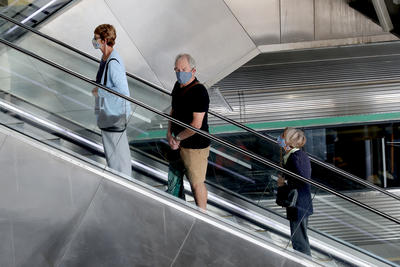
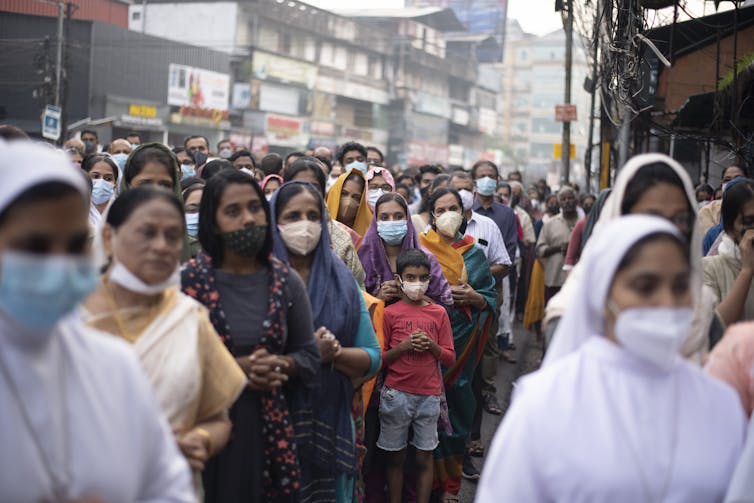
We can disrupt transmission by doing all the things we have been taught over the past two years – social distancing and wearing a mask when we can’t (preferably not a cloth one), regularly washing our hands, improving ventilation by opening windows and using an air purifier for poorly ventilated spaces. And we can isolate when we’re sick.
 WA is among the states who’ve reduced the reinfection window to 28 days.
AAP/Richard Wainwright
WA is among the states who’ve reduced the reinfection window to 28 days.
AAP/Richard Wainwright
Read more: How accurate is your RAT? 3 scenarios show it's about more than looking for lines
A reinfected future?
There is some hopeful recent data that shows while reinfection might be commonplace, it is rarely associated with severe disease. It also shows booster shots provide some modest protection.
While some (unlucky) individuals have become reinfected within a short time frame (less than 90 days), this appears to be uncommon and related to being young and mostly unvaccinated.
Plans for the rollout of mRNA booster vaccines to target the Omicron spike protein mutations offer the promise of regaining some immunological control of these variants. That said, it will only be a matter of time before further mutations develop.
The bottom line is it will be hard to outrun becoming infected or reinfected with a COVID variant in the years to come.
We can’t do much about the evolution of the virus or our own immune systems, but we can dramatically reduce the risk of severe infection in ourselves (and our loved ones) and disruption to our lives, by staying up to date with vaccinations and following simple infection-control practices.
Authors: Ashwin Swaminathan, Senior Lecturer, Australian National University