

Labor promises law reform for Australia's environment. Here's what you need to know
- Written by: Laura Schuijers, Deputy Director, Australian Centre for Climate and Environmental Law and Lecturer in Law, University of Sydney
Federal Environment Minister Tanya Plibersek acknowledges “it’s time to change” after the State of the Environment report revealed a bleak picture of Australia’s natural places.
In a speech on Tuesday, Plibersek foreshadowed a suite of reforms to Australia’s environment policies, including new legislation to go before parliament next year. Plibersek told reporters:
Australia’s environment is bad and getting worse, as this report shows, and much of the destruction outlined in the State of the Environment Report will take years to turn around. Nevertheless, I am optimistic about the steps that we can take over the next three years.
The changes will be informed by the government’s response to Professor Graeme Samuel’s independent review of federal environment law. That review found the law, the Environment Protection and Biodiversity Conservation (EPBC) Act, has failed to safeguard Australia’s vulnerable plants, animals, and ecological communities.
Having been in the minister’s chair for only six weeks, Plibersek was hesitant to outline major policy initiatives and said the government would consult widely before making changes. She says overhauling Australia’s environmental protections will be “challenging” and public views on the right policy response will differ wildly.
Our collective expertise spans environmental law and ecosystem processes. Here, we consider whether today’s announcements go far enough to restore and protect Australia’s precious natural assets.
What’s been promised?
Plibersek’s speech contained a couple of new announcements, and a reiteration of previous policy pledges. As well as committing to a response to the Samuel review by the end of the year, these include:
setting clear environmental standards with explicit targets
fundamental reform of national environmental laws and a new national level Environmental Protection Agency to enforce them
expanding Australia’s national estate to protect 30% of land and 30% of oceans by 2030
producing better and more shareable environmental data to better track progress and decline
including environmental indicators in the government’s new “wellbeing budget”
supporting investment into blue carbon projects, such as restoring mangroves and seagrasses
doubling the number of Indigenous rangers to 3,800 this decade and increasing funding for Indigenous protected areas.
enshrining a higher national emissions reduction target into law.
These important changes are likely to lead to environmental gains. But the key will be ensuring progress is independently monitored, and that new laws and targets can be amended as needed.
Changes urgently needed
The commitment to expand Australia’s national estate may be comforting, but it misses crucial context. As the report notes, the overall level of protection within reserves has fallen.
In fact, in some of our most prized protected areas, threatened species are declining. These include northern quolls, northern brown bandicoots and pale field-rats in Kakadu National Park.
Researchers estimated in 2019 that we spend only 15% of what’s needed to avoid extinctions and recover threatened species. Expanding protected areas means little unless accompanied by adequate funding for species recovery.
Read more: One cat, one year, 110 native animals: lock up your pet, it's a killing machine
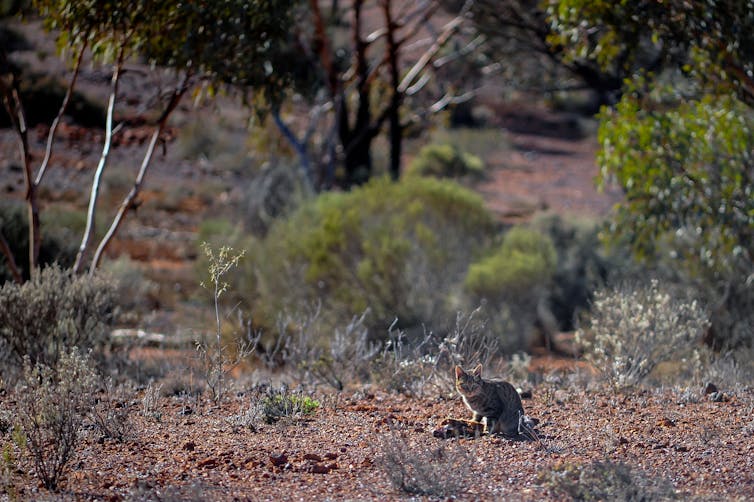
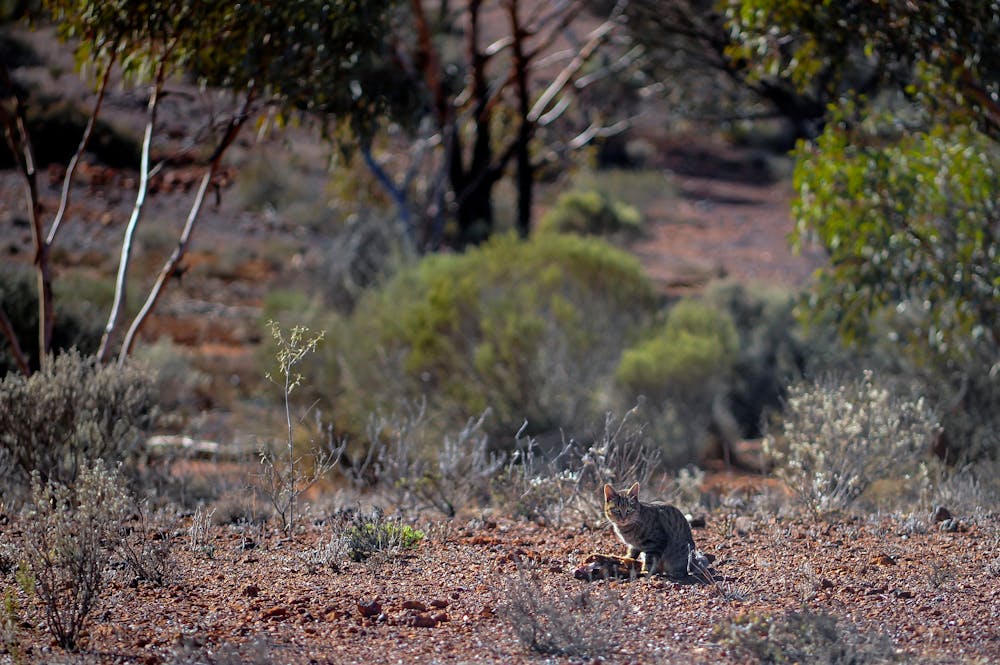
The report also recognises invasive species as one of the biggest threats to native biodiversity. In particular, feral and domestic cats have played a leading role in most of Australia’s mammal extinctions since colonisation.
Controlling invasive species such as feral cats will be difficult without developing new management strategies that can be applied at scale. This will require more investment in research and adequate resources to trial, test and monitor approaches.
Rates of land clearing also continue to soar, as Plibersek noted. But we’re yet to see details of how the federal government plans to address this crucial issue.
Nonetheless, Plibersek spoke optimistically about cooperating with state and territory governments, who are primarily responsible for forests in their jurisdictions.
The next five-yearly review of the Regional Forest Agreements – made between federal and state governments – offer an important opportunity. These agreements broadly exempt logging operations from federal environmental law.
Cooperating with the states will be important in addressing the environmental challenges posed by, for instance, native forest logging in Victoria, which has contributed to the greater glider being recently listed as endangered.
 Environment Minister Tanya Plibersek with a greater glider, a species recently listed as endangered.
AAP Image/Mick Tsikas
Environment Minister Tanya Plibersek with a greater glider, a species recently listed as endangered.
AAP Image/Mick Tsikas
New environmental law for 2023
Plibersek noted the importance of climate change as a cumulative threat to the pressures already affecting the environment.
While she reinforced her election promise to legislate emissions cuts, she skirted around how climate change’s harms to biodiversity could be incorporated into environmental law. A fundamental issue with the EPBC Act is that there’s no explicit mention of climate change.
This could be a problem if federal support continues to be given to new projects that could also undermine emissions targets. For example, the federal government recently approved Western Australia’s Scarborough-Pluto gas project. It is set to be one of Australia’s most emissions-intensive developments.
Another crucial problem with the EPBC Act, as Professor Graeme Samuel recognised is his review, is that it operates in a piecemeal way.
Instead of protecting the environment holistically, it’s triggered when individual projects are likely to affect specific aspects of the environment, such as a threatened species.
When triggered, the act requires an assessment of a project’s potential impact, but doesn’t require any specific measurable outcomes once the project has gone ahead.
It also focuses on lists of species and places, rather than the interactions within and between environmental systems. It will be impossible for the new government to adequately respond to the Samuel review without acknowledging this major flaw.
The proposal to introduce national environment standards next year will make a positive difference. It needs to operate not as a vague reference point, but as a ceiling.
We can’t afford to fail
Continuing to ignore the damning evidence revealed in the report today will worsen Australia’s biodiversity crisis. Not only will further losses lead to more extinctions, they will also compromise our ecosystems’ ability to support us.
Biodiversity loss has been heralded as one of the top threats to the global economy, ranking third behind climate change and extreme weather events.
Australia’s extinction track record is among the world’s worst. Failing to make the necessary legal and policy reforms could not only represent a missed opportunity to restore past losses, but also lock in further decline for decades.
The report shows the best time to take action has passed. The second best time is now.
Authors: Laura Schuijers, Deputy Director, Australian Centre for Climate and Environmental Law and Lecturer in Law, University of Sydney


















