

Despite what political leaders say, New Zealand's health workforce is in crisis – but it's the same everywhere else
- Written by: Paula Lorgelly, Professor of Health Economics, University of Auckland
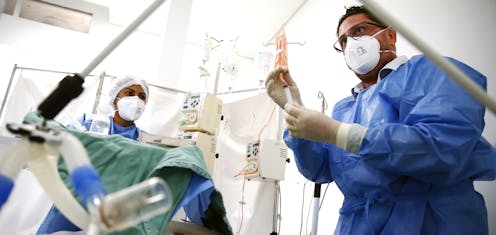
Earlier this week, New Zealand health minister Andrew Little stated what most who work in health already know.
Healthcare is all about people – the people being cared for and the people doing the caring.
Population growth, ageing and a pandemic mean there is no shortage of those needing care, but in New Zealand and globally, there is a chronic shortage of healthcare workers.
Little stopped short of calling it a crisis, but researchers and international agencies alike agree with a survey of New Zealand doctors that the health workforce is in crisis.
In 2016, the World Health Organization (WHO) projected a global shortage of 18 million healthcare workers by 2030. That was before the COVID-19 pandemic. Between 80,000 and 180,000 healthcare workers have died globally during the pandemic’s first 16 months, according to the WHO’s conservative estimate.
Add to this the impact the pandemic has had on the mental health of frontline health staff, including reports of post-traumatic stress disorder (PTSD), and a healthcare workforce seven times more likely to have severe COVID and now carrying the burden of long COVID. It’s clear healthcare is no longer the attractive sector it once was.
Read more: Nurses are leaving the profession, and replacing them won’t be easy
A highly mobile workforce and a global shortage
Like the cost-of-living crisis, the health workforce shortage is not unique to Aotearoa New Zealand.
This year’s budget included NZ$76 million for medical training and primary care specialists, but doctors who started training this year will not be specialists until 2034. Meanwhile, Labour’s solution is to undertake an international recruitment drive. It is hailing New Zealand as one of the easiest places in the world for healthcare workers to come to. But are our newly opened borders attractive enough?
In my health economics lectures I often use an anecdote about the Indian doctor who gets a job in the UK (colonial ties and a multicultural society), the British doctor who moves to Canada (less administration and more family friendly hours), the Canadian doctor who moves to the United States (specialists have much higher earning potential), and the US doctor who undertakes missionary work in India.
This highlights two issues: the health workforce is highly mobile and employment isn’t always about money. Aotearoa New Zealand is competing in a global health workforce market, and minister Little recently acknowledged the health sector as “fiercely competitive”. But this isn’t a new phenomenon for New Zealand.
Read more: A burnt-out health workforce impacts patient care
The health workforce in New Zealand has one of the largest shares of migrant workers, with 42% of doctors and almost 30% of nurses foreign-born (second only to Israel and Ireland, respectively). This is much higher than the aggregate estimates showing one in six doctors practicing in OECD countries studied overseas.
The OECD estimates the number of foreign-born doctors and nurses in OECD countries has increased by 20%, twice the growth rate of the overall increase across the workfery concerning.
The health workforce is not equally distributed. Migration of workers from low- and middle-income countries to high-income countries like Aotearoa New Zealand is a real threat to achieving universal health coverage and sustainable development goals. New Zealand needs to be mindful that promoting our open borders is not at the expense of under-performing health systems with much greater need.
Losing healthcare workers to Australia
Outflow is also a problem in New Zealand, with New Zealand-trained doctors and nurses crossing the Tasman every year. Add to this the international recruits leaving New Zealand for Australia and there most definitely is a health workforce crisis.
As our nearest neighbour, Australia is aggressively recruiting staff. And like pavlova and Phar Lap they are happy to claim what is ours as theirs. An easier route to citizenship and voting rights will make Australia even more desirable.
How can New Zealand compete in this market? Minister Little refers to encouraging Kiwis to return home, including lifting their pay. Research shows it’s not all about income. Location and professional development opportunities are important factors when choosing career moves.
The healthcare reforms helped tempt me back to New Zealand after 22 years away. Perhaps working in a system which has equity as its focus may encourage those who are clinically trained to return as well.
There is considerable research to inform policies around retention and recruitment. The New Zealand Ministry of Health may wish to look to the UK, which was historically dependent on EU health and care workers and now has a health workforce depleted by both Brexit and the pandemic.
In the recent LSE-Lancet Commission on the future of the NHS, British scholars argued a sustainable workforce needed integrated approaches to be developed alongside reforms to education and training that reflect changes in roles and the skill mix, and more multidisciplinary working.
The LSE-Lancet Commission authors flagged the need for better workforce planning. New Zealand’s approach to workforce forecasting has also been criticised previously.
Planning aside, a possible solution worthy of discussion is the required skill mix of the workforce, particularly with technological advancements and changing health needs. For example, the introduction of non-medical prescribers has improved job satisfaction, released clinical time and increased patient access.
New Zealand’s once-in-a-generation health reforms offer a logical time to undertake workforce reforms. We need to learn from our own historical mistakes and avoid disconnecting the workforce from the policy reforms.
If minister Little and the ministry are to solve this, he will first need to admit there is a health workforce crisis. Aotearoa New Zealand is unfortunately not alone in its quest to adequately staff healthcare, but the transformation of the health sector to create a more equitable, accessible, cohesive and people-centred system means New Zealand is uniquely placed to put those people who deliver care at the centre.
Authors: Paula Lorgelly, Professor of Health Economics, University of Auckland


















