

Urban patchwork is losing its green, making our cities and all who live in them vulnerable
- Written by: Gregory Moore, Senior Research Associate, School of Ecosystem and Forest Sciences, The University of Melbourne
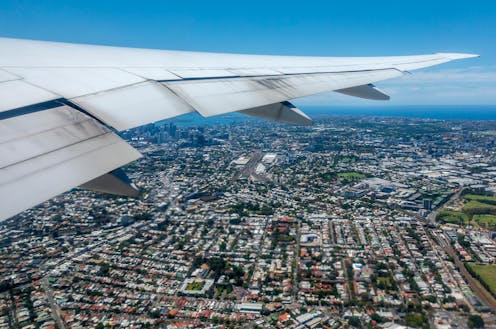
One delight of flying is seeing our familiar landscapes in a new way from above. At low altitude most of us know where things are, but as we ascend it becomes difficult to determine the local details, and we begin to see a bigger picture. Sometimes this bigger picture can be scary.
After nearly three years of being unable to fly I have had a couple of recent opportunities to take to the air. My first observation was that in many once-leafy suburbs the green tinge is disappearing under a tsunami of development. You can see this new development on the fringes of towns and cities, as well as redevelopment and infill in the older places. Familiar rows of roadside trees and large old trees that were once suburban landmarks have gone.
As you look from above, it comes as no surprise that the latest State of the Environment report delivered damning findings this week. Vegetation cover in cities is diminishing. So too are the wildlife corridors that once connected now-isolated remnant communities of plants and animals.
Read more: Roadside trees stitch the ecosystems of our nation together. Here’s why they’re in danger
Most of you will have heard people describing the view we get from above as being like a patchwork quilt of different colours and land uses, or perhaps like an Indigenous painting that gives us a bird’s eye view of the world below. It shows us a jigsaw puzzle of the disturbed and fragmented environments in which we live.
However, as we soar higher we are reminded that there is only one space, that it is all connected. Each piece of the jigsaw has a place in the big picture.
Cities can’t afford to lose their green cover
Not all green cover has gone in the past few years, but the losses are noticeable. And unless something is done quickly, they will continue. We will reach the point where so many trees are lost that it will jeopardise the capacity of our cities and towns to be resilient, liveable and sustainable in the face of climate change.
No local government can deal with this situation. It is a matter of state and federal planning policy and development regulation.
In most states, for example, developers adopt a scorched-earth policy of removing most, if not all, mature trees from a site before construction begins. State government agencies help deliver treeless sites for development. Expensive government legal teams often fight local community groups opposing tree removals through tribunals and courts.
Vegetation needs to be valued both for the habitat it provides and for the many services it provides to residents of towns and cities. As heatwaves become more intense and frequent, it’s sobering to think the loss of urban trees will result in greater urban heat island effects and more heatwave-related illnesses, hospitalisations and deaths.
Read more: Thousands of city trees have been lost to development, when we need them more than ever
Lockdowns reminded us of the value of these spaces
It was fascinating to watch the use of public open space during COVID-19 lockdowns. Concerns about people’s physical health, capacities for coping with stressful situations, increased risks of self-harm and domestic violence, and the learning and development environments of children led to people flocking to their local parks, gardens and riverside reserves.
From the air, though, it becomes painfully obvious that not every suburb or region has many such spaces. It is well known worldwide that people in areas of lower socio-economic status (SES) are disadvantaged by lack of access to treed open space.
This is true of Australia’s cities, regional centres and many country towns where some of the jigsaw pieces seem to be devoid of green. Lack of treed green space is associated with problems such as obesity, poor physical and mental health and social disadvantage.
It’s highly likely people in these areas were further disadvantaged and subjected to greater stress during the lockdowns because of the lack of accessible treed open space. Perhaps this partly explains why some urban areas had lower levels of lockdown compliance than others. There is evidence that the health benefits of access to treed open space are greatest for lower-SES communities.
Read more: Coronavirus reminds us how liveable neighbourhoods matter for our well-being
Public parks and gardens served their purpose admirably during lockdowns. With proper planning, they will do so again in enabling cities to cope with climate change. However, if cities and suburbs keep losing green space and tree cover, their capacity to adapt will be limited. Society as a whole will be the loser.
The mosaic quilt we see from the air reveals just how disconnected the green patches and corridors of our landscapes and urban environments have become. It is astonishing to see developments of large houses on small blocks, which could have been plucked from the new suburbs of any major Australian city, fringing hot, inland towns. There appears to have been no recognition of the effects of a hot Australian summer.
The rapid expansion of Australian cities and towns presents planning challenges in the face of demands to subdivide undeveloped land for housing, countered by demands for connected, treed, public, green space. Providing large and well-connected green space is going to be essential urban infrastructure for increased urban populations facing climate change. It’s not a luxury for a privileged minority, but a vital component of a sustainable economy and environment for all.
Authors: Gregory Moore, Senior Research Associate, School of Ecosystem and Forest Sciences, The University of Melbourne


















