

what The Queue says about Englishness
- Written by Cynthia Sear, PhD Candidate, The University of Melbourne
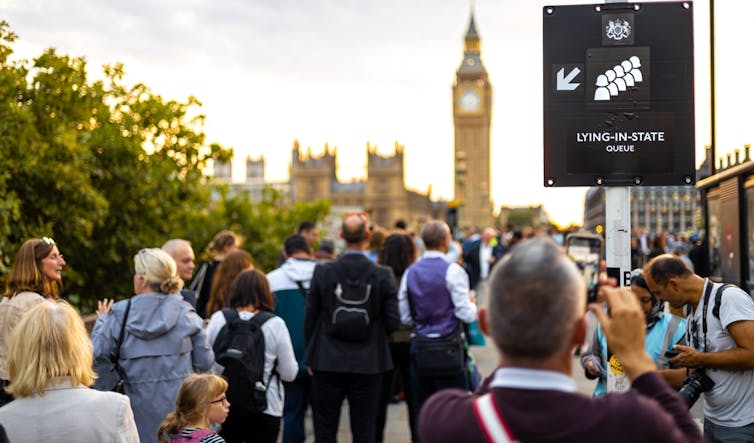
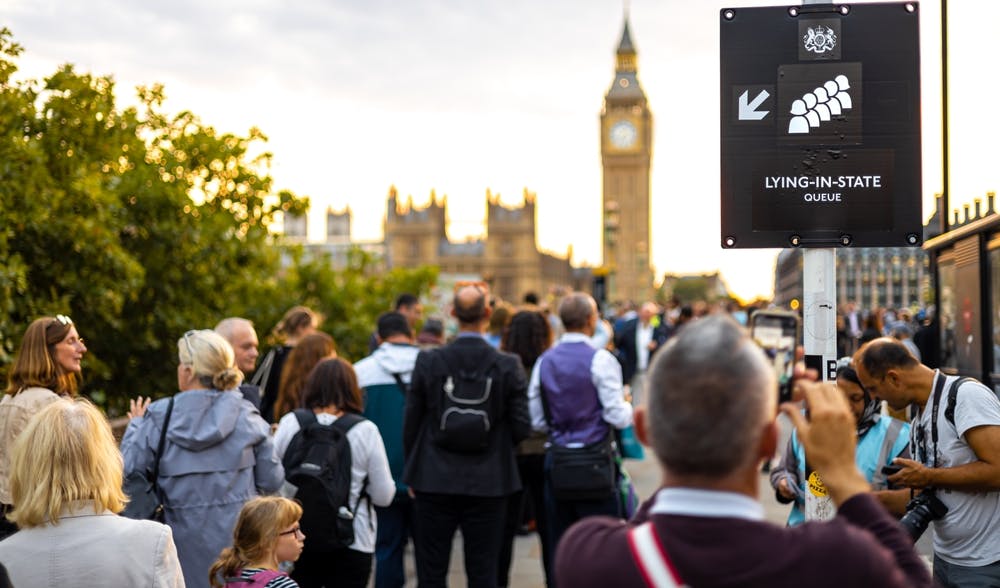
As we have seen from coverage of “The Queue” – capitalised and thus now, apparently, a proper noun – the English are proud of their queuing prowess.
The Queue for the queen lying in state is portrayed as testament to the English ideals of civility, duty and sacrifice.
David Beckham’s 13-hour wait in the crowd was widely praised, while TV hosts Holly Willoughby and Phillip Schofield’s alleged (although denied) “push-in” has been admonished.
But The Queue is part of a bigger picture. Like class, the English propensity to celebrate queuing illuminates a peculiar national obsession with order, hierarchy, and one’s place within it.
Queueing as a form of ceremony
Let’s address something important: are we talking here about Britishness or Englishness? What is seen to define an English person, British person or person of the United Kingdom is a matter of considerable debate. Our choice of the word “English” over “British” in this article reflects the fundamental Englishness of the British national project, to which the monarchy is central.
The English proclivity for queuing has been the subject of cultural commentary for decades.
In 1946 Hungarian humourist George Mikes reportedly noted:
An Englishman, even if he is alone, forms an orderly queue of one […] [queueing is] the national passion of an otherwise dispassionate race.
British anthropologist Kate Fox, author of Watching the English, wrote that in the 2011 London riots:
I witnessed looters forming an orderly queue to squeeze, one at a time, through the smashed window of a shop they were looting.
Queueing as a form of ceremony, such as seen in London this week, is perhaps a particular type of queue.
In defiance of the typical English reservedness, The Queue has been credited with fostering cameraderie and even chance meetings.
Read more: Queen Elizabeth II: capturing the world's most photographed woman in life and death
Queuing in England and around the world
Of course, it’s not only the English who queue. Regulating the flow and order of people is a universal human need.
Saving space in densely populated urban milieu, Japanese people form tight zig-zags.
In Spain, the penultimate person to arrive for a bus merely nods to the last person to let them know whom to follow.
In both cases, what appears to be anarchy is, in fact, tightly regulated.
However, there is something culturally distinctive about the English queue. The English seem to have a fondness for publicising their queuing ability.
Queuing and deficiency
While much of the recent coverage has emphasised the egalitarianism of The Queue, researchers such as Joe Moran have noted queuing has endured a chequered past.
In economically impoverished postwar Britain, food queues became a source of national resentment.
Many felt the queue was an unfair method of distribution – especially for older people, mothers with young children or working women, who faced more difficulty to wait in line for essential items.
In the late 1940s and early 1950s Winston Churchill seized on the unpopularity of queues to argue:
We [The Conservatives] are for the ladder. Let all try their best to climb. They [Labour] are for the queue. Let each wait in his place till his turn comes.
Queues, he argued, were socialist, and that, should a Labour government have its way, the country could become “Queuetopia”.
In the 1960s and ‘70s the English faced recurrent queues at banks and post offices. The queue was widely depicted as a symptom of inefficiency of the national economy, something one might expect on the other side of the Iron Curtain, but not appropriate for Britain.
Throughout the late 1970s and the 1980s, associating queues with incompetence and disorganisation was a constant theme in politics.
Advertising firm Saatchi and Saatchi produced a 1978 election poster for the Conservatives depicting a queue outside the unemployment office and the slogan: “Labour isn’t working”.
Queues and queue-jumping
More recently, as observed by sociologist Arlie Russell Hochschild, the queue and queue-jumping have been weaponised in political discourse regarding minorities.
As one of us (Andrew Dawson) has noted, many of Britain’s white working class perceive the British policy of multiculturalism as a relegation of their status.
The benefits that flow to immigrant ethnic minorities are often presented as an unfair “push-in” for the social mobility ladder, allowing them to effectively “jump” Britain’s class queue.
That queuing for social occasions such as the queen’s death has been reimagined in recent years as a positive phenomenon is curious.
Whether in a queue or a ladder, however, such appeals to social organisation are about knowing one’s place – a particularly English preoccupation.
Ask any Englishperson about their position in society. Depending upon their class, they may be embarrassed or affronted by the question, but they will have an answer, whether they share it with you or not (determined, again, by their class).
To this end, the reaction to Willoughby and Schofield’s alleged transgression speaks to the ability of this class system to reassert itself in the face of celebrity and fame.
Perhaps The Queue helps to explain why Meghan Markle, Duchess of Sussex, has experienced such hostility upon entering British society. Not just because of discriminatory and racist attitudes based on her biracial, divorcee, actress status, but also because she is American.
Queuing is seen by some as antithetical to America’s rampant individualism – where your place is often imagined as malleable rather than rigid, dependent on achievements, popularity and wealth.
Australians also may recoil at suggestions of one’s place in society, with some insisting that in contrast to the stuffy British “motherland”, we are a classless society.
While “The C-word”, as the Australian author Tim Winton called class, of course very much exists in Australia, we have far less of a vocabulary or understanding of class than the English.
While it may be less obvious in Australia, or railed against in America, many English people continue to embrace these systems even as the wider world moves on in seemingly disordered ways.
Read more: How does class impact on Australians' love lives? New research brings a complex issue into the open
Authors: Cynthia Sear, PhD Candidate, The University of Melbourne

















