
why it's time to act
- Written by: Mark RW Williams, Solicitor in private practice and Adjunct Professor in the School of Art, RMIT, RMIT University
Cauis Norbano Sorice was an actor of secondary roles. His herm (a sculpture of his head, mounted on a long pillar) stood in the porticus of Pompeii’s forum, by order of the city’s senators, when it was engulfed and preserved by volcanic ash in AD 79. We don’t know any more about this actor, but clearly he was regarded as a person of high status to be accorded this honour. We can’t say the same for working actors in Australia today.
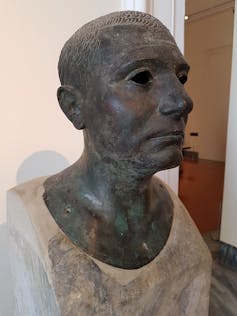 C. Norbano Sorice, National Museum of Archaeology, Naples.
Photograph, Mark Williams
C. Norbano Sorice, National Museum of Archaeology, Naples.
Photograph, Mark Williams
Compared to other Australian workers, professionals in the performing arts will end up poorer, have worse mental and physical health, and a shorter lifespan. They have made substantial contributions to our culture - yet traditional support networks all too often fail them. This means, as a society, that we have failed them. And in doing so, we have failed ourselves.
The latest economic study by David Throsby and Katya Petatskaya shows the population of professional artists is ageing, incomes have plateaued and self-employment is on the rise. It dovetails with Victoria University/Entertainment Assist’s report of October 2016, which focused on mental and physical health in the sector. It found suicide attempts among those working in the entertainment industry were more than double those of the general population. Levels of moderate to severe anxiety symptoms were 10 times higher than in the general population, with symptoms of depression five times higher.
Read more: Mental health woes are rife in the arts – no wonder
A 2015 Media Super Study meanwhile, found that most members working in arts and entertainment consider their work is important to the nation but are ignored by government and will be unable to support themselves in retirement. Indeed, the mean gross savings for those over 45 in MediaSuper, the main industry superannuation fund for workers in all media (including artists), was A$58,000 as of 2016. For those in UniSuper, by contrast, the figure was $144,000.
There has been a positive response to these various findings from flagship institutions such as the Sydney Opera House and Arts Centre Melbourne. But most people in the arts spend their careers underemployed, have multiple employers and work as freelancers here and internationally.
Studies of varying persuasiveness over the last few years point to factors such as insecure work, irregular working hours and high workplace mobility leading to reduced social networks, family instability and a lower sense of self-worth for those in the arts, when measured against the rest of society. Australian Ballet’s resident psychologist, Lucinda Sharp, also points to perfectionism and concern about body image as a source of insecurity.
Read more: Out of character: how acting puts a mental strain on performers
Housing is a major problem for many in the arts. Without regular income, most struggle to gain a foothold on the housing ladder. Yet tax advantages in Australia (such as negative gearing and salary sacrificing) mostly benefit those who own houses and have considerable super.
Within a free society, independence of thought requires independence of means. When either is compromised – by the industrialisation of culture or the fragmentation of material support – the consequences for the individual in terms of mental and physical health can be dire. The artist in society is thus the canary in the coal mine of the gig economy.
What can be done about this dire situation? In a new Platform Paper, released today, I suggest a number of possible solutions. They include:
Government, in addition to low-balance support for superannuation, considering a further supplement based on the salary sacrifice principles common in other sectors where artists, in relatively good times of well-paid work, could make additional contributions to their super via the PAYG system.
A levy of as little as five cents on every ticket to a live performance sold in Australia to support a tightly administered fund delivering welfare solutions to artists. There are other possibilities allied with large-scale entertainment: in the UK, since 2007, Britain’s Got Talent has donated a portion of money raised through phone voting to the Royal Variety Charity Fund.
More training (and funding) within arts companies to deal with health and mental health issues.
Industry superannuation funds looking at the provisions of their trust deeds to see if they can set up and administer emergency and other charitable support for members of the industries they cover - out of specific reserves - in a way that would not infringe the ancillary purpose test of the superannuation guarantee charge.
Maybe, too, we need to go back to the fork in the road others have travelled. The personification of that in Australian theatre was an actor-manager, “low comedian” and later Victorian MLA, George Selth Coppin.
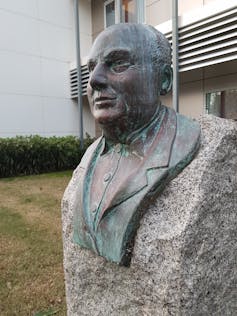 A herm of George Selth Coppin, Coppin Centre, Freemasons’ Homes, Melbourne.
Photograph Mark Williams
A herm of George Selth Coppin, Coppin Centre, Freemasons’ Homes, Melbourne.
Photograph Mark Williams
Instrumental in the creation of the Distressed Actors’ Fund and the Australasian Dramatic and Musical Association, Coppin arranged a grant of land, originally referred to as the Dramatic Homes in 1871. It later merged into the Old Colonists’ Association, which he also co-founded. The association exists to this day in North Fitzroy providing accommodation to people (some but not all of them actors) otherwise unable to afford secure housing in their old age.
In Britain, the US and Italy, institutions such as Denville Hall, Brinsworth House, Royal Opera House Benevolent Fund, the US Actors’ Trust and Casa Verdi, were founded around the same time. They continue to help those in the performing arts.
But Australian philanthropic models withered with the creation of the welfare state and compulsory superannuation. They need to be revived.
Mark Williams is the author of Falling through the Gaps: Artists’ Health and Welfare, available from Currency House. It’s launched today in Sydney with forums to follow in Melbourne and Canberra.
Authors: Mark RW Williams, Solicitor in private practice and Adjunct Professor in the School of Art, RMIT, RMIT University
Read more http://theconversation.com/artists-welfare-why-its-time-to-act-100736


















