
what are wisdom teeth and should I get mine out?
- Written by: Seth Delpachitra, Clinical Tutor in Oral and Maxillofacial Surgery, Faculty of Medicine, Dentistry and Health Sciences, University of Melbourne
Unfortunately, oral and dental pain is something everyone can relate to. One of the most common reasons people visit the dentist is for pain related to their “wisdom teeth”, or the third set of molar (grinding) teeth to erupt from the gums.
It’s difficult to prevent wisdom tooth problems from occurring – even in those with excellent oral hygiene habits. Even with no gum disease or tooth decay, wisdom teeth can be a source of pain, swelling, and infection.
Read more: Health Check: is chewing gum actually good for your teeth?
What is a wisdom tooth?
All people develop two sets of teeth in their lifetime. The first set (“baby teeth”) start to develop during infancy, and provide the necessary function of cutting and grinding food in childhood. From the age of six until early adulthood, these teeth are gradually replaced with the second set, or “permanent” teeth. Generally, the average adult will have a total of 32 permanent teeth.
The “wisdom teeth”, or third molars, are the last of the permanent teeth to erupt into the mouth. This tends to occur at the age of 18-25 years (historically but inaccurately associated with the development of wisdom).
Wisdom teeth are always the teeth furthest back in each quadrant of the mouth. Most people develop four wisdom teeth, but many people may only have three, two, one, or if you are particularly lucky, none.
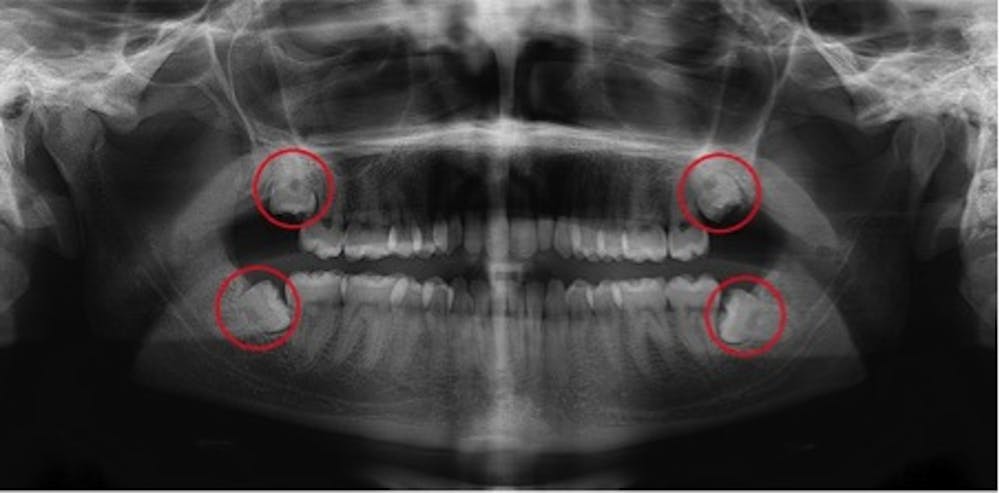 A set of four impacted wisdom teeth.
Author provided
A set of four impacted wisdom teeth.
Author provided
The wisdom of extracting third molars
Anthropologists believe changes in our dietary habits to softer, less abrasive foods have reduced the amount of tooth wear, meaning larger teeth and less room in the jaw. As such, by the time wisdom teeth erupt, there may not be enough space in the jaw for this process to occur normally. The result is impaction, where the tooth emerges at an abnormal angle. This can cause pain for two reasons:
the erupting wisdom tooth can press on the second molar
the tooth can stay partially erupted, leading to a pocket in the gum where food can collect, potentially causing infection and tooth decay.
A serious and unfortunately common complication of impacted wisdom teeth is infection, which if left untreated can spread deep into the face and neck and become life-threatening.
In very rare circumstances, tissue around the impacted teeth can become abnormal and lead to the development of cysts or tumours.
Impacted wisdom teeth never become fully functional, and the best way to manage the problems they cause is to remove the tooth. Because of the tight space and impaction, this is generally a complex surgical procedure that requires a specialist oral and maxillofacial surgeon, who are both doctors and dentists.
Read more: Four myths about water fluoridation and why they're wrong
When should I get them out?
In many people, wisdom teeth can erupt and grow normally, and there is no reason to remove them. While everyone should have a routine dental x-ray around the time of wisdom tooth emergence, only people with pain or signs of impaction or abnormalities need removal.
Occasionally, your surgeon may recommend a period of observation as it may be too early to tell whether your teeth will become impacted or not.
If your dentist does recommend removal, timing wisdom tooth extraction is based on a combination of symptoms, risks, and convenience. Removing wisdom teeth too early can mean a more challenging operation as the teeth may still be deeply embedded in the jaw bone; too late can mean an increased risk of complications due to the negative effects of ageing on the bone, teeth and gums.
Having wisdom teeth removed from age 18-25 is generally recommended, as there is a decreased chance of damage to adjacent teeth, lower risks associated with the procedure, and a faster recovery time.
What are the risks?
As with any surgery, there are some risks associated with the procedure. Some minor swelling, bruising, bleeding, and pain is to be expected, and this usually lasts no more than one week.
The following small but unexpected complications may occur following your surgery:
dry socket, or alveolar osteitis, is a painful condition of excessive inflammation in the wisdom tooth socket and this can occur days after the procedure. Dry socket is not an infection, but a failure to appropriately maintain a blood clot in the extraction socket, which is necessary for healing to occur. Dry socket is much more common in cigarette smokers, and so it’s generally advised not to smoke in the days preceding wisdom tooth extraction, up until the gum tissue has healed.
nerve injury. Close to the roots of lower wisdom teeth is a nerve that supplies feeling to the lip and chin. Sometimes this can be damaged during the procedure, leading to temporary numbness in these areas. Another nerve that supplies taste and feeling to the tongue may also be injured during the procedure, but this is less likely. Very rarely, nerve injuries can be permanent. Your surgeon should discuss this with you during consultation, as the wisdom tooth may not be suitable for extraction if intimately involved with the nerves in the region.
post-operative infections are a complication of any surgical procedure, and wisdom tooth extraction is no different. While there is no need to routinely use antibiotics after tooth extraction, your surgeon may offer antibiotic therapy if there are early signs of infection at the surgical site.
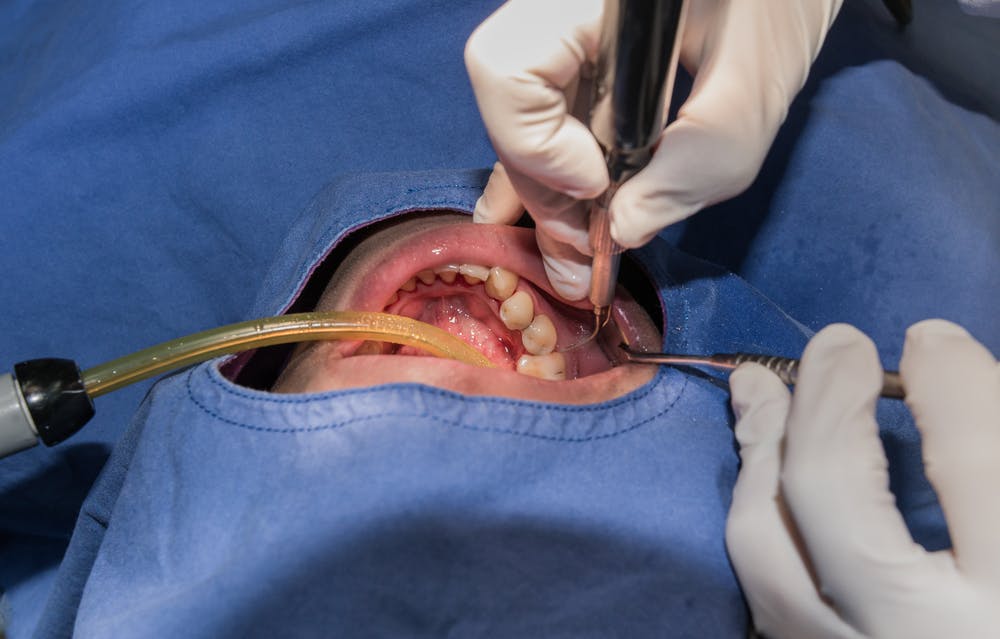 All surgeries carry risks.
from www.shutterstock.com
All surgeries carry risks.
from www.shutterstock.com
Read more: Bad teeth? Here's when you can and can't blame your parents
‘Knocked out’ or ‘in the chair’?
Wisdom teeth can be removed under local anaesthesia, or general anaesthesia. In either case, the surgical procedure involved is the same. Your specialist will generally offer both options, unless there’s a particular reason to not proceed with one or the other.
General anaesthetic is performed in a day surgery or hospital and involves a specialist anaesthetist to put you to sleep using medications through a drip. As a result, you will not be awake for the procedure nor remember any associated discomfort.
A general anaesthetic is very safe and commonly used for minor operations, but they do require you to be fasted for at least six hours before the operation, and you may experience some drowsiness, nausea, or lethargy for 24 hours afterwards. Depending on your medical status and conditions, you may not be suitable for general anaesthetic.
Local anaesthetic involves the administration of dental injections to numb the tooth and surrounding tissues. While the dental injections may cause some minor discomfort initially, the procedure is painless, but you may still feel vibration and hear noises associated with the dental instruments.
But no general anaesthetic means no associated side effects, so most people can return to their usual duties shortly after the procedure. Local anaesthetic may not be suitable in complex or difficult cases, or if you suffer from severe anxiety visiting the dentist.
So if you’re experiencing any pain in your jaw, talk to your dentist. She will be able to assess your wisdom teeth and order an x-ray, reassure you if everything is normal, or refer you to a specialist if needed.
Authors: Seth Delpachitra, Clinical Tutor in Oral and Maxillofacial Surgery, Faculty of Medicine, Dentistry and Health Sciences, University of Melbourne
Read more http://theconversation.com/explainer-what-are-wisdom-teeth-and-should-i-get-mine-out-100019


















