

Google AI
Modern Australian

what happens when we drink alcohol in four short videos

  • Written by: Emil Jeyaratnam, Multimedia Editor, The Conversation
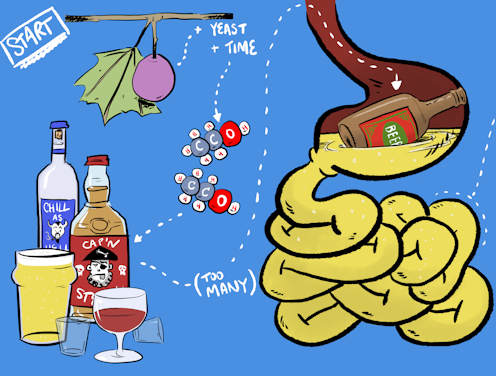
what happens when we drink alcohol in four short videos

Alcohol is a depressant, a diuretic, and a disinfectant. These generally aren’t pleasant attributes, but people have been drinking alcohol for thousands of years – some of the earliest written texts mention or contain recipes for beer, and pottery shards from China show people may have been making alcohol as far back as 7,000BCE.

So what is this special chemical that we’ve loved to drink for so long?

Well, there are many types of alcoholic drinks – fizzy and flat, hot and cold, fermented and distilled – but all of the alcohol we drink as humans is ethanol based.

The process of how ethanol gets from the glass into your brain is not straight forward. And how quickly it gets to your brain (and whether or not it’s quickly broken down by your liver) is down to a variety of factors, one of which it’s actually very easy for us to control: whether or not we’ve eaten.

Let’s take a look at what happens after that first sip of alcohol.

The organ that takes on the biggest burden of processing ethanol in our body is the liver.

The liver is one of our largest and most important organs and it performs hundreds of functions, including converting the nutrients in food into something our bodies can actually use.

But there’s a reason we apologise to our livers if we’ve a big night: the liver’s other job is processing any toxic substances we ingest into something harmless, or removing them from the body altogether. Which makes it the perfect organ to deal with ethanol.

Most – about 90 to 98% – of the ethanol we consume is processed in the liver, with the remainder either removed in our urine, sweat or when we exhale.

The liver processes alcohol in two distinct steps. The first involves an enzyme called alcohol dehydrogenase (ADH), which breaks down ethanol into a chemical called acetaldehyde. Unfortunately acetaldehyde is actually a toxin, which is why there’s a second stage to the process.

Another enzyme – aldehyde dehydrogenase (ALDH) – quickly breaks down acetaldehyde into acetate, which is harmless. It’s then either excreted, used to make other molecules or broken down into water and carbon dioxide.

And it’s while your liver is slowly processing the ethanol in your system (as quickly as it can) that the remainder makes its way to your brain.

A complicating factor for determining how drunk we’re likely to feel after a certain amount of alcohol is that different people will process alcohol at different speeds.

There are many things that impact how quickly the body processes alcohol, including your weight, body composition and hormones, the number of drinks you’ve had and how quickly you drank them.

But roughly, the liver can effectively process about 1 standard drink in an hour, give or take. Women and men do process alcohol at different speeds, which is why alcohol campaigns often suggest women consume fewer drinks in the first hour than men.

The problems start when you consume more than a standard drink per hour – which is not hard to do, given an average bottle of beer has 1.2 to 1.4 standard drinks, and a restaurant sized glass of wine is about 1.5 standard drinks.

While it can be hard to match up exactly how many drinks equate to how intoxicated you’ll feel, your blood alcohol concentration (or BAC) gives a pretty good indication of what most people will feel as they ingest escalating amounts of alcohol.

So what does that actually look like?

Alcohol makes us feel increasing pleasure and relaxation as we drink more, while simultaneously hampering both our ability to make decisions and even move capably, which can lead to dangerous consequences.

The actual recommended intake for adults is just two standard drinks a day, which is less than a pint of beer. Realistically, many Australians often drink more than this. So the important thing is to be aware of your limits, plan for how much you intend to drink, eat a meal before you begin drinking, and drink responsibly.

Read more: There are four types of drinker – which one are you?

Authors: Emil Jeyaratnam, Multimedia Editor, The Conversation

Read more http://theconversation.com/drink-drank-drunk-what-happens-when-we-drink-alcohol-in-four-short-videos-100206

What to Do When an Older Car Is No Longer Worth Keeping in Melbourne

Ever looked at another repair quote and wondered whether your old car is still worth the trouble? It is a common turning point for Melbourne motoris...

Your Baby's First Year: A Local Guide to Feeding, Sleep, and When to Get Extra Support

Ask ten parents in a Brisbane mothers' group how their baby is feeding or sleeping, and expect ten different answers.  Someone's baby sleeps throug...

Kitchen and Laundry Makeover Ideas That Don't Require a Full Renovation

Full kitchen renos are expensive — and most people don't actually need one.  They need the kitchen to stop looking like it's stuck in 2009, or they...

How Technology Is Reshaping the Modern Australian Commercial Kitchen

The commercial kitchen has always been shaped by technology. Refrigeration changed how ingredients could be stored, modern ventilation transformed k...

The Number on a Roller Blind Fabric That Nobody Explains

Somewhere in the fabric book, next to the colour name, there is a percentage. Three per cent. Five per cent. Ten per cent. Nobody explains it, most c...

What’s Trending in Men’s Jewellery This Father’s Day!

Finding a Father’s Day gift that feels personal, stylish and genuinely wearable is not always easy. While socks and novelty mugs have traditionally ...

Road Signs: Understanding Their Role in Clear and Effective Signage

Effective signage and display hardware can help businesses communicate information, promote products and organise customer or visitor movement. Road...

Bottle Label Printing: Key Factors to Consider Before Your Next Packaging Run

Effective packaging begins with understanding the product, bottle material, artwork and production requirements when planning bottle label printing. H...

Planning a Long-Distance Move With Interstate Movers Melbourne

Moving between states involves more planning than a typical local relocation. Along with packing and transporting household belongings, you need to...

Understanding the Role of an I/O Controller in Industrial Automation

Modern industrial systems depend on accurate communication between sensors, machines and control systems. An I/O controller can help manage this commu...

How the Right Mining Hose Supports Demanding Operations

Mining environments place considerable demands on equipment used for material transfer, water management and processing. Hoses operating in these co...

Simple Ideas for Making Social Gatherings More Memorable

We have all been to those parties where everyone just stands around the kitchen island, staring at their phones, waiting for someone else to make a mo...

Outdoor Wall Lights: Improving Exterior Lighting Around Your Home

Lighting can influence how a room looks, feels and functions, so the right fitting should be selected according to both appearance and practical req...

Commercial Office Cleaning: Combining Routine Office Cleaning With Melbourne Service

Keeping a workplace clean requires a service that can accommodate everyday tasks as well as the particular needs of the business. Professional comme...

Caravan Sales in Queensland: How to Find the Right Caravan for Sale QLD

Caravan ownership is about more than having somewhere to sleep while travelling. For many Queenslanders, it is one of the best ways to explore regio...

What Sir Walter Buffalo Turf Actually Costs in 2026 (And Why Quotes Vary So Much)

Two quotes landed on a Hills District homeowner's kitchen table last spring for the exact same 80-square-metre backyard. One said $12 a metre. The o...

Nearly 1,300 NSW Hospital Beds Are Occupied By People Who Are Ready To Go Home

1,276 people in NSW hospitals have been medically cleared for discharge but remain in hospital because they're still waiting for NDIS or aged care sup...

National Survey Launched to Measure Operational Impacts of Federal NDIS Policy Reforms

The effects of recent NDIS reforms are beginning to move beyond policy papers and into day to day service delivery. A new national survey is asking ...
















