

Thailand's mission to reduce statelessness
- Written by: Janepicha Cheva-Isarakul, Teaching Fellow, Victoria University of Wellington
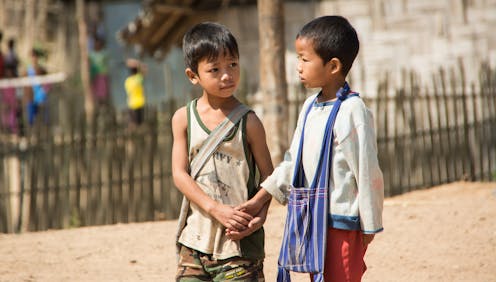
Last month’s epic rescue of the Wild Boars soccer team from a cave in northern Thailand gripped the world.
When it emerged that some of the boys are stateless, the news headlines changed in subtle ways from “Thai boys in the cave” to “boys in Thai cave”. Amid the widespread joy over the successful operation, the rescue has drawn attention to the broader issue of statelessness in Thailand.
Read more: Adul Sam-on: the stateless boy who survived the Thai cave – and helped with the rescue
My research into the lives of stateless youth in Northern Thailand, like those trapped in the cave, shows that classic theories of state succession and state dissolution do not explain the phenomenal number of stateless persons in Thailand.
Instead, uneven economic growth, erratic labour migration policies, bureaucratic failure, legal loopholes and endemic discrimination against non-Thais, especially highlanders (also known as “hill tribes”), are the most frequent causes of statelessness.
Stateless diversity
The exact number of stateless people in Thailand is unknown but it is likely more than two million. Stateless people cannot vote, buy land, seek legal employment or travel freely.
The umbrella term “stateless” might suggest a homogeneous population completely unrecognised by the state, but my ethnographic research reveals a complex and heterogeneous reality. The stateless population ranges from highlanders to children of migrants, who were born in Thailand and do not have ties to their parents’ country of origin.
The various types of non-Thai ID cards issued by the Thai state reflect this diversity. The ID card limits their physical mobility to the province under which they are registered and dictates respective possibilities of Thai citizenship. Until very recently, stateless persons were legally confined to 27 low-skilled occupations. However, this legal amendment only applies to stateless highlanders, and not stateless children of migrants.
Since 2005, all stateless persons have been able to access basic education and health care. In a school uniform, stateless children can appear and feel undifferentiated to other Thai citizen students: they all sing the national anthem, say prayers and play with friends. My research shows that it is only around the teenage years that they become more aware of the limitations of their status and start learning about possible legal pathways to becoming Thai citizens.
Citizenship: right vs deservedness
Following the cave rescue, the boys have since been inundated with offers of help, including full scholarships for university study up to doctorate degrees. The public raised the question whether the boys’ courage and will to survive should “earn” them legal citizenship.
Such citizenship debate is usually framed under the question of “deservedness” rather than a right. Often, this follows media stories about exceptional migrants that counter the negative stereotypes of the non-citizen “other” painted by right-wing politicians.
A case in point is that of Mamadou Gassama, a Malian migrant in Paris, whose bravery and extraordinary climbing skills saved a French child and earned him the title of “spiderman of Paris” as well as French citizenship. In the wake of exceptional events like these, political will often follows the media spotlight on the heroes.
Blood, soil and paper
For now, Thai authorities insist that there will be no preferential treatment for the boys or their coach and that protocols must be followed in order to grant them citizenship.
They must provide proof that they were born in Thailand. This seemingly straightforward and objective process masks the state’s own erratic registration practice of the non-citizen “other”. A birth certificate is now commonly issued to non-Thais, but this wasn’t always the case. However, failure to register a birth is often attributed to the “lack of knowledge” of these non-citizens.
A birth certificate alone does not guarantee citizenship. In principle, Thai citizenship laws recognise both jus sanguinis (right of blood) and jus soli (right of soil citizenship by birth). In practice, claiming citizenship by birth requires a child to present not only his/her documents but also those of his/her parents. The result is a complex system of unevenly applied regulations that distribute citizenship via combinations of blood, soil and paper.
A long road to citizenship
Changes in citizenship laws in late 2016 are said to open a path toward citizenship for 80,000 stateless persons. The UN High Commission for Refugees’ global campaign on ending statelessness by 2024 and the late King Bhumibol’s platinum jubilee have been cited by politicians and rights activists I met as the main motivators for the unprecedented urgency to solve this issue, especially regarding children.
However, these changes still reflect criteria based on “deservedness” rather than a more fundamental right to have rights, highlighting the complexities of contemporary migration. Among the requirements are loyalty to the monarch, good conduct and evidence of educational achievement (completion of a Bachelor’s degree).
Read in this light, the complex situation facing the stateless members of the Wild Boars begins to clarify. While their path to citizenship is likely to benefit from media spotlight, it might still entail a bureaucratic ordeal as endured by the thousands of other stateless individuals living in Thailand. For some of the Wild Boars boys, that scholarship offer may come in handy after all, and so too will their perseverance in the face of great difficulty, once again.
Authors: Janepicha Cheva-Isarakul, Teaching Fellow, Victoria University of Wellington
Read more http://theconversation.com/blood-soil-and-paper-thailands-mission-to-reduce-statelessness-100519


















