

Trees are made of human breath
- Written by: Cris Brack, Associate Professor, forest measurement & management, Australian National University
Outside my office window, two skilled workers complete a hard and dirty job. They’re cutting the felled trunk of a tree into small enough pieces to be thrown into the back of a truck with the rest of the chipped remains. I know that this act was ultimately for my own safety. I, like tens of thousands of others over the past 50 years, regularly walked beneath the canopy of that tree.
But recently it was concluded by people, better trained than I, that there was too much decay and the risk to our safety was too great. I know that tree had to go – it was too close to a major path and there was no alternative. But as the last of the chips were swept up, I felt we had lost a piece of history.
Read more: Where the old things are: Australia's most ancient trees
Isn’t that what trees are: air, water and history? With a bit of sun, a tree uses the natural miracle of photosynthesis to combine a little water with carbon dioxide from the air to produce the building blocks for its own growth, as well as oxygen for us. Over time, that tree can build itself higher and more massive, while recording the history of its growth in its rings.
The tree outside my office had been growing alongside that popular path for years, and thousands of students walked past it each day. Those students gained much from the rich air that tree was responsible for creating. That air was drawn deep into the lungs of all those passing students. Maybe they even performed a little better in their studies, energised by the walk beneath the tree.
But remember – the students breathed out again.
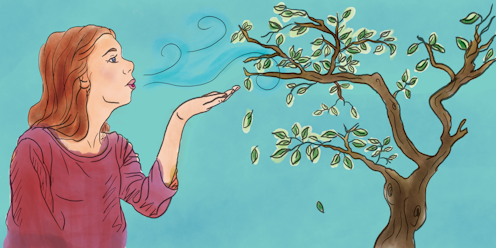
That very same tree took that expelled air, breathed from the lungs of all those students and now rich in carbon dioxide, and drew it back into itself to grow.
Think of that. All those students who passed that tree over the past half-century have given a part of themselves to help form the wood at the heart of that tree. The tree is recording a history of us. In this way, the tree is us.
But it is gone now, cut into manageable pieces and chipped or discarded. The carbon dioxide that was drawn from the breath of all those students will return to the atmosphere as the chips decay over the coming years. In the atmosphere, it will mingle with other carbon dioxide molecules that themselves have been released from the long past lives of plants and marine creatures, as coal and oil are burned. In a very real sense, our history has been turned into a greenhouse gas.
Surely the history of all those students could have been better used and respected. Yes, this tree had to go. But instead of being turned into chips, couldn’t the trunk have been cut into usable boards that would not quickly decay and release carbon dioxide? Those boards could become outdoor furniture, literally supporting future students who sit under the shade of the next tree planted to record more history.
Read more: Loving emails show there's more to trees than ecosystem services
It is, of course, faster and easier just to chip a tree when it is felled. Trees growing in the open are all different, and any sawmiller who accepts such a tree will have to process it very carefully. There is no efficiency of scale with urban trees.
Every urban tree is unique. Anyone who milled with them would have to carefully consider every cut and work with each individual tree’s shape and growth pattern. But isn’t this appropriate consideration for a tree that contains our very breath and our history? Shouldn’t every tree that grows in our cities be uniquely treated and turned into a useful product when it comes time to cut it down?
Any urban tree that needs to be cut down should go to the schools for student woodworkers or other makers, to become art or furniture – not into the atmosphere to add to the greenhouse gas load.
Authors: Cris Brack, Associate Professor, forest measurement & management, Australian National University
Read more http://theconversation.com/trees-are-made-of-human-breath-99368


















