

The Auckland floods are a sign of things to come – the city needs stormwater systems fit for climate change
- Written by James Renwick, Professor, Physical Geography (climate science), Te Herenga Waka — Victoria University of Wellington
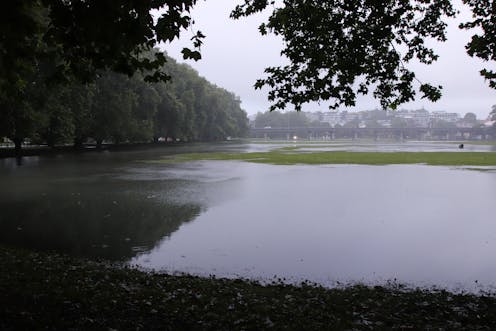
The extraordinary flood event Auckland experienced on the night of January 27, the eve of the city’s anniversary weekend, was caused by rainfall that was literally off the chart.
Over 24 hours, 249mm of rain fell – well above the previous record of 161.8mm. A state of emergency was declared late in the evening.
It has taken a terrible toll on Aucklanders, with two people reported dead and two more missing. Damage to houses, cars, roads and infrastructure will run into many millions of dollars.
Watching the images roll into social media on Friday evening, I thought to myself that I’ve seen these kinds of pictures before. But usually they’re from North America or Asia, or maybe Europe. But this was New Zealand’s largest city. Nowhere is safe from extreme weather these days.
How it happened
The torrential rain came from a storm in the north Tasman Sea linked to a source of moisture from the tropics. This is what meteorologists call an “atmospheric river”.
The storm was quite slow-moving because it was cradled to the south by a huge anticyclone (a high) that stopped it moving quickly across the country.
Embedded in the main band of rain, severe thunderstorms developed in the unstable air over the Auckland region. These delivered the heaviest rain falls, with MetService figures showing Auckland Airport received its average monthly rain for January in less than hour.
The type of storm which brought the mayhem was not especially remarkable, however. Plenty of similar storms have passed through Auckland. But, as the climate continues to warm, the amount of water vapour in the air increases.
I am confident climate change contributed significantly to the incredible volume of rain that fell so quickly in Auckland this time.
Warmer air means more water
There will be careful analysis of historical records and many simulations with climate models to nail down the return period of this flood (surely in the hundreds of years at least, in terms of our past climate).
How much climate change contributed to the rainfall total will be part of those calculations. But it is obvious to me this event is exactly what we expect as a result of climate change.
One degree of warming in the air translates, on average, to about 7% more water vapour in that air. The globe and New Zealand have experienced a bit over a degree of warming in the past century, and we have measured the increasing water vapour content.
But when a storm comes along, it can translate to much more than a 7% increase in rainfall. Air “converges” (is drawn in) near the Earth’s surface into a storm system. So all that moister air is brought together, then “wrung out” to deliver the rain.
A severe thunderstorm is the same thing on a smaller scale. Air is sucked in at ground level, lofted up and cooled quickly, losing much of its moisture in the process.
While the atmosphere now holds 7% more water vapour, this convergence of air masses means the rain bursts can be 10% or even 20% heavier.
Beyond the capacity of stormwater systems
The National Institute of Water and Atmosphere (NIWA) estimates that over Auckland, one degree of warming translates to abount a 20% increase in the one-hour rainfall, for a one-in-50-year event.
The longer we continue to warm the climate, the heavier the storm rainfalls will get.
Given what we have already seen, how do we adapt? Flooding happens when stormwater can’t drain away fast enough. So what we need are bigger drains, larger stormwater pipes and stormwater systems that can deal with such extremes.
The country’s stormwater drain system was designed for the climate we used to have – 50 or more years ago. What we need is a stormwater system designed for the climate we have now, and the one we’ll have in 50 years from now.
Another part of the response can be a “softening” of the urban environment. Tar-seal and concrete surfaces force water to stay at the surface, to pool and flow.
If we can re-expose some of the streams that have been diverted into culverts, re-establish a few wetlands among the built areas, we can create a more spongy surface environment more naturally able to cope with heavy rainfall. These are the responses we need to be thinking about and taking action on now.
We also need to stop burning fossil fuels and get global emissions of carbon dioxide and other greenhouse gases down as fast as we can. New Zealand has an emissions reduction plan – we need to see it having an effect from this year. And every country must follow suit.
As I said at the start, no community is immune from these extremes and we must all work together.
Authors: James Renwick, Professor, Physical Geography (climate science), Te Herenga Waka — Victoria University of Wellington

















