

How culling Australia's feral water buffalo could help tackle climate change
- Written by Hugh Davies, Research Associate, Charles Darwin University
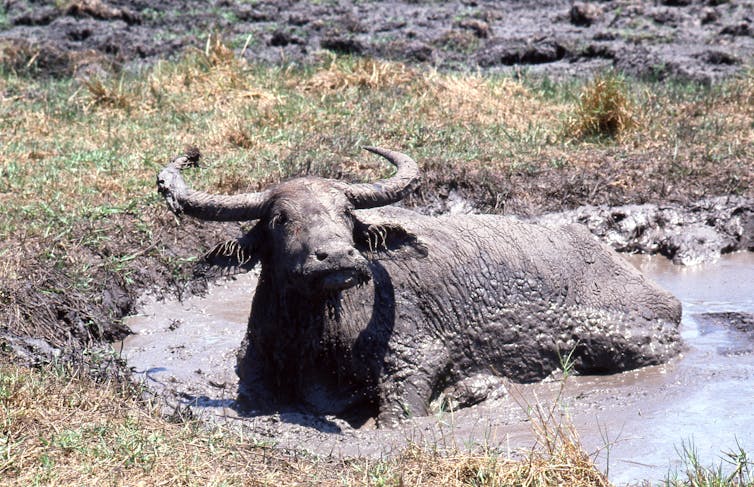
The world’s largest wild population of water buffalo now roam Australia. As does the largest wild herd of camels. We have millions of feral goats and deer. For these introduced species, Australia is a paradise. Plenty of vegetation, and not many predators, other than dingoes, crocodiles and humans.
The problem is, these ruminants burp out the potent greenhouse gas methane from fermenting vegetation in their stomachs. While ferals only produce an estimated 5% of the methane produced by Australia’s 24 million cattle and 74 million sheep, feral ruminant numbers are soaring.
Buffalo, in particular, are high methane emitters, pumping out methane at around the same rate as cattle. Their numbers have rebounded after earlier culls to more than 200,000. Of the world’s animal methane emissions, cattle account for 77% and buffalo for 13%.
At present, culling is expensive. But our new research on feral water buffalo in Kakadu shows this could change. If landowners, land managers and governments could claim carbon credits for culling, it would go from an expense to a profit. At a stroke, we could reduce pressure on ecosystems, cut emissions and add another source of income for those doing the work.

Are feral ruminants really a big problem?
If you live in a big city, you’re unlikely to ever see the full scale of the issue. But that’s changing. Residents in Melbourne and Sydney have become more familiar with feral deer, as they spread up and down the Great Dividing Range.
We’re more familiar with the damage done by other introduced species, including foxes, rabbits, rats and cats. Ruminants are a real problem – just usually not in the places where most people live.
These large herbivores are often much heavier than kangaroos and, unlike any native animal, have hard hooves which trample plants, compact soil and increase erosion. They can foul rivers and lakes, and carry diseases to farm animals.
Why is it hard to control these animals at present? The cost. Historically, keeping feral ruminant numbers down has been done by sending shooters up in helicopters. Since the 1960s, we have spent billions controlling feral ruminants.
Read more: EcoCheck: Australia's vast, majestic northern savannas need more care
Despite this, most of these species are more common than ever. How can that be? Once we stop culling, feral animal populations often bounce back very quickly because of their high breeding rates and through migration from neighbouring areas where culling hasn’t been undertaken.
For land managers, the scale of the task is often bigger than their budget, meaning feral ruminant control is often placed in the “too hard” basket, especially for remote areas. That’s where carbon credits could help. As the carbon economy grows, it has begun to change the economics of land use and land management.
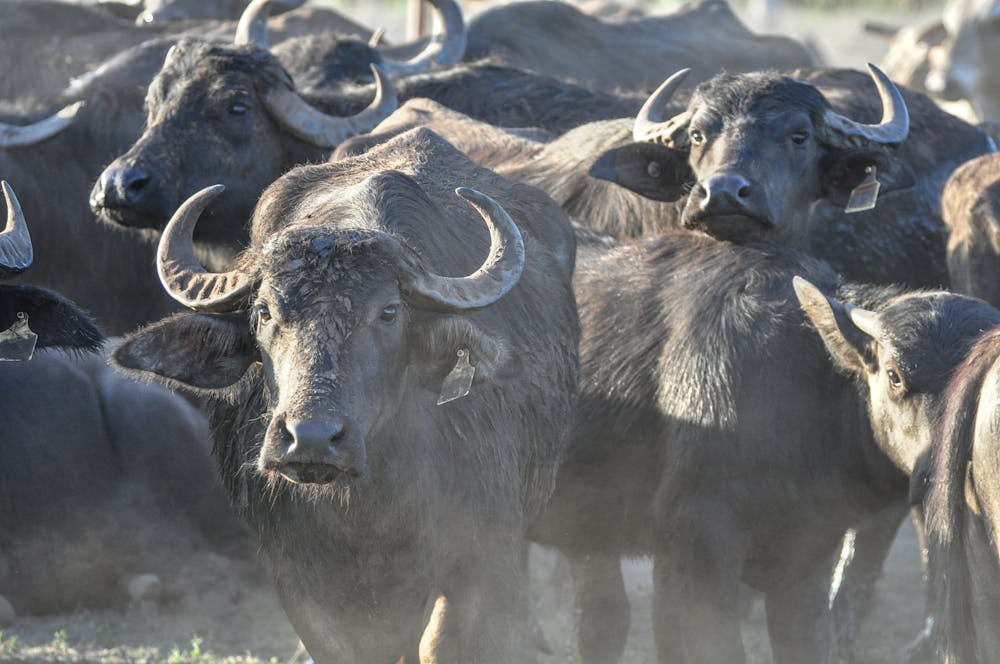 Buffalo populations have bounced back from earlier culling programs.
Shutterstock
Buffalo populations have bounced back from earlier culling programs.
Shutterstock
Could carbon credits really improve feral ruminant control?
Land managers now have incentives to take action to avoid emissions in a way which can be documented and to increase how much carbon their land can sequester in trees, wetlands or soils.
That’s because these actions can earn them carbon credits. Every tonne of carbon dioxide equivalent (CO₂-e) kept out of the atmosphere is currently worth around A$30. Credits can be sold to third parties looking to offset their emissions.
How could land managers create credits by controlling buffalo? We could borrow from the success of farmers and managers across northern Australia’s vast and fire-prone savannas who produce credits by using cool burns to reduce fuel loads and prevent devastating late-season fires which release large volumes of greenhouse gases.
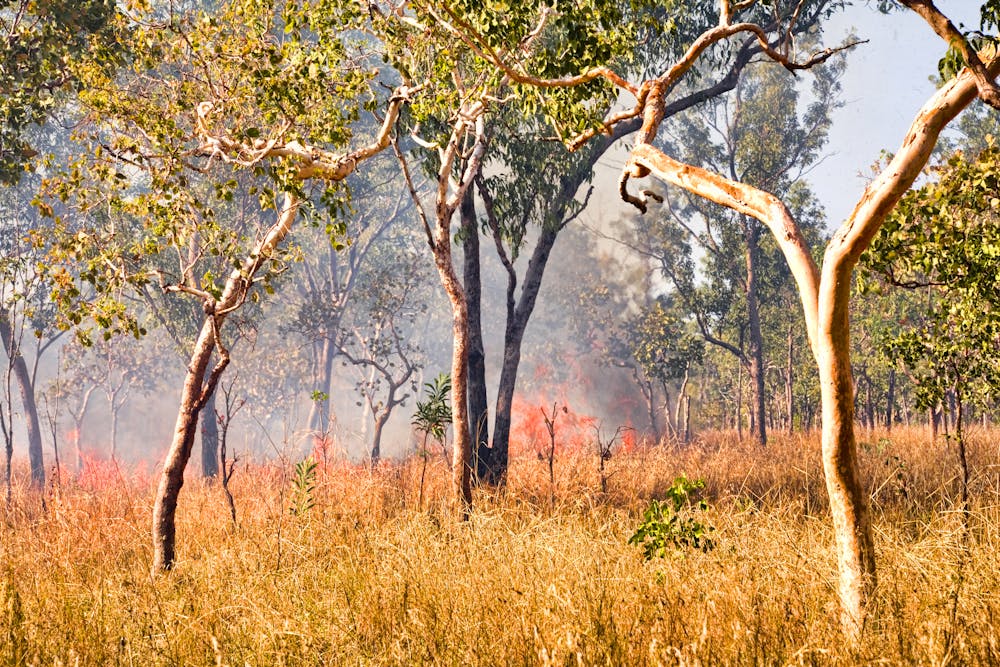 Early cool burns in northern Australia can create carbon credits.
Shutterstock
Early cool burns in northern Australia can create carbon credits.
Shutterstock
At present, you cannot claim carbon credits for culling. What if you could? We put that to the test in our research to see if the income from carbon credits would make culling self-sustaining.
In short, it would make a major difference. The income from selling carbon credits could far outweigh the costs of culling. Rather than being a huge expense, keeping numbers down on your landholdings would become a substantial source of income.
A water buffalo belches an average of 76 kilograms of methane each year. That’s the equivalent of 2.1 tonnes of CO₂. Over a 25-year lifespan, that’s the equivalent of more than 50 tonnes of carbon dioxide.
A rare win-win?
We examined the feral buffalo population around the South Alligator River in Kakadu National Park, and simulated different culling scenarios. We found effective control would drastically reduce emissions, abating up to 913,000 tonnes of CO₂-e over 20 years. That would make aerial culling very profitable. The net income from these avoided emissions would be more than $26 million in credits – after taking out the cost of culling.
While more research is needed, we hope our research demonstrates the concept is viable. If culling high-emitting ruminants such as buffalo earned carbon credits, we believe it would open the door to far better feral animal control across the Top End.
We could reduce greenhouse gas emissions, open up new income streams for landowners and managers, and give regional ecosystems a health boost.
With buffalo pressure reduced, the wetlands and floodplains they churn into mudpits could recover. That, in turn, would help these natural systems hold their carbon better – and mean the value of buffalo removal would increase even more. At present, however, we haven’t quantified how much extra carbon could be stored.
It’s rare to find an approach in land management that benefits both landholders and the environment. Buffalo carbon credits might just be that rare win-win.
Read more: 'Unacceptable costs': savanna burning under Australia's carbon credit scheme is harming human health
Authors: Hugh Davies, Research Associate, Charles Darwin University

















