

Australia is finally getting a last-chance view of a green comet not seen for 50,000 years
- Written by Jonti Horner, Professor (Astrophysics), University of Southern Queensland
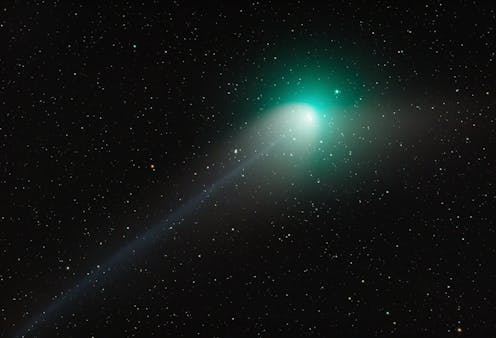
Over the past few weeks, social media has been abuzz with excited posts about the green comet that is currently “whizzing” or “flying through the sky”.
Now, comets don’t so much whizz as crawl. Despite that, there is a grain of truth in the reports – along with a whole heap of hype.
There is a relatively bright, green comet in the sky at the moment. Sadly, despite the hyperbole, you’re unlikely to spot it with the unaided eye – unless you have great eyesight, a dark sky, and know where to look.
People in the Northern Hemisphere have been following the comet for weeks. Now, for us in Australia, it will finally become visible, just a few days after its closest approach to Earth. So what’s all the fuss about?
Green and rare
Comet C/2022 E3 (ZTF) is a small dirty snowball discovered in March 2022 by the automated Zwicky Transient Facility (hence the name ZTF).
Unlike asteroids, which are made of rock, comets are icy bodies. When they approach the Sun and the temperature rises, that icy surface sublimates (changes directly from a solid to a gas). The comet thus becomes shrouded in a fuzzy “coma” of gas and dust. Radiation pressure from the Sun, along with the effects of the solar wind, pushes the gas and dust outwards, and the comet grows a “tail”.
The gas released by the comet is exposed to sunlight in the vacuum of space. That radiation, particularly the ultraviolet light, excites the gas. This means the gas gets rid of the energy it absorbs by shining in specific colours.
Much of the work astronomers do is based on breaking the light from distant objects into its component colours, to study what they are made of. Comet tails are usually blue, but comet ZTF has a very distinct greenish hue. Green is the telltale sign the comet is emitting large amounts of diatomic carbon and cyanogen, which both create a greenish glow when excited.
So, by looking at the comet’s colour, we can immediately learn a bit about its composition – which is pretty cool!

Upon discovery, the comet was just inside the orbit of Jupiter. Astronomers soon realised it would come relatively close to Earth in January and February this year, just a couple of weeks after its closest approach to the Sun (perihelion, which came on January 12).
Comet ZTF is a “long period comet”, which means it’s moving on an extremely elongated orbit around the Sun. It originated in the Oort cloud – a vast cloud of trillions of cometary nuclei that stretches halfway to the nearest star, leftovers from planetary formation 4.5 billion years ago. Those comets are held in cold storage until something nudges them inwards.
The last time comet ZTF graced the inner Solar System was around 50,000 years ago. While long period comets are not uncommon, interestingly this is likely ZTF’s final swing past our star. Thanks to a quirk of celestial mechanics, it is going to leave the Solar System altogether, travelling just fast enough to escape the Sun’s gravity.
Our Solar System (and all other planetary systems) are continually shedding comets like dandruff – with ZTF being just one more flake to add to the interstellar snowstorm.
A perfect ringside seat
Now, under normal circumstances, comet ZTF would be solely of interest to keen amateur and professional astronomers. It is actually a relatively small comet, with a nucleus likely no more than a few hundred metres across.
Were it not for the fact of its relatively close approach, it would never get bright enough to be noteworthy.
Instead, pure chance has led to the comet passing through the inner Solar System at just the right time to come close to us. Instead of a dim and distant view, our planet has a perfect ringside seat to see the comet at its finest.
When and where can we see it in Australia?
At 17:54 UT on February 1 (that’s in the early morning of February 2 in Australia, around 5am on the east coast, but earlier in west), comet ZTF will be just under 42.5 million kilometres (0.284 au) from Earth.
Just as expected, the comet is now at its brightest – visible to observers in the Northern Hemisphere as a faint fuzzy blob (with the naked eye, from dark skies), albeit one that is made significantly harder to spot thanks to the glare of the nearly full Moon.
For observers in the Southern Hemisphere, we had to wait because the comet was too far in the northern sky – essentially “above” our planet in space.
Fortunately, the comet is now moving southwards at a rate of around five or six degrees per day for the first ten days of February. Observers in the far north (Cairns and Darwin) might catch a glimpse low in the northern sky on the evening of February 2. Those in Hobart will have to wait until February 7 or 8 before it creeps high enough above the horizon to be spotted.
A good resource to check when the comet will be above the horizon from your home town is the free web-based planetarium package Stellarium. Go to the site, pan around to the north, and set the clock (at the bottom right) to an hour or two after sunset – then step forward day by day until ‘C/2022 E3 (ZTF)’ is visible above the northern horizon.
Get your gear ready
Technically, the comet is currently bright enough to see with the naked eye. Eagle-eyed northern observers have been reporting sightings without optical aid since mid-January.
However, the comet is only just visible in this way – which means you need to know exactly where to look, and to have a really dark sky. And even if you can, what you see will likely be underwhelming – a dim fuzzy blob.
By the time the comet is visible in Australia, it will be dimming quite rapidly, making it harder to see from one night to the next.
If you’re keen to see it, your best bet is to at least get a pair of binoculars. Work out where it should be, and scan the sky slowly, looking for a fuzzy patch of light.
The best time to find the comet will likely be February 11, when it will be within a degree of Mars, which currently shines bright and red, high to the north in the evening sky.
On the night of the 11th, find Mars with your binoculars, and pan just slightly to the right – you should be able to find the comet there.
But the best way to view the comet will be online. Astronomers worldwide are capturing incredible images of our celestial visitor. Taken with exposures many minutes in length, these photos reveal a view far better than anything possible with the naked eye.
Authors: Jonti Horner, Professor (Astrophysics), University of Southern Queensland

















