

This strange donkey orchid uses UV light to trick bees into thinking it has food
- Written by Adrian Dyer, Associate Professor, Monash University
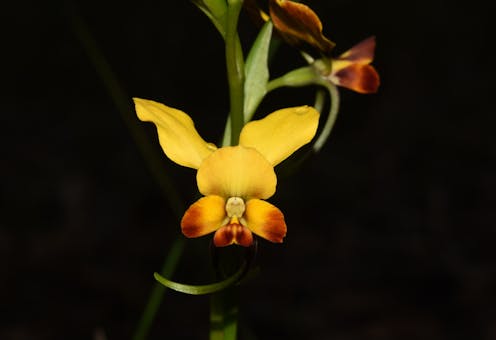
If you’ve ever compared a frozen pizza to the photo on the box, you know the feeling of being duped by appetising looks.
In our latest study we show that animals – in this case, bees – are also prone to being tricked into making poor decisions, which explains a lot about how gaps in perception are exploited in nature.
When Charles Darwin was testing the theory of evolution 150 years ago, he looked at the interaction between flowering plants and the animals that forage to collect nectar.
This helped establish that flowers have adaptations to promote easier pollinator access, making it beneficial for the animal who gets a food “reward” from them. At the same time, it means the plants get pollinated and can reproduce.
One perplexing problem is some flowering plants that reproduce by pollination are non-rewarding – the animal doesn’t get nectar from visiting the flower. This is true of certain orchids, yet these flowers are still visited by pollinators and survive well in nature.
A mistaken identity
With the benefit of modern scientific tools like a spectrophotometer that measures the amount of colour, digital ultraviolet (UV) photography and computer modelling of how bees see the world, our international team set out to understand how some orchids have evolved dazzling floral displays.
Our chosen species was the winter donkey orchid (Diuris brumalis), endemic to Western Australia. This non-rewarding, food deceptive plant blooms at the same time as rewarding native pea plants (Daviesia).
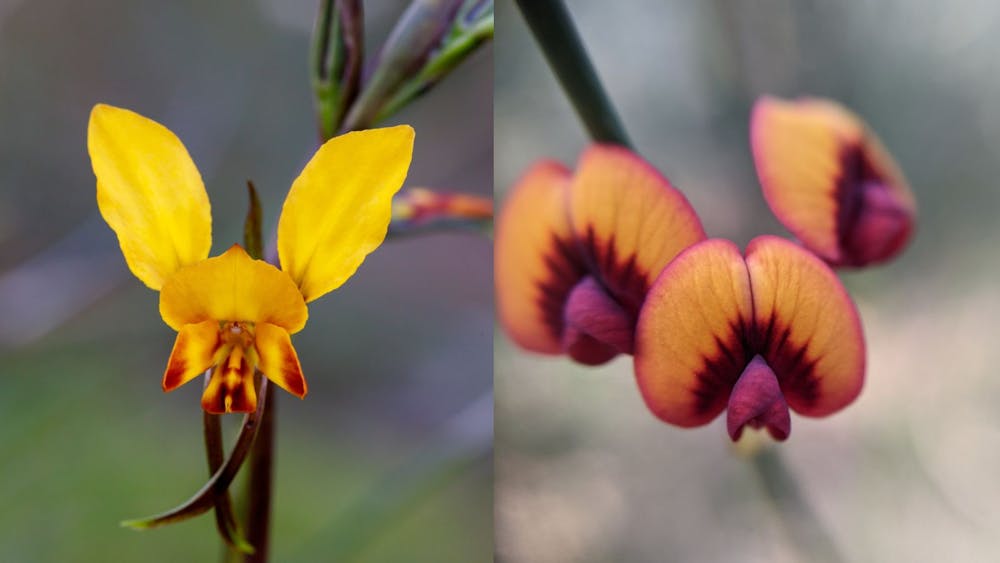
As a result, native Trichocolletes bees appear to mistake the orchid for legume plants frequently enough that the orchid gets pollinated.
We quantified the flower colour signals from both plants, revealing the main component of the visual information perceived by a bee was in the short wavelength UV region of the spectrum.
This made sense – while our vision sees blue, green and red wavelengths of light as primary colours, bees can see UV reflected light but lack a channel for perceiving primary red.
By using computer models of bee pollinator perception, we observed the orchid mimic species and the native pea plant species did actually look similar in colour to bees.
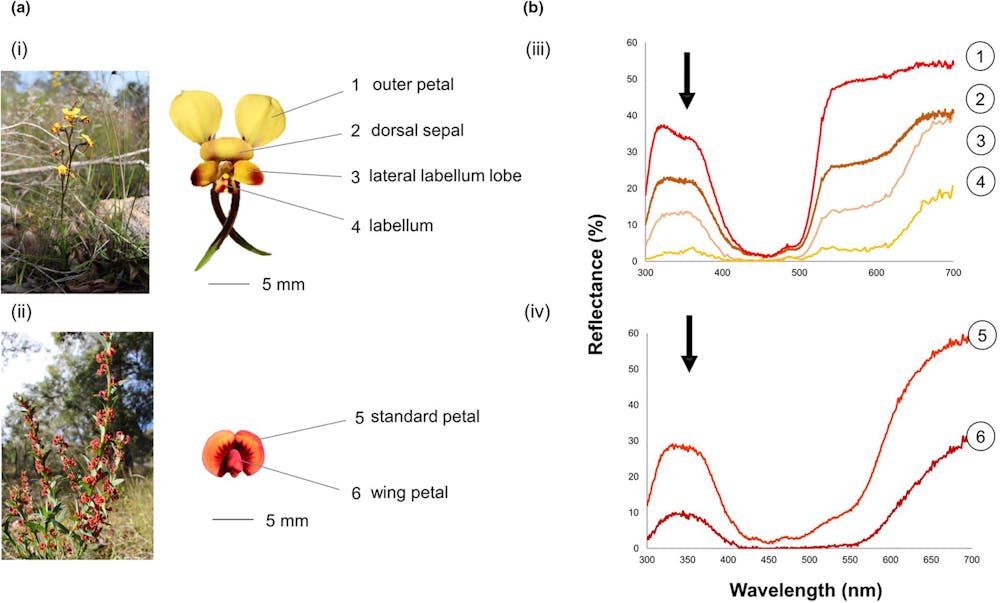 Flower shape and colour properties of an orchid (upper row) and a native pea flower (lower row) shown in the field, as individual flowers, and with spectral measurements.
Scaccabarozzi et al., 2023, Author provided
Flower shape and colour properties of an orchid (upper row) and a native pea flower (lower row) shown in the field, as individual flowers, and with spectral measurements.
Scaccabarozzi et al., 2023, Author provided
Putting a UV block on flowers
What was surprising, however, was the non-rewarding orchid flowers – pollinated by deception – actually have more conspicuous advertising for bee vision.
For example, the main display outer flower petals were significantly larger on the orchid plants, and also produced a stronger UV colour signal.
To understand if such signalling was biologically relevant, we next conducted field experiments with the plants. We used a special UV sun-blocking solution to remove the strong UV signals in half of the orchid species, whilst the other half retained their natural appearance.
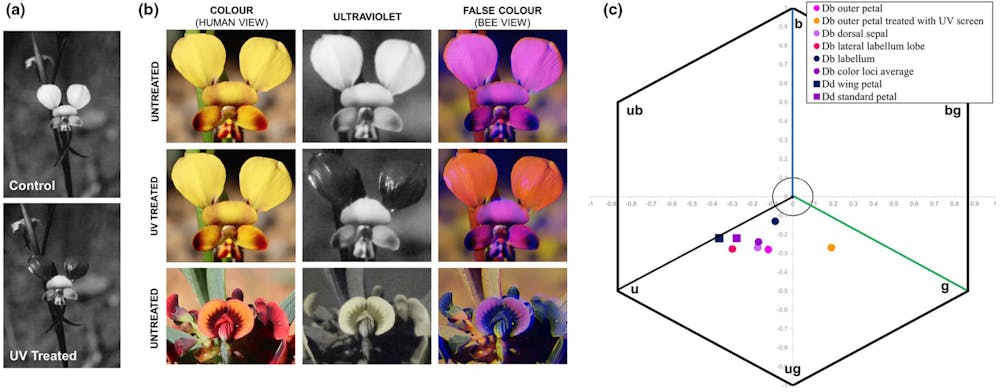 UV photographs of orchid flowers (upper left panel) in natural state and also with applied UV blocking screen. Middle panels show false-colour photographs of flower appearance for a bee, and right hand panel a computer model of how bee vision perceives flower colours.
Scaccabarozzi et al., 2023, Author provided
UV photographs of orchid flowers (upper left panel) in natural state and also with applied UV blocking screen. Middle panels show false-colour photographs of flower appearance for a bee, and right hand panel a computer model of how bee vision perceives flower colours.
Scaccabarozzi et al., 2023, Author provided
At the completion of the field season, several months latter, we could measure which plants were more successfully pollinated by bees, revealing the strong UV signals had a significant role in promoting pollination in the orchids.
A second interesting finding of the field experiments was the distance between the pea flowers and their copycat orchids was a major factor in the success of the orchids’ deception strategy.
If the orchids with strong UV signals were within close proximity – a meter or two – to the rewarding native pea flowers, the deception was less successful and few orchid flowers were pollinated. However, if the deceptive orchids were about eight meters away from the rewarding model species, this produced the highest success rate in pollination.
Why deception works
It turns out a distance of about eight meters is important because of the way bee brains process colour. When bees see a pair of colours in close proximity, they can evaluate them at the same time. This leads to very precise colour matching. A similar process happens in human brains – we also have to see colours at the same time.
However, seeing colour stimuli with a time interval in between means the brain has to remember the first colour, inspect the second colour, and make a mental calculation about whether the two samples are indeed the same.
Neither bee brains, nor our own, are good at successive colour comparisons. This is why when we purchase paint for a repair job we take a sample to get a precise match, rather than try and remember what we thought the colour should look like.
Deceptive flowers are successful by exploiting this perceptual gap in how brains have to code information when bees need to fly several meters in search of more food.
By using a “look at me” strategy (essentially, better advertising than other plants) it is possible to survive in nature without actually offering a food reward to the pollinators. To do this, the plants need to be at an optimal distance from the plants they are mimicking. Not too close and not too far, and success is assured.
Authors: Adrian Dyer, Associate Professor, Monash University

















