

Why do black holes twinkle? We studied 5,000 star-eating behemoths to find out
- Written by Christian Wolf, Associate Professor, Astronomy & Astrophysics, Australian National University
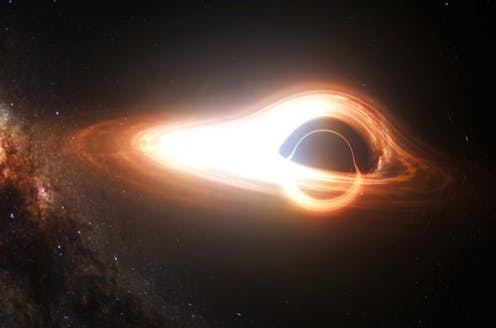
Black holes are bizarre things, even by the standards of astronomers. Their mass is so great, it bends space around them so tightly that nothing can escape, even light itself.
And yet, despite their famous blackness, some black holes are quite visible. The gas and stars these galactic vacuums devour are sucked into a glowing disc before their one-way trip into the hole, and these discs can shine more brightly than entire galaxies.
Stranger still, these black holes twinkle. The brightness of the glowing discs can fluctuate from day to day, and nobody is entirely sure why.
We piggy-backed on NASA’s asteroid defence effort to watch more than 5,000 of the fastest-growing black holes in the sky for five years, in an attempt to understand why this twinkling occurs. In a new paper in Nature Astronomy, we report our answer: a kind of turbulence driven by friction and intense gravitational and magnetic fields.
Gigantic star-eaters
We study supermassive black holes, the kind that sit at the centres of galaxies and are as massive as millions or billions of Suns.
Our own galaxy, the Milky Way, has one of these giants at its centre, with a mass of about four million Suns. For the most part, the 200 billion or so stars that make up the rest of the galaxy (including our Sun) happily orbit around the black hole at the centre.
Read more: Are black holes time machines? Yes, but there's a catch
However, things are not so peaceful in all galaxies. When pairs of galaxies pull on each other via gravity, many stars may end up tugged too close to their galaxy’s black hole. This ends badly for the stars: they are torn apart and devoured.
We are confident this must have happened in galaxies with black holes that weigh as much as a billion suns, because we can’t imagine how else they could have grown so large. It may also have happened in the Milky Way in the past.
Black holes can also feed in a slower, more gentle way: by sucking in clouds of gas blown out by geriatric stars known as red giants.
Feeding time
In our new study, we looked closely at the feeding process among the 5,000 fastest-growing black holes in the Universe.
In earlier studies, we discovered the black holes with the most voracious appetite. Last year, we found a black hole that eats an Earth’s-worth of stuff every second. In 2018, we found one that eats a whole Sun every 48 hours.
But we have lots of questions about their actual feeding behaviour. We know material on its way into the hole spirals into a glowing “accretion disc” that can be bright enough to outshine entire galaxies. These visibly feeding black holes are called quasars.
Most of these black holes are a long, long way away – much too far for us to see any detail of the disc. We have some images of accretion discs around nearby black holes, but they are merely breathing in some cosmic gas rather than feasting on stars.
Five years of flickering black holes
In our new work, we used data from NASA’s ATLAS telescope in Hawaii. It scans the entire sky every night (weather permitting), monitoring for asteroids approaching Earth from the outer darkness.
These whole-sky scans also happen to provide a nightly record of the glow of hungry black holes, deep in the background. Our team put together a five-year movie of each of those black holes, showing the day-to-day changes in brightness caused by the bubbling and boiling glowing maelstrom of the accretion disc.
The twinkling of these black holes can tell us something about accretion discs.
In 1998, astrophysicists Steven Balbus and John Hawley proposed a theory of “magneto-rotational instabilities” that describes how magnetic fields can cause turbulence in the discs. If that is the right idea, then the discs should sizzle in regular patterns. They would twinkle in random patterns that unfold as the discs orbit. Larger discs orbit more slowly with a slow twinkle, while tighter and faster orbits in smaller discs twinkle more rapidly.
But would the discs in the real world prove this simple, without any further complexities? (Whether “simple” is the right word for turbulence in an ultra-dense, out-of-control environment embedded in intense gravitational and magnetic fields where space itself is bent to breaking point is perhaps a separate question.)
Using statistical methods we measured how much the light emitted from our 5,000 discs flickered over time. The pattern of flickering in each one looked somewhat different.
But when we sorted them by size, brightness and colour, we began to see intriguing patterns. We were able to determine the orbital speed of each disc – and once you set your clock to run at the disc’s speed, all the flickering patterns started to look the same.
This universal behaviour is indeed predicted by the theory of “magneto-rotational instabilities”.
That was comforting! It means these mind-boggling maelstroms are “simple” after all.
And it opens new possibilities. We think the remaining subtle differences between accretion discs occur because we are looking at them from different orientations.
The next step is to examine these subtle differences more closely and see whether they hold clues to discern a black hole’s orientation. Eventually, our future measurements of black holes could be even more accurate.
Authors: Christian Wolf, Associate Professor, Astronomy & Astrophysics, Australian National University

















