

A rose by any other name – how roses and cut flowers became a symbol of love and luxury
- Written by Peter McNeil, Distinguished Professor of Design History, UTS, University of Technology Sydney
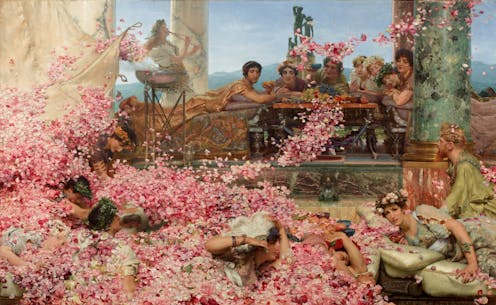
Before the creation of international systems of cultivation and the ability to move goods by air freight, flowers matched the pattern of the seasons. Roses on Saint Valentine’s Day were something unexpected, and very expensive.
In very old age, in 1989, the late Queen Mother wrote a letter about her youth:
I remember dancing with a nice young American at Lady Powis’ ball in Berkeley Square (aged 17) and the amazement and thrill when the next day a huge bunch of red roses arrived! In those days flowers were very rare!
Where does the tradition of flower gifts come from and do they pose risks for an ecologically aware world today?
Roses in culture and society
A Roman murdered for his religion on February 14, AD 269, St Valentine was promoted by Geoffrey Chaucer in the 14th century as a figure of courtly romance. The red rose therefore signals blood and sacrifice as well as devotion. The tradition of flowers having anything to do with love came to the West much later than the classical world.
Many of our beautiful roses descend from enormously tall, single-petalled specimens originally found in south central and northern China. Simple versions are also found in Europe and North Africa. They required crossings and hybridisation to produce the many lush varieties we enjoy today. We could say the flower that we call natural has been for centuries a product of conquest and commerce.
The rose – so spectacular for its thorny beauty – was all over early floral decorations. In Greek mythology it was woven into the fabric that Andromache made for Hector at the time of his death in Troy.
Commercial trade in flowers began as early as Hellenistic times. Egypt grew mass-produced blooms and shipped them long-distance for ritual, including wearing garland crowns.
 Hector and Andromache - Giovanni Antonio Pellegrini (1675-1741)
Wikimedia Commons
Hector and Andromache - Giovanni Antonio Pellegrini (1675-1741)
Wikimedia Commons
Early Christians were suspicious of flowers
Greek and Roman men and women wore floral crowns later presented as offerings to the dead. This was too pagan for the early Christian Church. St Jerome and St Ambrose were suspicious about flowers on tombs. They raised concerns of luxury. The rose was doubly suspect as it was linked to the Crown of Thorns worn at the Crucifixion. The evil Roman Emperor Heliogabalus was said to have smothered his diners with roses and violets released from a false glass ceiling. Exotic flowers were about decadence, not virtue.
The foundations of botany emerged within both ancient China and Greece. Knowledge of plants plummeted after the fall of the classical world in the West. Islam and the Near East were less disrupted by the decline of cities and had rich traditions of cultivation and botanical trade, notably in the 8th and 9th centuries AD. The rose appears stylised in the famous Persian carpets.
Read more: The rich history of our love affair with luxury
China, called by plant collectors the “flowering land”, had one of the most diverse floral resources, a result of its geology and great horticultural expertise encouraged by the literati class. From China came the azalea, the camellia, chrysanthemum, magnolia and new types of rose.
In China flowers were uniformly positive. “Hua” can mean a blossom, a firework, a decorative border or a cotton print, or it can refer to women and courtesans. Han ladies wore large flowers in their hair, either fresh or artificial, and their make-up included flowers and petals. Courtesans, some of whom worked on flower-filled barges, were named after blooms.
Roses were rehabilitated in the Christian West in the 12th century. Within Gothic art, the stained-glass rose window of the cathedral itself resembled that flower.
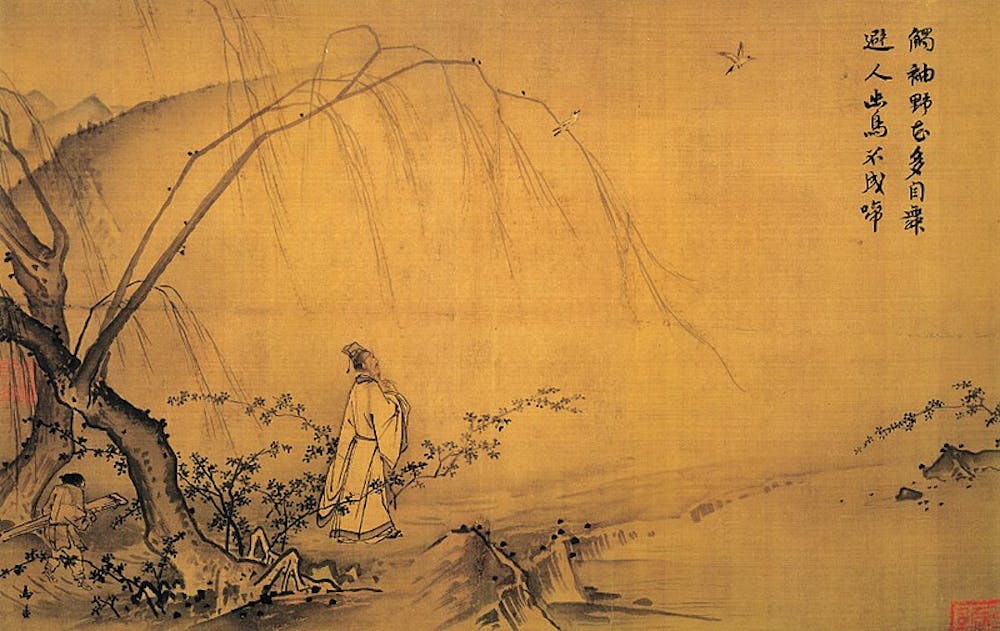 A detail of Chinese artist Ma Yuan’s On a Mountain Path in Spring. 1190-1225 CE. Ink and colour on silk. (National Museum, Taipei, Taiwan).
Public Domain
A detail of Chinese artist Ma Yuan’s On a Mountain Path in Spring. 1190-1225 CE. Ink and colour on silk. (National Museum, Taipei, Taiwan).
Public Domain
Men liked flowers as much as women
Thirteenth-century French romances describe young men wearing clothes embroidered with flowers, and during this period the Paris guild of hatters produced hats for men decorated with peacock feathers and fresh flowers. Young men decorating their straw hats with flowers in summer remains a tradition at the famous English school Eton.
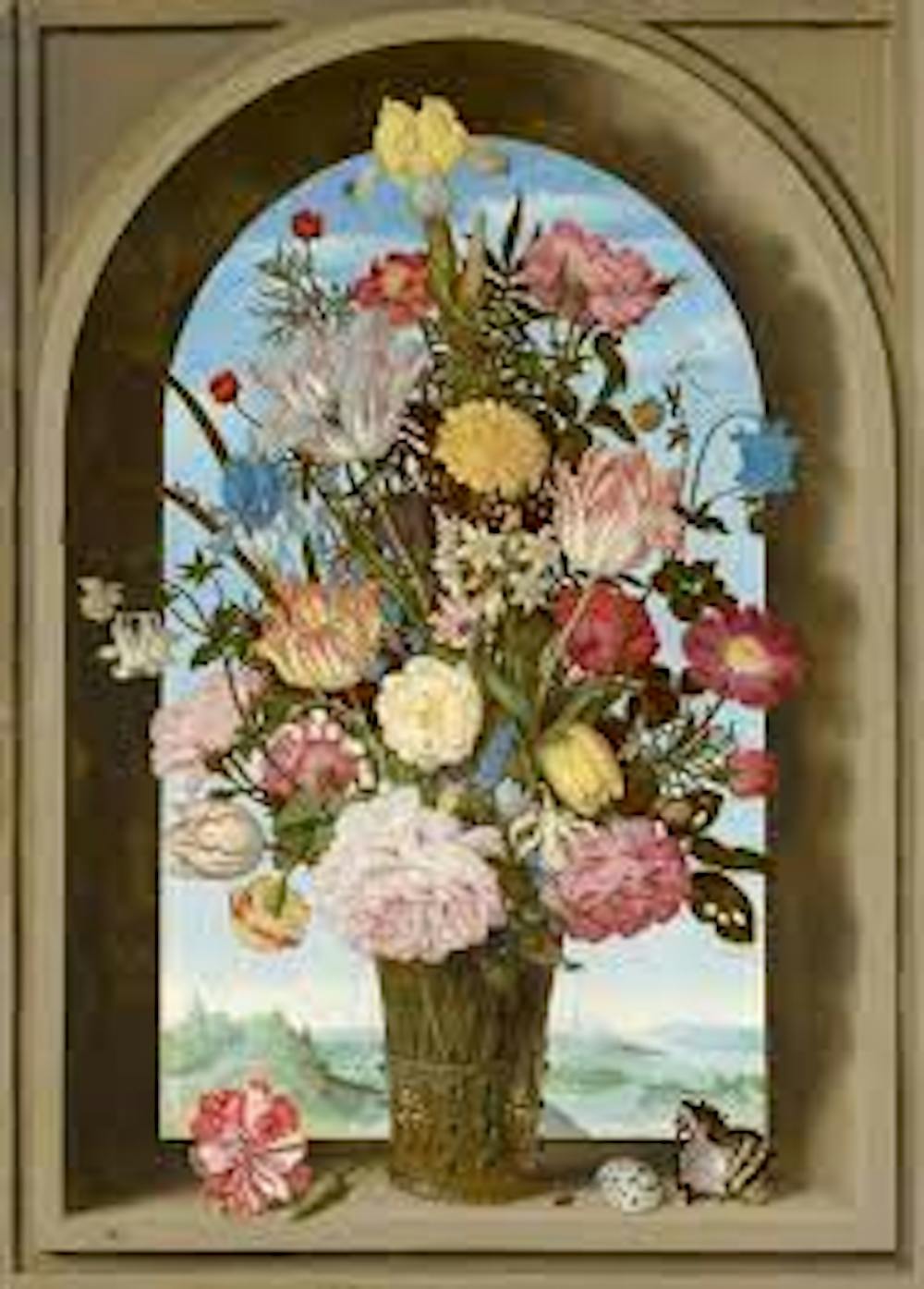
Flower painting emerges as an independent European form in the Ghent-Bruges School of manuscript decorators after 1475. Many Flemish painters specialised in paintings of the Virgin surrounded by a garland or wreath. The inclusion of bees, butterflies, insects and worms was a reminder of the transience of life, a memento mori.
Flowers underlined the contrast between internal and external beauty typical of classical sources. Sixth-century Roman philosopher Boethius wrote:
The beauty of things is fleet and swift, more fugitive than the passing of flowers in Spring". Here is the explanation why we are so fascinated by flowers, they are about life, but at the same time, death and decay.
By the 17th century, flowering plants were established as essential luxuries for rulers and merchants. Collectors and patrons travelled between notable botanical centres including Prague, London, Leiden, Brussels, Antwerp, Middleburg, Milan and Paris to engage with this new science and form of collecting. This, the ethnologist Jack Goody claims, was an expert system that led to floriography – the European language of flowers. The red rose is love, the white rose devotion.
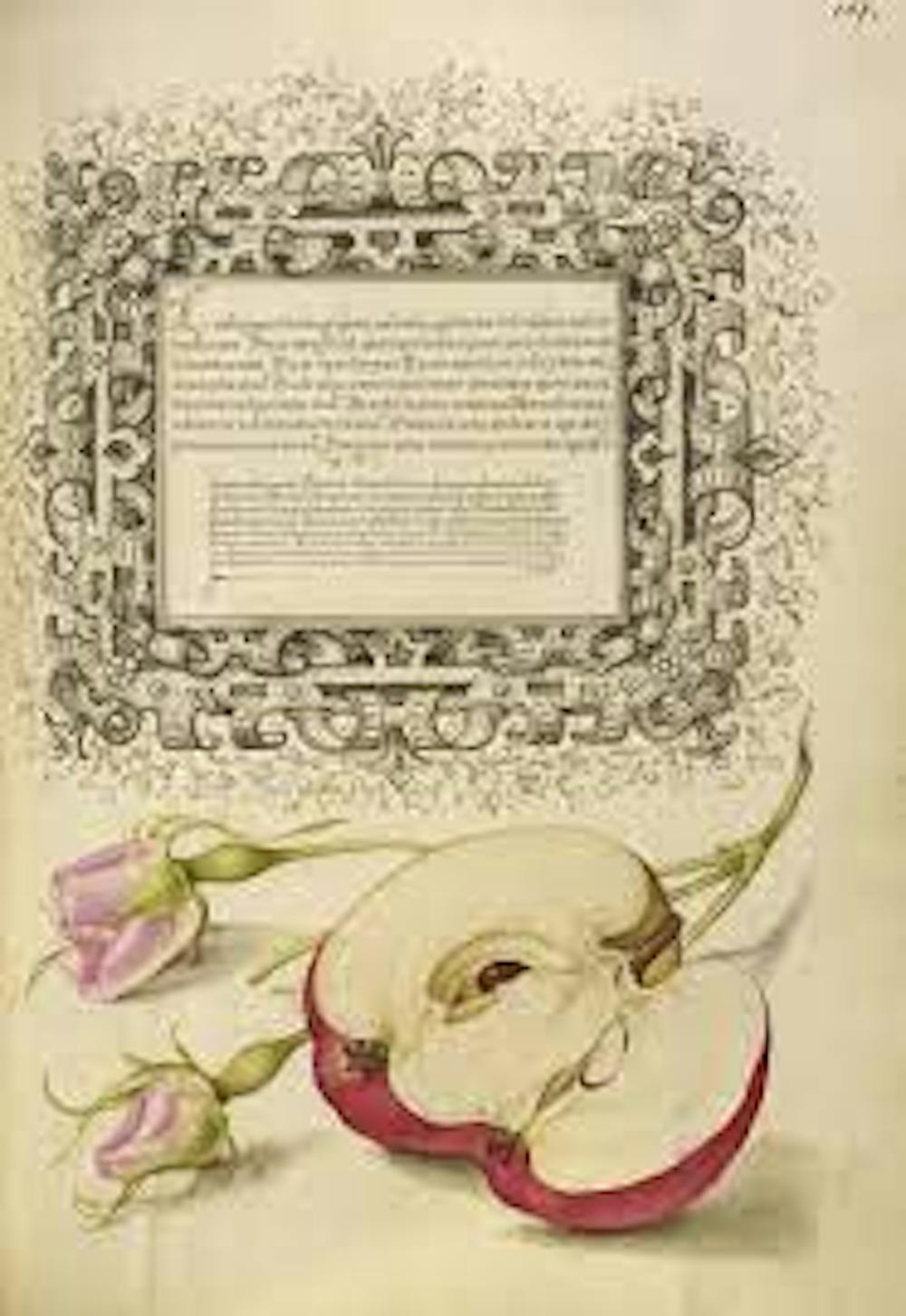 French Rose and Apple, Joris Hoefnagel (1561–1562).
Wikimedia Commons
French Rose and Apple, Joris Hoefnagel (1561–1562).
Wikimedia Commons
‘Too true, too perfect’: nineteenth-century fashion and flowers
In 19th-century Paris the flower market expanded to a twice-weekly format with corner booths, spiced with the erotic charms of the flower sellers who worked the streets.
Large blooms such as lilacs, Easter lilies and the large, perfumed Bourbon roses were the height of luxury. Flowers had shorter seasons and were scarcer than now, although the rich endeavoured to force plants in their private hothouses. The cult of flowers was significant. There were 100 florists in St Petersburg in 1912 – trains carried out-of-season blooms up on the St Petersburg-Paris-Nice express.
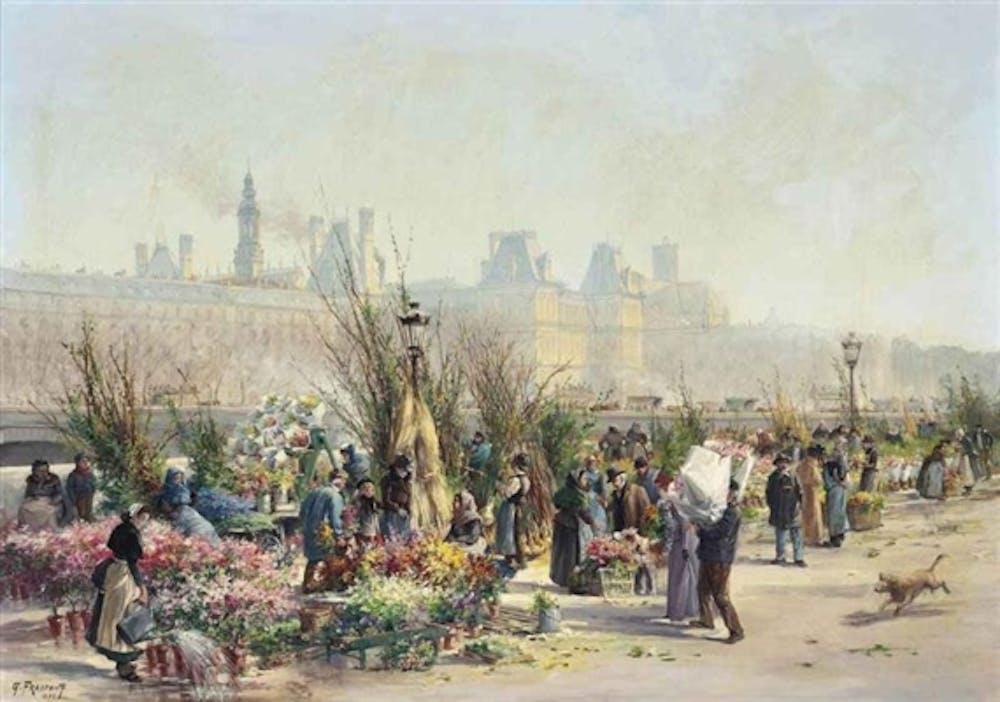 A flower market on the Seine by George Fraipont.
Wikimedia Commons
A flower market on the Seine by George Fraipont.
Wikimedia Commons
Mature women were not to use real flowers, the prerogative of youth, but rather artificial ones dispersed in their textiles and made in ornamental fabrics.
Today, flowers can be purchased at corner supermarkets every day. Most of what you see in stores is not grown locally. Much of it has been grown in South America or South Africa, shipped up to the Dutch wholesale markets, then flown back to the southern hemisphere. Flower cultivation uses large amounts of water and pesticides and often proceeds with low-paid labour in the developing world. Many of us could grow a few flowers ourselves, and get back to the simplicity of our grandparents’ generation, when flowers were scarce and also cherished.
If your flowers have not arrived for Valentines’ Day, remember this: Mizza Bricard, who worked for Christian Dior in the 1950s, once noted:
when a man asks who is your favourite florist, say my florist is Cartier.
Authors: Peter McNeil, Distinguished Professor of Design History, UTS, University of Technology Sydney

















