

Trees can be weeds too – here's why that's a problem
- Written by Gregory Moore, Senior Research Associate, School of Ecosystem and Forest Sciences, The University of Melbourne
When we think of weeds, often what comes to mind are small, quick-growing plants such as the dandelions or couch grass we might find in our gardens. You may not think of trees as being weedy.
But trees can be weeds too. They can spread quickly, showering an area in seeds and pushing out other species. Even species native to Australia can be a problem when they’re introduced to other areas.
It’s worth knowing the most common weedy trees so you can avoid planting them – or take them out before they get large and expensive to remove.
Which overseas trees can be weeds?
In many parts of Australia, the common Monterey pine (Pinus radiata) is a serious weed. Native to the United States, it’s widely planted in forestry plantations and as windbreaks on farms. Renowned for rapid growth, these pines seed prolifically and spread easily. Their needles contain chemicals that stop other plants growing beneath them.
Camphor laurel (Cinnamomum camphora), a tree native to China, Japan and Taiwan, can dominate moist environments and force out other species. It was once planted widely to give shade, especially in southeastern Queensland. Cities such as Toowoomba still have streets lined with them. But these trees are major weeds on farms. Every part of the plant is toxic to aquatic life.
Similarly, desert ash (Fraxinus angustifolia) was once planted as a street tree across Australia’s southeast. But this common European tree showers spiralling wind-borne seeds over a wide area, and can spread by suckers too. It outcompetes native trees and invades nature reserves.
Jacarandas are hugely popular with many Australians, especially when they are in full flower, but they can be hard to control in South Africa and parts of Australia.
Read more: Pulling out weeds is the best thing you can do to help nature recover from the fires
Not all weedy trees are prolific seeders. Some reproduce from suckers to create dense thickets of woody growth. Many of our native Acacia or wattle species sucker prolifically after fire and floods. A single tree in your garden can give rise to a thicket of hundreds of small trees that are difficult to eradicate.
The iconic willow (Salix) was once widely planted along waterways to stop erosion. Unfortunately, they grow very rapidly from pieces of a tree that break off and take root in moist soil. These thirsty trees quickly spread along thousands of kilometres of creeks and rivers. It’s now illegal to sell almost any willow species, except for less-invasive ones such as the weeping willow.
Our trees can be pests overseas
Australia’s own broad-leafed paperbark (Melaleuca quinquenervia) has become a major weed tree in Florida’s famous Everglades, creating dense thickets and crowding out native species. It’s similarly devastating in Madagascar.
Even our beloved river red gum is a problem in southern Africa, where it spreads easily, while the Tasmanian blue gum has spread so widely in California that its detractors dub it the “gasoline tree” for its ability to intensify fires.
Even native trees can be pests
Trees don’t have to come from overseas to be considered weeds. Sweet pittosporum (Pittosporum undulatum) occurs naturally in Victoria and New South Wales. Even so, it’s considered weedy in parts of both states, as well as in Western Australia, New Zealand, parts of Africa, and the United States.
This tree engages in chemical warfare, its fallen leaves suppressing rival species. Currawongs and common mynahs eat its fruit and spread the seeds in their droppings.
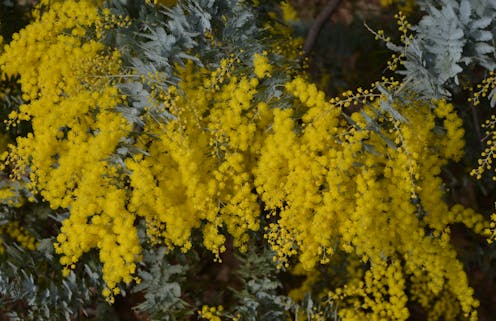
The once widely loved Cootamundra wattle (Acacia baileyana), with its golden orb flowers and grey leaves, is now considered a weed outside its native range in NSW.
Read more: Planning to plant an Australian native like wattle? Read this first — you might be spreading a weed
What can be done about these trees?
Which trees are most likely to become weeds? Those that reproduce quickly, grow fast, tolerate different soils and climates, have fruit or seeds dispersed by animals and birds, and are able to force out native tree species.
It’s far better we stop new species from becoming weeds rather than to try to control them once they’re here.
But for those species already in the soil, we’re left with control measures. In many places, government agencies can direct you to remove weed species. Local governments can ban the planting of certain weedy species and require land owners to remove such species at their own expense.
Our efforts here often have had little effect. Some plants regulated as weeds in the 1800s never became weedy; others long considered weeds remain so and some have become even bigger problems. Some Northern Hemisphere thistles were proclaimed weeds more than a century ago, but have since proved not to be a major problem. African boxthorn (Lycium ferocissimum) is still a problem, despite being a listed and controlled weed for more than a century.
Botanists have tried to tackle the issue by breeding varieties of attractive but weedy trees with far fewer fruit and seeds. You can now buy safer varieties of maple (Acer), black locust (Robinia pseudoacacia), white cedar (Melia azedarach) and liquidambar.
So next time you’re looking to plant a new tree in your garden, look into whether the species is OK for the area. You could also consider joining a local group involved in caring for parks and reserves and help remove any weedy trees.
Authors: Gregory Moore, Senior Research Associate, School of Ecosystem and Forest Sciences, The University of Melbourne
Read more https://theconversation.com/trees-can-be-weeds-too-heres-why-thats-a-problem-182599

















