

medieval descriptions of an 1114 CE earthquake in present-day Turkey and Syria feel eerily familiar
- Written by Beth Spacey, Associate Lecturer, The University of Queensland
The catastrophic earthquakes of February 6 2023 in Turkey and Syria are so far known to have claimed the lives of over 41,000 people. This number will likely grow as rescue and recovery efforts continue.
The region has known earthquakes before. In the past century alone, Turkey has seen nearly 20 earthquakes of a magnitude 7.0 or above.
Seismic activity is so frequent in this area because it sits on three continually grating tectonic plates. This means the region has a history of earthquakes that stretches far beyond the previous century.
While we might expect that the voices of those who survived these earlier earthquakes have been lost to history, this isn’t strictly true. Some have survived.
Read more: Why have so many earthquakes hit Turkey and Syria?
The earthquake of 1114 CE
One of the cities that has been hit hardest by the 2023 quake is Antakya in southern Turkey.
This is not the first earthquake to devastate Antakya. It was struck by another deadly tremor just over 900 years ago, in the early hours of November 29 1114 CE, or 508 AH in the Islamic calendar.
This earthquake is now known as the Marash earthquake, named for one of the worst-hit cities. One contemporary, an Armenian priest called Matthew of Edessa, estimated it killed 40,000 people in Marash alone.
Antakya is roughly 160km southwest of Marash and also suffered devastation. Much of what we know about the earthquake comes from texts that were either written in Antakya or name the city as one that was most significantly affected.
At the time of this quake, the geopolitical map of the region looked very different from today. It was the Middle Ages, and Antakya – then known as Antioch – was the capital of the Principality of Antioch.
Written accounts from medieval West Asia record several earthquakes. The quake of 1114, however, stands out both for the impact it had on people at the time, and for its continued importance for decades after.
Even at a distance of 900 years, accounts of the 1114 earthquake reveal historical societies went about recording natural disasters in terms that remain poignantly resonant.
Read more: What early Christian communities tell us about giving financial aid at a time of crises
Contemporaries recorded the disaster
In the aftermath of the 1114 earthquake, Christian and Muslim chroniclers in the region set about committing the disaster to writing.
In this period, to write something down was to make a serious statement: this is important and needs to be remembered. Writing was, and remains, a powerful tool.
Walter, chancellor of Antioch in the first half of the 12th century, recorded how the quake struck in the dead of night.
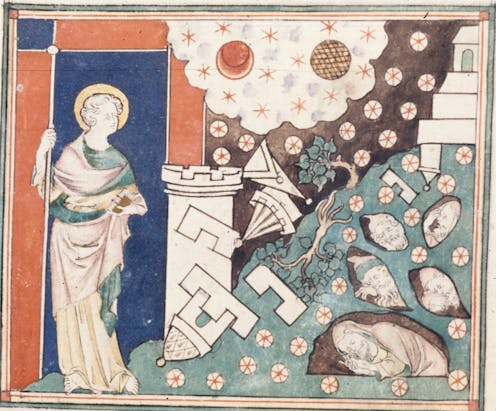
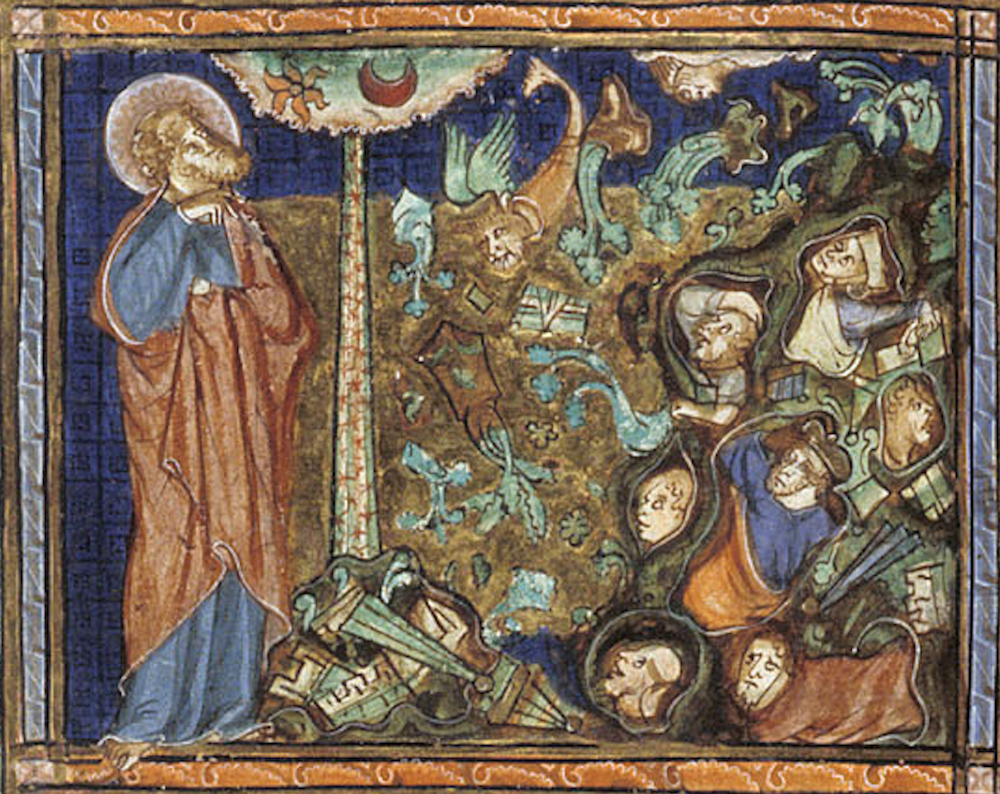
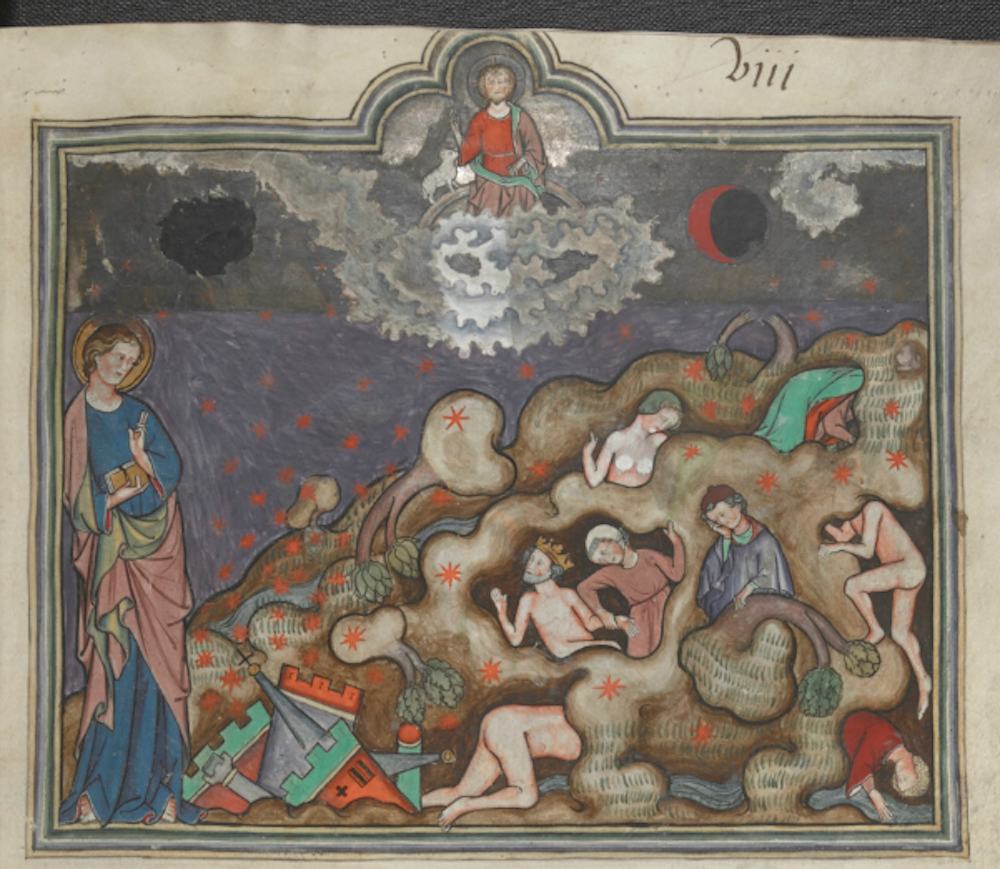 An earthquake depicted in a 14th century Apocalypse manuscript.
British Library
An earthquake depicted in a 14th century Apocalypse manuscript.
British Library
He describes a scene that seems horrifyingly familiar: of people trapped in collapsed buildings as they slept, others who couldn’t be found, and survivors in the streets who raised their hands to the heavens and cried out in despair.
He wrote:
In the streets, in courtyards, in gardens, in groves, and in other deserted dwelling places, [the people of Antioch] took tents for homes.
In present-day Jerusalem, 500km to the south, Fulcher of Chartres – the chaplain to King Baldwin I – wrote his own description of the quake.
It was, Fulcher says, the worst earthquake anyone had ever known:
[The earthquake] shook the region of Antioch so that it demolished to the ground most of the towns, either whole or in part, houses as well as walls, and in the collapse some of the people perished, suffocated.
Between Antioch in the north and Jerusalem in the south lies the city of Damascus in present-day Syria. In 1114, it was ruled by the Turkish governor Tughtakin.
According to the Damascene administrator Ibn al-Qalānisī, who lived and worked in the city, the quake shook the earth and terrified the people.
Remembrance across space and time
The 1114 earthquake and its impacts were not quickly forgotten. It became infamous far beyond the area where it had struck. This is probably thanks in large part to the efforts of those who recorded it in the aftermath.
In the early 13th century, nearly 100 years later, the great chronicler Ibn al-Athīr was composing his al-Kāmil fit-Tārīkh (The Complete History) in Mosul, more than 600km east of Antioch.
Ibn al-Athīr described the 1114 earthquake in his chronicle:
In this year [508 AH] in Jamada II [the month of November], there was a strong earthquake in Al-Jazira area, Al-Sham and others, causing a wide destruction at Al-Ruha, Harran, Samsat, Balis and others, and many people killed under debris.
As far away as England, 13th-century chroniclers such as Roger of Wendover continued to record the 1114 earthquake. Roger briefly noted that in 1114:
An earthquake destroyed part of the city of Mamistra, not far from Antioch, together with two castles.
The historical accounts of the 1114 quake give us a rare insight into human responses to natural disasters 900 years ago, especially processes of recording and remembering.
Then, as now, their impact could make an indelible mark on a region’s collective memory.
Read more: Secondary crises after the Turkey-Syria earthquakes are now the greatest threat to life
Authors: Beth Spacey, Associate Lecturer, The University of Queensland

















