

Water buybacks are back on the table in the Murray-Darling Basin. Here's a refresher on how they work
- Written by Sarah Ann Wheeler, Professor in Water Economics, University of Adelaide
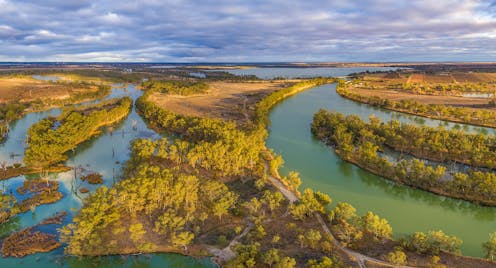
The federal government has announced a new round of strategic water buybacks in the Murray-Darling Basin. The government intends to purchase water entitlements from voluntary sellers in parts of New South Wales and Queensland.
A total of 49.2 gigalitres (GL) will be purchased across seven catchment areas through open, competitive and transparent tenders. This water will then be returned to the environment.
The government decided to restart buybacks because other methods, such as water-saving and offset measures both on and off farms, have been less effective and won’t be achieved in time. There is a 49.2GL “gap” between the current revised 2,075GL target set for June 30 2024, and the amount of water recovered so far.
The Morrison government effectively stopped using buybacks as a tool when Barnaby Joyce became federal water minister. Over time, the Murray-Darling Basin Plan – and buybacks in particular – became a focal point of blame for all kinds of problems in rural communities.
This blame played out in legislation to cap water recovery via buybacks in 2015. Although the Howard government introduced the water recovery schemes from 2007-08 onwards, it was the Rudd/Gillard governments that achieved the largest amount of water recovery. The Albanese government is now trying to get water policy and recovery back on track.
Why are we recovering water for the environment?
Over the past 50 years, water has been over-allocated to agriculture in the Murray-Darling Basin. Coupled with the catastrophic Millennium Drought in the 2000s, this meant many ecosystems, and rural communities, were at crisis point. The Water Act 2007 and the Murray-Darling Basin Plan aimed to return water from irrigation to environmental use.
There were considerable arguments regarding how much water was needed for a sustainable river basin, and the final amount of 2,750GL legislated in 2012 was far less than the original proposal. Actual physical water recovery was then whittled downwards again in the 2018 Basin Plan amendment to 2,075GL, which reduced water recovery in the northern basin and implemented a sustainable diversion limit adjustment mechanism offset, made up of supply and efficiency projects.
To appease South Australia – which, as the downstream state, suffers the most negative consequences of a declining river system – an extra 450GL was included as an additional target in 2012. This was to be achieved solely through efficiency measures such as upgrading irrigation infrastructure from gravity-fed to drip irrigation, or reducing evaporation from irrigation delivery channels. So far, only a few gigalitres have been achieved of this additional 450GL.
Environmental water recovery methods
Water recovery has so far occurred via two main mechanisms that have cost a total of $7.2 billion. The main method is buybacks, with $2.67 billion spent to recover 1,228GL of water. Buybacks allow farmers to spend the money wherever they want, whether it be on reducing debt, reinvestment, improving productivity or adapting to dry conditions.
The second has mainly involved subsidising irrigation infrastructure on and off farms to improve water efficiency or to achieve water offsets. So far, $4.52 billion has been spent on things such as lining channels, or changing irrigation systems, which has garnered the 693GL now held in water licences by the government.
Data provided by the Department of Climate Change, Energy, the Environment and Water in late 2022 suggests that on average, just over $2,100 per megalitre has been spent to recover water through buybacks, and more than $6,550 per megalitre to recover water through irrigation infrastructure subsidies. This is one of the reasons buybacks have been the most successful policy instrument in delivering water recovery. Most of this was already achieved by 2015, and since then, only some small strategic purchases have been made.
This cost differential in water recovery methods is expected to widen substantially. Water recovery projects put forward by states are now quoting huge amounts of money, regularly figures over $20,000 per megalitre.
On and off-farm efficiency projects have also been heavily criticised for their lack of effectiveness. The net “additional” increase to environmental water holdings is questionable, due to the fact they lead to reduced return flows into groundwater and surface water. There are also question marks over whether some supply “environmental equivalence” projects will actually work.
Water Policy Reversals
Following the introduction of the Basin Plan legislation in 2012, water policy has gone backwards. Capping buyback purchases to a total of 1,500GL in 2015 is one such example. This halted the most effective instrument we have in recovering water.
Lobbyists and irrigator groups have been successful in spreading misinformation and fostering widely held beliefs that buybacks are responsible for large-scale rural economic decline. Indeed, there is a “Beyond Buyback” campaign underway right now.
However, it has been shown that the social costs of buyback have been overestimated and the benefits underestimated.
Rural and farm prosperity reflects a more complex mix of factors, including falling commodity prices, increasing input costs, and climate change.
Environmental water has many benefits for rural communities, right across the Basin. Unfortunately these facts are often ignored, both in media commentary and in some very dodgy economic modelling that relies on highly simplistic and unrealistic assumptions about the impacts of water recovery.
What do we need to do next?
The very first Nobel Prize in Economics – Jan Tinbergen (1969) - was given for work demonstrating that one policy is needed to address one objective. If we have one policy for multiple objectives, unexpected responses occur.
When we subsidise irrigation infrastructure in order to meet farm productivity, economic development and environmental water recovery objectives, sometimes we end up not achieving our original aim – namely net water recovery for the environment.
Hence, the federal government’s announcement of the latest round of buybacks is very welcome, for it allows us to use the most effective instrument we can for environmental water recovery. Let’s hope we can use these lessons for the additional 450GL of water recovery, and for starting a conversation about cultural water rights.
This does not mean we don’t have to worry about rural regional consequences of water reform – of course we do. But let’s use the best policy options we have to address those issues.
For example, research shows that money spent on regional development (such as in essential social services) creates three to four times more jobs than efficiency upgrades. The Productivity Commission suggested there was little evidence that existing economic structural adjustment policies in the Murray-Darling Basin have helped local communities transition through water reforms.
In an era of climate change, we must grapple with the best ways to share water, and look after all interests as best as we can.
Authors: Sarah Ann Wheeler, Professor in Water Economics, University of Adelaide

















