This freaky slime mould from HBO's The Last of Us isn't a fungus at all – but it is a brainless predator
- Written by Chris R. Reid, ARC Future Fellow, Macquarie University
In HBO’s post-apocalyptic drama The Last of Us, human civilisation has fallen in the face of a fungal takeover triggered by climate change.
The show’s opening credits and creature designs are inspired by the slime mould Physarum polycephalum. But while the show’s “infected” (i.e. zombies) are meant to be victims of a fungal pandemic, slime moulds are not actually fungi at all.
Opening credits for The Last of Us. HBO Max/YouTube.They are in fact much more ancient, and less closely related to fungi than even we are. Since scientists first tried to classify slime moulds, they have been wrongly grouped with plants, animals, and in particular, fungi.
This is because they typically occur in the same ecosystems as fungi, and because they produce structures to help spread their spores, much like their fungal cousins do.
Molecular methods for grouping lifeforms by comparing their DNA have helped us better understand slime moulds’ distinct heritage. Yet their exact place on the tree of life is still unclear.
A fierce predator
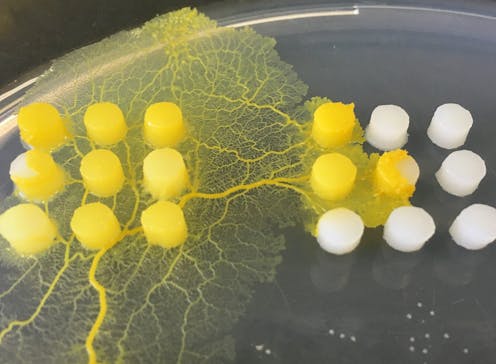
Despite bearing a superficial similarity to fungi, there are many aspects of the slime mould’s biology that are strikingly unique. This yellow blob of goo may not look like much, but it is in fact a fierce predator of bacteria, yeasts and other microorganisms, including fungi.
Though they can grow quite large – up to several square metres across – each slime mould is a single cell, containing millions of nuclei and all the other complex machinery that lies inside cells like ours.
The slime mould’s “body” is a network of veins and tubes that can move at the rapid pace of up to five centimetres per hour to locate and capture their prey.
Inside the slime mould, a rich soup of cell components and food particles flows back and forth within the network. This flow transmits nutrients, chemical signals and information between different regions of the slime mould.
These rippling, sprawling movements are likely what makes slime mould so appealingly creepy to horror artists and filmmakers.
Read more: The Last of Us: fungal infections really can kill – and they’re getting more dangerous
Zombie intelligence
Slime mould physiology and anatomy is as alien as it is fascinating. But it’s their behaviour that separates them from their peers, and perhaps mirrors our own a little too closely for comfort.
Far from being simple cells moving blindly through the leaf litter, slime moulds can gather a huge amount of information from their environment, and use it to make smart decisions about where to move and look for food, much like the infected in The Last of Us, which operate as one large organism in search of prey.
So far, the slime mould has been shown to sense and move toward or away from carbohydrates, proteins, amino acids, free nucleotides, volatile organic chemicals, salts, pH, light, humidity and temperature, even sensing the direction of gravity and magnetic fields.
When a slime mould finds several food sources at the same time, it tries to cover each food with as much of itself as it can (to absorb it), without splitting into disconnected individuals. The most efficient way to do this is to have a single tube connecting the two foods along the shortest path between them.
Slime moulds have evolved over millions of years to become master network engineers. They are expert maze-solvers, and researchers have begun to build computer algorithms for the design of human train and telecommunication networks based on slime mould approaches.
The yellow blob of goo is a single network (and single cell) of Physarum polycephalum exploring the surface of an agar plate in search of food. The footage is sped up significantly (around 20x). Chris R. Reid/New Jersey Institute of Technology.Read more: The brainless slime mould that remembers where it's been
No brain? No problem
Slime moulds’ problem-solving abilities are all the more fascinating because the creature doesn’t have a brain or even a single neuron. Nevertheless, they show signs of memorisation and even learning – two things which traditionally were thought possible only in animals with brains.
As they move, slime moulds leave behind a trail of slime similar to mucous. This slime trail serves as an externalised memory of areas it has explored in the past, which is very useful for solving mazes.
They can distinguish between their own trails, their neighbours’, and those of other slime mould species. They also use food signals left behind in the trails to judge their own chances of finding food in an area.
Researchers have also found slime moulds can learn to ignore a substance they normally find repellent (such as quinine or caffeine) after prolonged exposure. Researchers call this basic form of learning “habituation”.
Amazingly, when a habituated slime mould fuses together with an untrained slime mould (oh yeah, they can do that), the learned behaviour is observed in the new combined individual.
All this raises the (somewhat creepy) question: what other kinds of knowledge do slimy creatures pass between each other as they crawl beneath the forest floor?
Read more: Nature's traffic engineers have come up with many simple but effective solutions
Authors: Chris R. Reid, ARC Future Fellow, Macquarie University