

different building designs could lessen future damage
- Written by: Graeme MacRae, Senior Lecturer in Social Anthropology, Massey University
The series of earthquakes in North Lombok and others further east goes on. But hopefully the worst is over and the intensity will recede from now.
Hundreds of people have been killed and a lot more injured, many of them seriously. Nearly all this human suffering was caused by collapsing buildings. The subsequent homelessness will go on for many months for hundreds of thousands of people.
But a lot of this suffering need not have happened.
Read more: After devastating earthquakes, Indonesia must embrace radical change
Changing building standards
The strongest quake on August 5, 6.9 in magnitude and at a relatively shallow depth, is large by any standard. But, as photos and video footage show, not all buildings collapsed. Among the landscape of devastation are many buildings that appear to have suffered little if any damage.
According to one estimate, 70% of buildings suffered serious damage, which means 30% did not. In many parts of the world, such as Japan, New Zealand and Chile, buildings are designed to withstand earthquakes of this scale and many of them do, repeatedly.
Read more: Two types of tectonic plate activity create earthquake and tsunami risk on Lombok
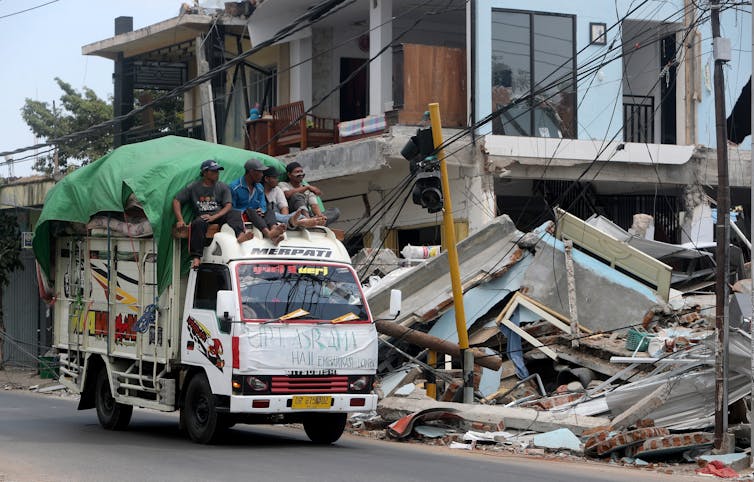 About 70% of buildings suffered serious damage in the Lombok earthquakes, but some stood up to the shaking.
AAP, CC BY
About 70% of buildings suffered serious damage in the Lombok earthquakes, but some stood up to the shaking.
AAP, CC BY
Traditional buildings in most of Indonesia, including northern Lombok, were built of timber framing with thatched roofs. In an earthquake they flex and sway but rarely collapse. If they do, it is likely to happen slowly and incompletely and any falling roofing is relatively light and soft.
But over recent decades, building materials and methods have changed. Timber and thatch have become scarce and expensive and popular tastes have shifted towards houses that look, at least superficially, like those of the global modern middle class – little villas with plastered walls, glass windows and tiled roofs.
But underneath the (often picturesque) facades, the construction is of brick or concrete blocks, held together only with weak mortar and supported by little or no framing. The better ones may have some concrete framing, but the quality of the concrete is usually poor and the steel reinforcing, especially at joints, is minimal. These facades do not reliably support infill materials and they are heavy when they fall.
Roof tiles are only loosely secured and ceilings below them are too light to catch them. If one had to design a system of construction for easy collapse and maximum injuries, this would be the perfect model.
Learning from past earthquakes
In Yogyakarta, in central Java, in May 2006, at least 150,000 houses of exactly this kind collapsed in less than a minute of shaking caused by a lesser earthquake than the largest in Lombok. Nearly 6,000 people were killed and thousands more injured. Farm animals housed in traditional buildings mostly survived.
A massive international humanitarian aid response and significant government programmes followed and within a year Yogyakarta was largely rebuilt – an astonishing result in the circumstances. Both government and international agencies went to considerable lengths to design safer methods, educate people about them and offer support, materials and incentives to “build back better”.
An expert report ten years later (unfortunately not yet published) concluded that:
The overall poor quality of construction however has almost certainly placed more people at increased risk of larger, heavier building elements collapsing upon them.
Northern Lombok has not had this kind of experience in recent decades and, because it is a relatively poor part of Indonesia, until 20 years ago, many people outside the urban areas lived in traditional houses. However, over recent years, partly as a result of tourism revenues, many houses have been built or extended in the new style and construction.
Here too, construction standards tend to be low, and even lower for poorer households. The video evidence shows exactly the kind of failures as in Yogyakarta 12 years ago, because of exactly the same basic weaknesses of design. The next earthquake, wherever it may be in Indonesia, will almost certainly have the same effects.
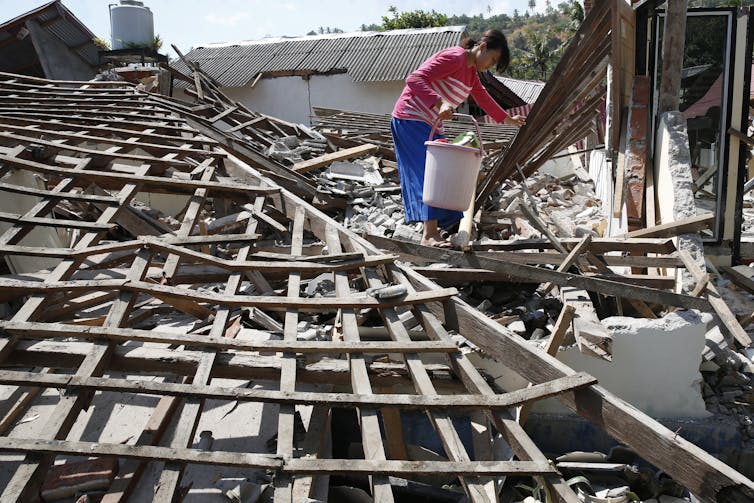 Houses in Lombok collapsed because of design failures similar to those in Yogyakarta 12 years ago.
AAP, CC BY
Houses in Lombok collapsed because of design failures similar to those in Yogyakarta 12 years ago.
AAP, CC BY
No easy solutions
A recent article makes similar points and blames inadequate enforcement of building codes and lack of government commitment. Unfortunately the reality is not so simple.
The Yogyakarta experience shows that even with a massive campaign by government and international agencies, and with the fear of earthquakes still fresh in people’s minds, the rebuilding was little better than what it replaced. Building codes do exist in Indonesia, but they are rarely followed, easily evaded, and rarely enforced, least of all at the level of owner-built local housing.
Even if there were a serious effort to implement codes, it would be undermined by well-known levels of bureaucratic inefficiency and corruption, as well as public resistance and evasion. It would also have unintended consequences, including making decent housing even less affordable, especially for poorer people.
There will be no easy solutions, but national education in basic structural design principles, subsidised design, production and distribution of cheap and simple hardware for mitigating the most common failures of design and financial incentives for appropriate construction might be worthwhile places to start.
Authors: Graeme MacRae, Senior Lecturer in Social Anthropology, Massey University


















